


Trees are planted in urban areas as privacy screens, as security hedges and as landscaping. Public policy encourages planting trees because trees contribute to the canopy cover and provide ecosystem services.
Popular trees are Eucalypts, Pines/Conifers, Lilly Pillies and Common Bamboo, either as single trees or as hedges.
Trees and hedges planted along boundaries can cause disputes between neighbours because:
• Branches can overhang and affect amenity
• Falling branches can cause damage to fences and buildings
• Tree roots can cause damage to paths, buildings and sewer pipes
• Trees can cause injury to persons
• High hedges can block sunlight or a view
In this article, we examine the self-help remedy to prune branches that overhang. We examine remedies for the other tree disputes in articles that follow.
Case Study
In Leichhardt, a closely settled inner city suburb of Sydney, a couple planted a hedgerow of 12 Lilly Pilly trees on their side of the fence that marked the boundary. After 3 years, the trees were growing above the fence and were intruding into the next-door neighbour’s property. The neighbours began to trim the hedge back to the fence line weekly, swept up the trimmings of branches and leaves and deposited them over the fence onto the hedge owner’s land.
The relationship between the neighbours deteriorated, first into dispute, then into legal proceedings in the Supreme Court of NSW. The Court judgment is reported as Donnellan & Anor v Cadeddu [2021] NSWSC 1600 (White J) (30 November 2021).
The neighbours who planted the hedge commenced the proceedings. They alleged that their next-door neighbours had committed trespass by depositing ‘green waste’ onto their land. They alleged that on one occasion the neighbours had gone further and cut branches and created gaps in the hedge on their side by leaning over the top of the fence and standing on a ladder to do so. They sought remedies of damages and an injunction to prevent future deposits of ‘green waste’.
Justice White said that the common law of nuisance applied to encroaching hedges, the same as it applied to encroaching tree branches.
A neighbour is permitted by law to remove encroaching tree branches. This is called the ‘right to abate the nuisance’. This is what Justice White said:
“The law as to encroaching branches was settled in Lemmon v Webb” by the Court of Appeal [1894] 3 Ch 1 and the House of Lords [1894] UKHL 1; [1895] 1 AC 1 in England, “and in Mills v Brooker” by the High Court in England (1919) 1 KB 555.
“Lemmon v Webb established that where branches overhang the land of another person he or she is entitled, without notice to his or her neighbour, to remove the encroaching branches from the tree if that is done without entering the land on which the tree stands. It is because the encroachment by itself is an actionable nuisance that the owner or occupier of the property over which branches hang is entitled to abate.” [para 23, judgment]
Note – in this case, Lemmon complained that his neighbour Webb had pruned overhanging branches of his large elm and oak trees without giving him prior notice of intent to prune (to allow him to prune the branches, should he wish to do so). Lemmon’s complaint was dismissed.
“Mills v Brooker decided that the encroaching branches and any fruit that they bear belong to the owner of the land on which the tree is planted. … a person who has abated the nuisance by cutting off encroaching branches must … return … them to that owner's land. …
The right to return the severed branches to the land on which the tree stands is incidental to the right to abate. The owner of the adjoining property overhung by branches is not obliged to go to any additional trouble or expense in order to dispose of the branches he or she is entitled to sever.” [para 31, judgment]
Note – in this case, Mills who had an apple orchard, claimed damages for apples taken from overhanging branches of his apple trees which had been sold by Brooker. Mills was successful.
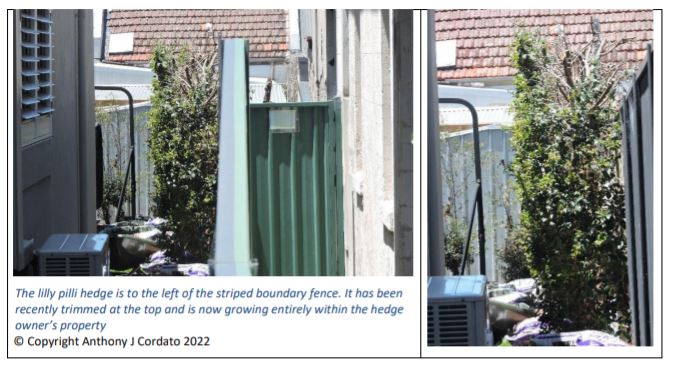
Justice White held that the next-door neighbour (Cadeddu) was entitled to ‘abate the nuisance’ by trimming the hedge, and that it was not trespass for Cadeddu to deposit the trimmings onto the hedge owner’s (Donnellan’s) land. Donnellan claimed that on one occasion Cadeddu had trespassed because the trimmings contained “animal faecal matter, namely dog poo”. Justice White brushed that claim aside, saying, that even if dog poo was swept up with the trimmings, it was an “isolated act which would not, in any event, warrant the grant of any injunctive relief or damages”.
Justice White found no claim in trespass and dismissed the proceedings. These are photos taken one month after the decision was handed down:
Twelve Rules for pruning overhanging branches These rules apply to the right to abate the nuisance of overhanging branches:
- A neighbour has the right to ‘abate the nuisance’, that is, to prune the tree or trim the hedge branches if the branches encroach on their property. Nothing more is required. There is no need to show that the tree or hedge is causing any harm. Encroachment is enough.
- The right is to prune the branches to the boundary line of the property.
- The pruning should be carried out without injuring the tree or hedge. Pruning should be carried out within the guidelines of the Australian Standard: ‘Pruning of Amenity Trees’ (AS 4373-2007).
- Some Local Council websites state that the tree owner’s permission is needed to prune an overhanging branch. This is not correct. According to Justice White who said that the 127-year-old precedent of Lemmon v Webb was ‘settled law’, no permission is required. While there is no legal necessity, it is ‘neighbourly’ to let the neighbour (the tree owner) know that branches of their tree will be pruned so as to give the neighbour (the tree owner) the opportunity to do so themselves.
- The neighbour who prunes should return the pruned branches and leaves to the tree or hedge owner, because the tree branches or hedge clippings belong to the tree or hedge owner. If the branches have fruit or flowers (including any fruit or flowers which have fallen), or if the wood is valuable, the neighbour must return them to avoid liability for taking or keeping them (the torts of conversion and detinue).
- Justice White’s comments that a neighbour does not need to go to any more trouble to dispose of the trimmings than to deposit them over the fence should not be taken literally. It is good practice to ‘offer’ the trimmings to the neighbour whose tree or hedge it is, to place them in the neighbour’s garden organics (green lid) bin. If the neighbour rejects or does not respond to the ‘offer’, then the neighbour who prunes can dispose of the trimmings themselves. The offer might best be in writing in the form of a note or an email.
- Abatement is a self-help remedy. It is to protect against the nuisance (the loss of amenity caused by the overhanging branch). The neighbour who prunes pays the cost of pruning (the ‘abatement’). Exceptions to this rule apply if the tree is poisonous, in which case the tree owner is responsible to pay for the cost of pruning if they planted the tree.
- Justice White found that the right to ‘abate the nuisance’ by pruning overhanging branches was not abolished by the Trees (Disputes Between Neighbours) Act 2006 (NSW) (the Trees Act). The Trees Act must be used if the neighbour affected wants to claim compensation for damage caused by the branches or wants an order that the neighbour prune a tree because it is dangerous, or a hedge because it blocks sunlight or a view.
- The common law right to prune overhanging branches is subject to Local Council requirements which require a person to obtain approval to prune or remove a tree. The requirements are found in the Local Council Vegetation/Tree Management Plans (in NSW). These Plans are made under the local Development Control Plan which contains controls which aim to conserve and enhance the tree scape and environmental amenity of the of the local area.
- There is no standard definition of a ‘tree’. Local Council definitions of a ‘tree’ vary widely - it could be a tree higher than 3/3.5/4/5/6 metres or with a trunk girth of more than 0.1/0.3/0.4/0.5/0.6/1.0 metres or with a crown/canopy spread of more than 3/4 metres.
- Some Local Councils allow pruning of up to 10% of the crown once in a calendar year without a permit. Others require permits for all pruning. In heritage/conservation areas, Development Consent is required to prune or remove a tree. Failure to obtain a permit can incur substantial fines.
- There are some exemptions to Council requirements; i.e. for pruning and removal of noxious trees such as Coral Trees and Camphor Laurel, or Bamboo; and for pruning of tree branches which directly overhang the roof of a residence or commercial building.
This article is the first in a series of five. The other articles are:
Tree Disputes #2 Tree branches and trunks causing damage
Tree Disputes #3 Tree roots causing damage
Tree Disputes #4 Trees causing injury
Tree Disputes #5 High hedges blocking sunlight or a view
Click to access them.
