



1.INTRODUCTION
Cross-border electricity trade is the import and export of electricity between countries.[1] It takes place on a two-way integrated wide-area transmission that enables electricity to be traded throughout the year, a day, or even simultaneously, provided that there are multiple transmission lines (interties) across jurisdictions.[2] Currently, the utilization of cross-border electricity trade has grown in prevalence. One of the most recent projects is the cross-border electricity trading between Singapore and Malaysia through the signing of the Memorandum of Understanding (MoU) between Singapore Power and Tenaga Nasional Bhd in 2023.[3] Furthermore, during the Indonesia International Sustainability Forum held on September 2024, the Singaporean Energy Market Authority (EMA) announced that it had granted conditional licenses to five companies, among others, Adaro Solar International and Keppel Energy, to import green electricity from Indonesia.[4] However, in addition to a conditional license, an importer license remains to be obtained and the Government of Indonesia (GOI)’s approval is also required for electricity to be exported from the country.[5] Given the cross-border and highly technical nature of electricity trade projects, it is pertinent to select a suitable dispute resolution mechanism and draft a dispute resolution clause that is tailored to the nature of the project to ensure that business objectives can be achieved.
2. POTENTIAL DISPUTES IN CROSS-BORDER ELECTRICITY TRADE
Arbitration has progressively become the preferred means for the settlement of cross-border disputes involving the energy sector.[6] This is attributable to the characteristic of arbitration which, among others, allows for the enforcement of arbitral awards internationally, the parties’ ability to appoint an expert as an arbitrator, especially, having considered the complex nature of energy contracts, the parties’ autonomy to select the seat of arbitration, the language, the arbitrators, the rules and law that applies to the proceedings.[7]
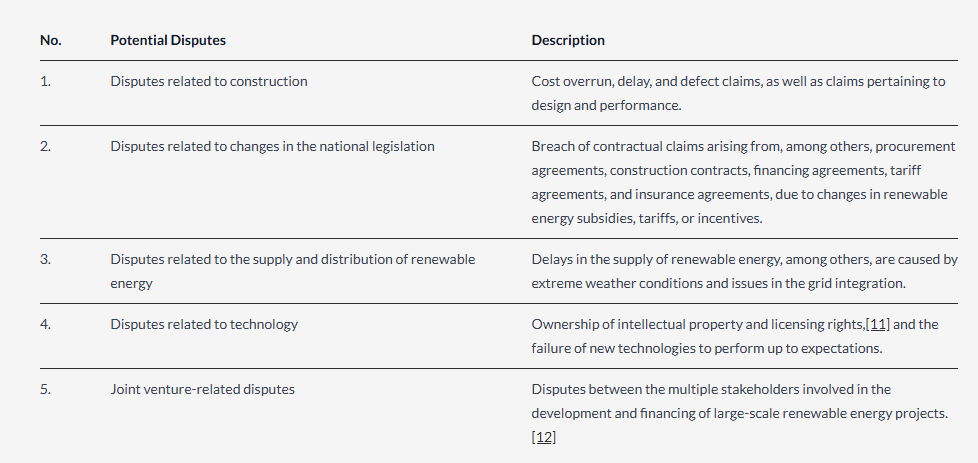
Furthermore, there are different categories of disputes that may arise in the energy sector, such as:[8] (i) Disputes between states; (ii) Disputes between investor and state; and (iii) Disputes between private parties. However, this article will specifically focus on disputes between private parties, and hence, commercial arbitration.[9] Contractual disputes in the energy sector may stem from: (i) Construction; (ii) Changes in national legislation, which are prevalent having considered that energy contracts tend to span across a long period; (iii) The supply and distribution of electricity;[10] (iv) Failure in the performance of new technologies, and (v) Joint venture-related disputes.
3. KEY PROVISIONS OF AN ARBITRATION
A well-drafted arbitration clause is particularly beneficial for disputing parties as it reflects how successful, fair, and efficient an arbitration proceeding will be.[13] The key provisions of an arbitration clause, among others, are as follows:
- Seat
The seat of arbitration is one of the most salient factors to consider in drafting an international arbitration clause. This occurs as the law of the seat of arbitration almost always serves as the lex arbitri, or the law that governs the conduct of international arbitration. The lex arbitri, among others, regulates the procedure for the annulment of an arbitral award, the determination of the competent court in case of a jurisdictional challenge between domestic courts and arbitral tribunals, judicial assistance regarding the constitution of an arbitral tribunal, judicial assistance in ordering evidence-taking, the basis for challenging an arbitrator, and interim measures of protection.[14] Thus, the choice of the seat of arbitration may have significant implications for the possibility of the annulment of international arbitral awards. Additionally, it is important for parties to consider choosing a seat that has a proven track record of supporting the international arbitration process and whether it has ratified the 1958 New York Convention,[15] which can ensure the recognition and enforcement of international arbitral awards rendered in contracting states.
- The Applicable Institutional Rules
If the parties to the dispute do not designate an arbitration institution to administer the arbitration under its institutional rules, the parties must develop a set of rules on their own or select the arbitration rules of a particular institution.[16] The key aspect to consider before choosing an institutional rule is the extent to which a dispute can be resolved fairly and efficiently, one of which could be achieved through the flexibility afforded by the institutional rules. Different institutional rules may contain different provisions regarding expedited procedures, the extent of confidentiality, and the timeline for the award to be rendered.
For example, according to the 2025 SIAC Rules, a party may apply for an expedited procedure, if, at the time of the application, the amount in dispute does not exceed the equivalent amount of (a) S$10,000,000 but exceeds the equivalent amount of S$1,000,000;[17] and (b) the amount in dispute does not exceed the equivalent amount of S$1,000,000 and the President has determined under Rule 13.1(b) that the Streamlined Procedure shall not apply to the arbitration.[18] This differs from the provisions of the 2021 Rules of Arbitration of ICC (the “Rules”),[19] which stated that the expedited procedural rules shall apply if the amount in dispute does not exceed US$ 3,000,000[20] upon receipt of the Answer to the Request, or upon expiry of the time limit for the Answer or at any relevant time thereafter, subject to the provision of Article 30(3) regarding the conditions for which the expedited procedure provisions shall not apply.
- Governing Law of the Contract
The governing law of the contract or lex contractus serves as the substantive law applicable to the merits of the dispute. The existence of the main contract, its validity, and its interpretation are among others the aspects regulated by the governing law of the contract. Before choosing the governing law of the contract, the parties may want to keep in mind that legislative changes in a country’s law pose a high risk of affecting the overall project structure.[21]
4. MULTI-TIERED DISPUTE RESOLUTION CLAUSE IN AN ENERGY CONTRACT
Aside from dispute resolution through arbitration, alternatively, the parties may opt for a multi-tiered dispute resolution by including a multi-tiered dispute resolution clause in the energy contract. This clause involves a series of steps in the dispute resolution process and commonly involves alternative dispute resolution (“ADR”) as the first step, such as negotiation, mediation or conciliation. If the parties fail to settle the dispute through such means, they may resort to settle their disputes through arbitration.[22] The combination of ADR and adversarial proceedings enables the parties to conduct dispute resolution that is tailored to the needs of their relationship[23] and encourage a positive relationship between them.[24]
Multi-tier dispute resolution clauses are common and enforceable in Indonesia. According to Article 1 Number (10) of Law Number 30 of 1999 concerning Arbitration and Alternative Dispute Resolution (“Arbitration Law”), ADR is the settlement of disputes outside of the court through consultation, negotiation, mediation, conciliation, or expert assessment.[25] Disputes or differences of opinion are resolved through ADR in a direct meeting by the parties within a maximum of 14 (fourteen) days and the results are stated in a written settlement.[26] In the event that the dispute or differences of opinion cannot be resolved, with a written agreement of the parties, the dispute or difference of opinion shall be resolved through the assistance of one or more expert advisors or through a mediator.[27] If the parties within a maximum of 14 (fourteen) days with the help of one or more expert advisors or through a mediator did not succeed in reaching an agreement, or the mediator did not succeed in bringing the two parties together, the parties may contact an arbitration institution or an ADR institution to appoint a mediator.[28]
Efforts to resolve disputes or differences of opinion through the mediator by upholding confidentiality, within a maximum of 30 (thirty) days must reach a settlement in written form signed by all parties involved.[29] The written settlement is final and binding on the parties, must be registered at the District Court within a maximum of 30 (thirty) days from the signing,[30] and its implementation must be completed within a maximum of 30 (thirty) days from registration.[31] If the reconcilement effort as referred to above cannot be achieved, then the parties based on a written agreement may propose a dispute resolution effort through an arbitration institution or ad hoc arbitration.[32] It should be noted, however, that similar to arbitration, the settlement of disputes through ADR excludes the parties from settling their dispute through litigation in the District Court.[33]
In order to avoid hurdles in the enforcement of multi-tiered dispute resolution clauses, however, there must be contractual certainty, which can be attained through the following ways:[34]
- The use of mandatory words must be clear. For example, “Mediation is condition precedent to arbitration” or by using the word “shall” instead of “may”;
- The establishment of a specific deadline for the fulfillment of ADR, or a period within which the notification of ADR must be given;
- The steps to fulfill the ADR must be laid out clearly. For example, the procedure for the appointment of mediators or conciliators; and
- The clear stipulation of the consequences for the non-fulfillment of the ADR clause. For example, by providing that failure to fulfill the ADR clause prevents the parties from settling the dispute through arbitration or litigation.
- Potential Disputes In Cross-Border Electricity Trade
Having considered the infrastructural, logistical, and long-term nature of energy contracts, the potential disputes that may occur in a cross-border electricity trade may arise from: (i) Construction; (ii) Changes in national legislation; (iii) The supply and distribution of electricity; (iv) Failure in the performance of new technologies, and (v) Joint venture-related disputes.
5. Conclusion
1. Potential Disputes In Cross-Border Electricity Trade
Having considered the infrastructural, logistical, and long-term nature of energy contracts, the potential disputes that may occur in a cross-border electricity trade may arise from: (i) Construction; (ii) Changes in national legislation; (iii) The supply and distribution of electricity; (iv) Failure in the performance of new technologies, and (v) Joint venture-related disputes.
2. Key Provisions of an Arbitration Clause
The key provisions of an arbitration clause that are crucial to be included comprise the seat of arbitration, applicable institutional rules, and governing law of the contract, having considered that such components pose significant implications for the overall efficiency and success of arbitration proceedings. The law of the seat of arbitration, among others governs the procedure for the annulment of an arbitral award. Parties may want to consider choosing a seat that has a proven track record of supporting the international arbitration process and has ratified the 1958 New York Convention, to ensure the recognition and enforcement of international arbitral awards. Further, different institutional arbitration rules offer different features and different degrees of flexibility, which among others, are reflected through provisions on expedited procedures, degree of confidentiality, and time limit for the rendering of an arbitral award. Lastly, the governing law of the contract governs the existence of the main contract, its validity, and its interpretation. Additionally, it should be noted that legislative changes in a country’s law may potentially affect the renewable energy project structure.
2. Multi-Tiered Dispute Resolution Clause In An Energy Contract
Additionally, aside from resolving their dispute through arbitration, the parties may alternatively opt for a multi-tiered dispute resolution. Multi-tier dispute resolution clauses are common and enforceable in Indonesia. However, to avoid hurdles in their enforcement, contractual certainty must be attained, which can be conducted through: (i) Clear usage of mandatory words; (ii) The establishment of a specific deadline for the fulfillment of ADR, or a period within which the notification of ADR must be given; (iii) Clear steps to fulfill the ADR; and (iv) The clear stipulation of the consequences for the non-fulfillment of the ADR clause.
