



Cryptocurrency is a digital currency produced by a public network, rather than any government, that uses cryptography to make sure payments are sent and received safely[1], it also has no physical form, and its supply is not determined by a central bank. In the past decade, cryptocurrency rises as an asset for people to invest on and as a currency for making payments. As of October 2024, there are 21 million crypto investors in Indonesia with total transaction of Rp 48,44 trillion.[2] In Indonesia, cryptocurrency only acts as an investment asset traded in futures exchange[3], or a digital financial asset in simple,[4] as Rupiah is the only currency acknowledged to be used in a transaction.[5]
As cryptocurrency falls within futures exchange commodity in Indonesia, the supervision of this asset trading was under Commodity Futures Trading Regulatory Agency/Badan Pengawas Perdagangan Berjangka Komoditi (“Bappebti”). Bappebti is a government body that supervises and regulates commodity futures trading. Physical Crypto Asset Traders were required to deliver several periodical reports to Bappebti.[6] However, recently the authorized body to supervise the crypto asset transaction shifted.
The Government of Indonesia issued Government Regulation Number 49 Year 2024 concerning Transfer of Duties for Regulation and Supervision of Digital Financial Assets Including Crypto Assets and Financial Derivatives (“GR 49/2024”) on 31 December 2024. The regulation transfer the authorized body to supervise the crypto asset transaction from Bappebti to the Financial Services Authority/Otoritas Jasa Keuangan (“OJK”).[7] OJK is a state body that regulates and supervises all activities in financial services sector which are banking sectors, capital market, and non-bank financial services such as insurance, retirement fund, funding institution, and other financial institutions. This transfer is in accordance with Article 8 number 4 and Article 312 paragraph (1) of Law Number 4 Year 2023 Development and Strengthening of the Financial Sector that amends OJK’s duty of supervising and regulating. With this authority shift, all marketing and trade activities of crypto assets including its supporting infrastructure must adhere and fulfill the requirements set forth by OJK.[8]
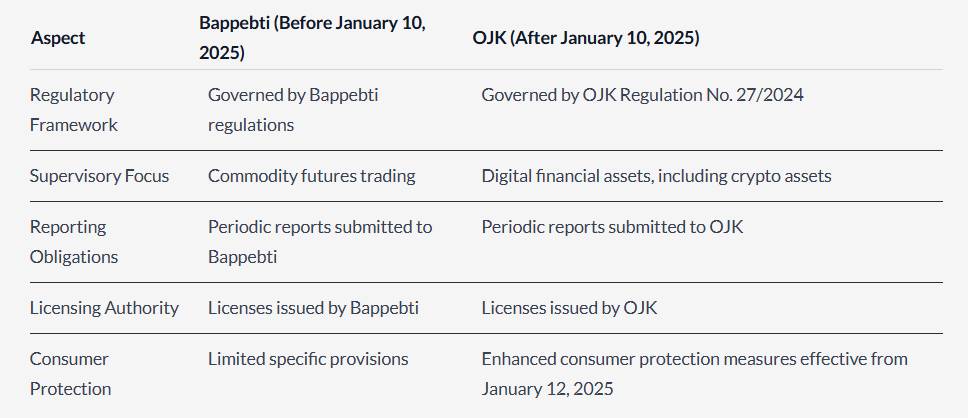
To illustrate the changes in regulatory oversight resulting from the transition, the following table compares the key aspects of crypto asset supervision under BAPPEBTI and OJK:
Comparative Table: Bappebti vs. OJK in Crypto Asset Supervision
The regulation states that this transfer is to be effective on 10 January 2025.[9] During the transition between 31 December 2024 and 10 January 2025, Bappebti is still authorized to grant or extend license for products, parties and activities relating to crypto assets, and to issue regulations relating to crypto asset strategic policy.[10] Furthermore, licensing, approval, registration of product or instrument that has been issued by Bappebti prior to the effective date of transfer shall remain valid as long as they do not contradict the prevailing laws and regulations.[11] However, for licensing, approval, registration of product or instrument that is still in the process of settlement, shall be continued by OJK.[12]
In organizing crypto asset trade, OJK has also issued an implementing regulation through Financial Services Authority Regulation Number 27 Year 2024 concerning Organization of Digital Financial Assets Trading including Crypto Assets (“POJK 27/2024”). This POJK 27/2024 has been effective since 10 January 2025.[13] Digital Financial Asset Trading Providers are granted a 6-month grace period to comply on provisions of governance, personal data protection, and consumer protection. Specifically for Traders, consumer protection provisions are effective starting from 12 January 2025.[14] Nevertheless, the implementing regulations relating to crypto assets still prevail if it does not contradict the provisions of laws and regulations.[15]
