


Introduction
Recent events such as the US-China trade war and the COVID-19 pandemic have severely impacted the global economy, with Singapore being particularly affected given its open and trade-reliant economy. This is driving Singapore to look for new and innovative ways to attract increased and diversified foreign investment, part of which would entail easing up on work visa and immigration policies for foreign talents. At the same time, a weakened job market due to the economic downturn, coupled with intensifying political contest reflected in the latest general election results, has led to the government’s increased focus on protecting the local labor force.
As a result, the Singapore government has to navigate a new balance between these evolving conflicting interests, in order to keep Singapore competitive and attractive to foreign businesses whilst protecting the local workforce. This article examines some of the new policy measures taken, analyses their impact on foreign investors, and offers some suggestions to foreign businesses in navigating the new regulatory landscape.
Tech.Pass
Recently on 12 November 2020, the Singapore Economic Board (EDB) announced the launch of a new targeted programme Tech.Pass to attract founders, leaders, and technical experts with experience in established or fast-growing technology companies to aid the development of Singapore’s technology industry.
To be eligible, candidates must meet any 2 out of the following 3 requirements:
- Have a last drawn fixed monthly salary (in the last 1 year) of at least S$20,000 (or equivalent in foreign currency). Candidates or business owners with annual income in excess of S$240,000 (or equivalent in foreign currency) will also be considered;
- Have at least 5 cumulative years of experience in a leading role in a technology company with a valuation/market cap of at least US$500mil or at least US$30mil funding and beyond; and/or
- Have at least 5 cumulative years of experience in a leading role in the development of a technology product (i.e. having made major contributions to its design, development, and/or deployment) that has at least 100,000 monthly active users or at least US$100mil revenue.
Tech.Pass holders will have flexibility in participating in a wide range of activities, including starting and operating a business, being an employee or director of a Singapore-based company, being a shareholder or investor in a Singapore company, being a mentor or advisor to start-ups or companies in Singapore, and lecturing at institutes of higher learning. The programme will be open for application soon in January 2021, with 500 places available upon launch. The pass will be valid for 2 years in the first instance, with a one-time renewal for a subsequent 2 years (subject to satisfaction of renewal criteria).
Many global technology companies already have a presence in Singapore. In particular, major Chinese technology players AliBaba, ByteDance, and Tencent have set up regional hubs in Singapore. By now targeting accomplished individuals directly, in addition to existing policies that attract companies, the new Tech.Pass will further consolidate Singapore’s appeal as a global technology hub. One key advantage of the Tech.Pass, as compared to a standard employment pass, is that Tech.Pass applicants do not need to secure employment in Singapore prior to application, and can so apply without employer sponsorship. Also, the Tech.Pass requirements, as compared to the Entrepass (a pass which allows eligible foreigners to start and operate a new business in Singapore) requirements, appear more objective. Further, Tech.Pass applicants, as opposed to EntrePass applicants, do not need to have started or intend to start a Singapore company.
However, further elaboration will need to be made regarding the specifics of the programme. For example, in the range of Tech.Pass activities allowed, the distinction between the phrases “Singapore companies” and “Singapore-based companies”, as used differently between the EDB website and press release, needs to be clarified.
Tightening of Work Pass Requirements
On 27 August 2020, the Singapore Ministry of Manpower (MOM) announced several new measures, including the following:
- Increasing the salary criteria for employment pass (EP) applications
EPs are meant for foreign professionals, managers, and executives. For EP applications generally, the previous minimum qualifying salary of S$3,600 was raised to S$3,900 (from 1 May 2020), and was further raised to S$4,500 (from 1 September 2020) for new applicants. For EP applications in the financial services sector in particular, the minimum qualifying salary was similarly raised to S$4,500 (from 1 September 2020) as per above, but will be further raised to S$5,000 (from 1 December 2020) for new applicants.
The qualifying salaries for older and more experienced EP candidates in their 40s will be raised correspondingly and will remain around double the minimum qualifying salary for the youngest applicants. For renewal applicants, these new salary criteria will come into effect from 1 May 2021. In addition, the S pass (meant for semi-skilled workers) salary requirements were also raised.
- Assessing commitment to local workforce when considering EP and S pass applications
In evaluating EP and S pass applications, MOM would take into account whether the employer has kept up support of local PMETs (i.e. professionals, managers, executives and technicians) in their employment; has been responsive to government efforts to help them recruit and train more Singaporean PMETs; and has discriminated against qualified Singaporeans. Employers whose PMET workforce profiles suggest a bias against locals will be put on a watchlist. For employers whose Singaporean core has been weakening or whose EP and S pass applications are overly concentrated from a single foreign source, MOM will engage them to review their hiring practices before placing them on the watchlist.
- Continuing emphasis on Fair Consideration Framework (FCF)
MOM will continue to apply the FCF, which emphasizes fair hiring, due consideration to local job applicants regardless of age, gender and ethnicity, and no discrimination against local job applicants in favor of foreign applicants. In addition, from 1 October 2020, the FCF job advertising requirement was extended to S pass applications, and the minimum job advertising duration for both EP and S pass applications was doubled from 14 days to 28 days.
In the financial services sector, the revised higher minimum qualifying salary requirement for EP applications reflect a greater need to protect local labor against displacement in a sector that has traditionally attracted strong interest from foreign investment. As a global financial center, foreign investors continue to see Singapore as a safe base to park and manage their financial assets, develop and invest in new financial technologies (such as digital currencies and digital banking), and to set up family offices and trusts. Given the amount of wealth in the financial services sector however, a slightly higher qualifying salary requirement is not likely to significantly deter businesses looking to obtain EPs for their foreign staff, especially for affluent Chinese and foreign investors seeking to set up an offshore financial base.
An important exemption to the FCF job advertising requirement applies if, amongst other things, the company has fewer than 10 employees. This exemption is particularly useful for Chinese and other foreign investors looking to simply set up a holding company or single family office in Singapore to be staffed by a small core team.
Employers will find it easier to renew or apply for EPs for foreigners who are already in Singapore, as compared to obtaining approval for new EP applications. Due to periodic border closures brought about by COVID-19, approvals for new EP applications this year has been and continues to be limited. Employment services agents advise against submitting EP applications in view of the low or virtually nil chance of approval. In spite of this, in our recent successful experience, a properly-prepared EP application, backed by a well-drafted supporting letter and other documentation that are creatively submitted within the application system, can still be approved.
Global Investor Programme
The Global Investor Programme (GIP) is an existing programme also administered by the EDB that targets entrepreneurs and business owners. Whilst this programme is not new, it is worth mentioning here due to its popularity with high net worth individuals, and as a comparison to both the new Tech.Pass and the tightened general work pass requirements.
To be eligible, candidates have to meet the following qualifying criteria:
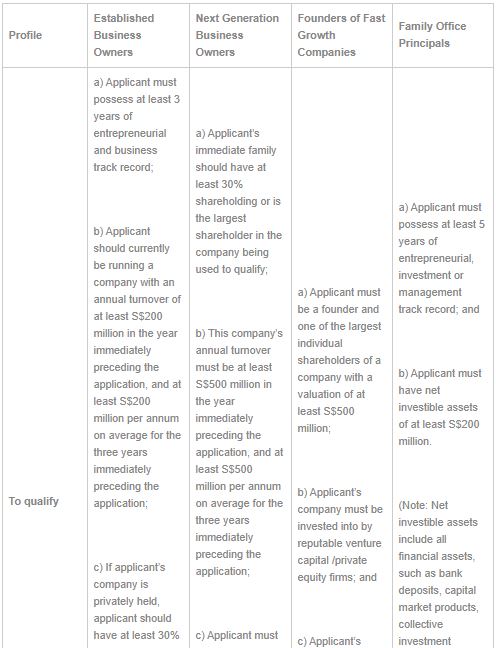
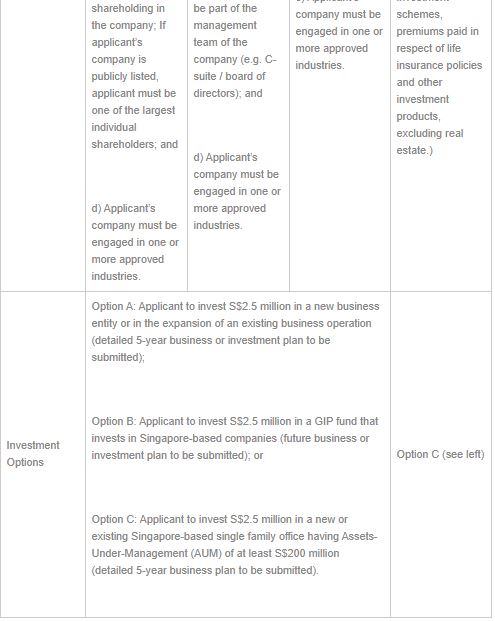
The list of approved industries is wide, and includes consumer business, electronics, energy, engineering services, healthcare, logistics and supply chain manufacturing, media and entertainment, shipping, pharmaceuticals and biotechnology, professional services, and family offices and financial services etc.. Interested applicants should note that whilst there are generally no restrictions on foreign investment in Singapore, investments in certain regulated sectors such as finance (e.g. banking, capital market services) and mass media etc. may require prior notification or approval of the relevant regulatory authority.
Once an Approval-in-Principle letter is issued, the applicant will need to make the necessary investment within 6 months of such letter. Once the investment is verified, a Final Approval letter will be issued, and the applicant must formalize his/her permanent residence status in Singapore within 12 months from the date of such letter. The permanent residence status will be renewed by the 5th year for either a 5-year or 3-year period, provided that the relevant renewal criteria are met.
The key advantage of GIP is that successful applicants obtain Singapore permanent residence status straightaway, whereas other programmes provide work passes but not the permanent residence status. A key difference between GIP and Tech.Pass is that GIP holders have to actually start a business or invest in Singapore, whereas Tech.Pass holders will have flexibility in participating in a wide range of activities (see above). As it presently takes about 9 to 12 months for a GIP application to be processed, Chinese and other foreign investors will be looking to see if the Tech.Pass approval timeframe and processes will be shorter and simpler.
Conclusion
The new work visa and immigration requirements reflect a move by the Singapore government to focus more on quality, and less on quantity, in its foreign talent policy. In so doing, it hopes to continue to attract valued foreign talent to Singapore, particularly in key targeted sectors such as technology, in order to drive the next phase of growth in the country’s ongoing economic restructuring. At the same time, more stringent thresholds and requirements will be applied in other areas to enhance the protection of the local labor force and the creation of a “Singaporean core” in companies. Singapore has to stay open to survive and flourish, but moving forward, it will be more selective in who it lets in through the door.
