

The Copyright Board, a quasi-judicial body, was constituted in the year 1958 by the Government of India with an object to determine reasonableness of rates or royalties, consider application for general licenses and assessment of compensation. Additionally, appeal against any order/decision of the Registrar of Copyrights was filed before the Copyright Board. Before 2012, the Board constituted of a Secretary and several other officers selected by the Central Government. However, post the 2012 amendment to the Copyright Act, the Board comprised of One Chairman and two members in contrast to 14 members earlier.
Even though the amendment was done with the intention of efficient working, the hearings before the Copyright Board suffered tremendously for various reasons including incomplete quorum and there was no political will to change the state of affairs.
In the year 2017, with the passing of the Finance Bill, the Copyright Board was dissolved and its functions were transferred to the Intellectual Property Appellate Board (IPAB), which primarily used to deal with matters relating to trademarks, patents and geographical indications. However, the quorum for the Copyright matters in IPAB remained incomplete as the position of technical member for Copyrights remained vacant till the year 2020. It was only in July, 2020 Mr. S. P. Chockalingam was appointed as the technical member for Copyrights at the IPAB, thereby giving a ray of hope of at least beginning of disposal of disputed Copyright matters which were jammed for over 5 years.
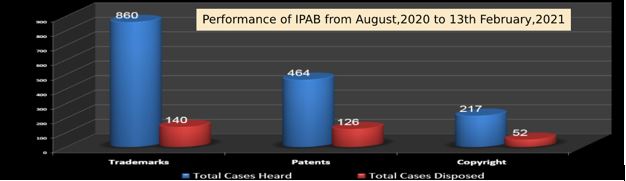
Source: https://www.ipab.gov.in/
Only when we thought that the disposal of Copyright disputes are being streamlined the Government passed an ordinance of abolition of IPAB [Tribunals Reforms (Rationalization and Conditions of Service) Ordinance, 2021] on April 04, 2021. As per the Ordinance the powers vested with IPAB stands transferred to the Commercial Courts, a division of High Courts.
The High Courts are already overloaded with huge number of cases to be adjudicated and now with the transfer of pending cases of IPAB it has become a matter of grave concern for stakeholders.
Although the intention of the Government in passing the Ordinance was to streamline the works and expedite the disposal of IP matters but the Ordinance has opened up various questions and concerns.
First, it is correct that the High Court will never lack quorum and will go non-functional for years like IPAB, but unlike IPAB, the High Court will lack the 'technical members'. Further, there will be a periodical rotation of the judges. Secondly, the Commercial Courts Act mandates disposal of the cases within a year. With the transfer of IPAB cases the High Court will be clogged with backlog of cases and the disposal of cases within one year will be like a dream of making castles in the sky. Thirdly, the procedure before the IPAB was easier, cheaper and less cumbersome as compared to the High Court. With the abolition of IPAB, the expense of litigation will surely result in a hole in the pockets of the aggrieved persons. Lastly, the Ordinance has given no clarification regarding the jurisdiction in pending and fresh matters.
Certainly there have been delays in appointment of chairman and members, but the tribunal alone cannot be blamed. There were circumstances which were beyond their control and were dependent on the Government. It appears that the Government has opted the easy road of abandonment than taking charge.
With so many other urgent things on the plate, the Government's move of passing the bill as an Ordinance by the President will perhaps leave the aggrieved hanging between the devil and the deep sea.
