


Routine website tracking tools are rapidly becoming one of the most significant sources of privacy liability for businesses today.
Common website tracking technologies such as advertising pixels, analytics scripts, and session-replay tools were once considered routine features of modern website infrastructure. Today, they are driving a rapidly expanding wave of privacy litigation, exposing businesses across nearly every industry to significant liability under federal and state wiretapping laws.
The federal Wiretap Act (18 U.S.C. § 2511) prohibits the intentional interception of wire, oral, or electronic communications unless at least one party to the communication consents. Several states go further, imposing strict “all-party consent” requirements that require authorization from every participant. Although these statutes were originally designed to address covert telephone surveillance, plaintiffs’ attorneys have increasingly repurposed them to challenge commonplace web-tracking technologies.
The theory is straightforward: when a website embeds third-party code that captures and transmits user interactions to an outside vendor without clear, affirmative consent, that transmission constitutes an unlawful “interception.”
What began as a handful of creative lawsuits has since evolved into a coordinated enforcement strategy. Plaintiffs’ firms are deploying demand letters, class actions, and mass arbitration filings designed to extract settlements from companies using standard tracking tools without carefully structured consent mechanisms. For many businesses, the question is no longer whether they will be targeted, but when and at what cost.
What Are Tracking Pixels and Why Are They at the Center of Litigation?
A tracking pixel is a snippet of code embedded on a webpage or in a marketing email that transmits data to third-party providers such as Meta, Google, Fullstory, or Hotjar. This data can include IP addresses, pages visited, device details, and user interactions. Critically, the breadth and specificity of this collection can transform what might otherwise be considered “record data” into protected “content” under wiretapping statutes, dramatically expanding potential liability.
The surge in filings is driven in part by the steep damages authorized under applicable statutes. The California Invasion of Privacy Act, for example, imposes statutory penalties of $5,000 per violation. When multiplied across thousands or millions of website visitors, this can produce staggering aggregate exposure. Even businesses with arbitration provisions are not insulated. Plaintiffs’ firms have adapted by filing or threatening mass individual arbitrations, leveraging filing fees to pressure early settlement. The economics of this strategy are intentionally coercive and have proven effective.
Plaintiffs have also streamlined how they identify targets. Using browser developer tools, network traffic analysis, and automated scanning technology, firms have turned case development into an assembly-line operation capable of generating claims at scale. Because tracking technologies are ubiquitous across websites of all sizes, the pool of potential defendants is vast. Small and mid-sized businesses are particularly vulnerable, as they often lack the resources to proactively audit their tracking practices, assess consent mechanisms, or mount an effective defense when faced with demand letters or litigation.
Federal and State Wiretapping Law Survey
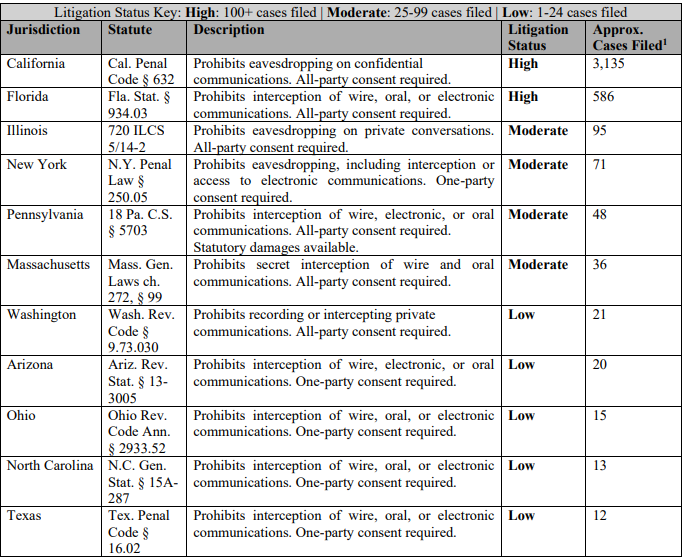
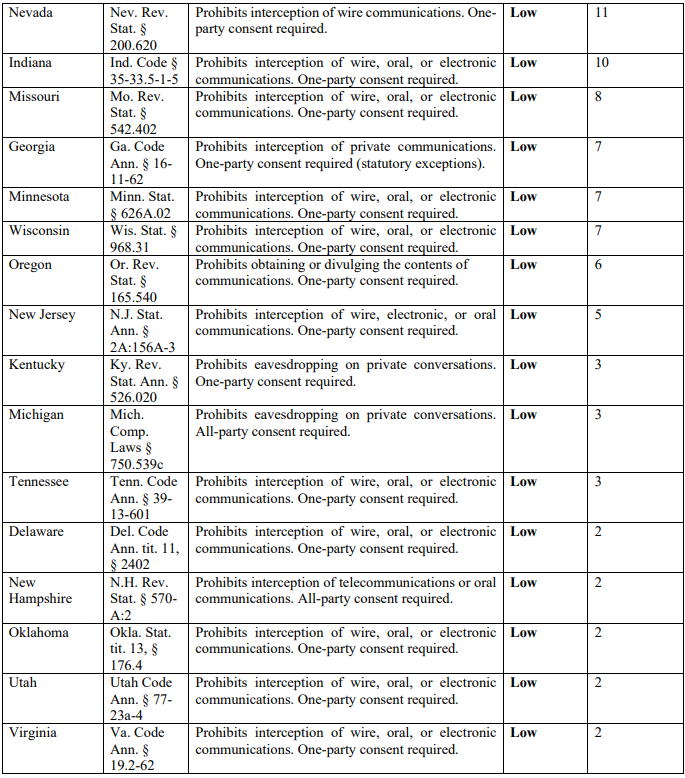
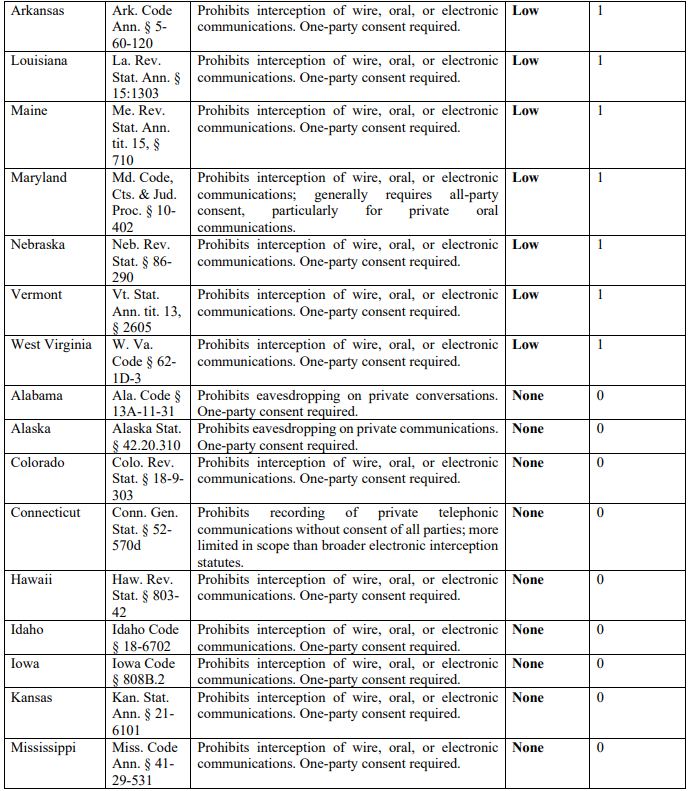
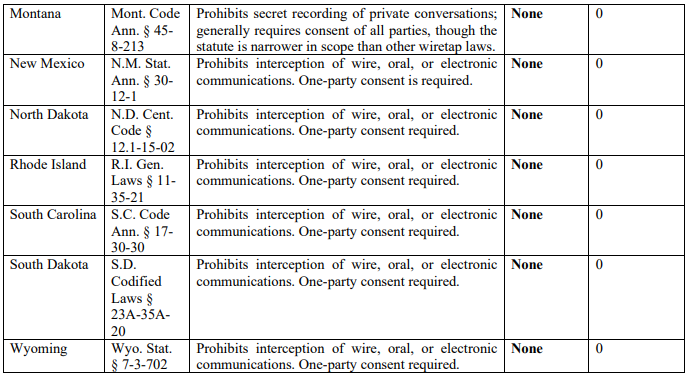
The federal Wiretap Act establishes a baseline prohibition against the unauthorized interception of electronic communications, while state statutes impose additional, sometimes more stringent, requirements. Together, these laws create a complex and evolving liability landscape for businesses that rely on tracking technologies. The chart below summarizes key state wiretapping laws, including the applicable statute, core requirements, and current levels of litigation activity.
Emerging Trends
As the chart illustrates, litigation activity remains concentrated in a handful of jurisdictions, particularly those that require all-party consent. However, plaintiffs’ firms are rapidly expanding these theories beyond their original strongholds, signaling that the current geographic concentration is unlikely to remain static. Businesses should evaluate their practices from a nationwide perspective rather than focusing solely on historically active jurisdictions.
While California remains the epicenter of tracking pixel litigation, a second wave of jurisdictions is rapidly emerging. Florida, Illinois, and Pennsylvania have seen increased filings as plaintiffs scale these claims into new forums. Florida, in particular, has become a focal point, with a surge of class actions, demand letters, and small-claims filings. In W.W. v. Orlando Health, Inc., No. 6:24-cv-1068-JSS-RMN, 2025 WL 722892 (M.D. Fla. Mar. 6, 2025), a court denied dismissal of claims under the Florida Security of Communications Act, concluding that allegations involving the transmission of substantive user interactions raised “highly technical questions” not suitable for resolution at the pleading stage. Illinois and Pennsylvania are similarly gaining traction as plaintiffs test these theories under state and federal law.
At the same time, courts remain divided on whether routine website interactions constitute “communications” subject to interception and whether third-party tracking vendors function as independent eavesdroppers or extensions of the website operator. Some courts have adopted an expansive view, while others have taken a more restrictive approach. In Vita v. New England Baptist Hospital, 494 Mass. 824, 243 N.E.3d 1185 (2024), the Massachusetts Supreme Judicial Court held that the state’s wiretap statute does not extend to ordinary web browsing activity, emphasizing that the statute was designed to address secret audio surveillance rather than commonplace digital interactions. The plaintiff has since moved to assert claims under the Federal Wiretap Act, signaling a broader trend of plaintiffs pivoting to federal statutory theories when state-law claims falter.
This uncertainty is compounded by the expansion of these theories into adjacent technologies, including AI-driven chatbots and video-based platforms. Plaintiffs are increasingly invoking the Video Privacy Protection Act, arguing that tracking technologies disclose video viewing behavior and associated identifiers to third parties. Courts are divided on key elements of the statute, particularly who qualifies as a “consumer,” resulting in a growing circuit split. The U.S. Supreme Court’s recent decision to grant certiorari in Salazar v. Paramount Global, 133 F.4th 642 (6th Cir. 2025), cert. granted, No. 25-459 (U.S. 2026), signals that further clarification is forthcoming and may shape the next phase of litigation.
Compliance Risks
Wiretapping exposure does not exist in isolation. Businesses that deploy tracking technologies must also navigate an expanding patchwork of comprehensive state privacy laws that impose independent and, in many cases, overlapping obligations. As of early 2026, twenty states have enacted such legislation, beginning with California’s Consumer Privacy Act and its successor, the California Privacy Rights Act.
Since then, similar frameworks have been adopted in Virginia, Colorado, Connecticut, Utah, Texas, Oregon, Montana, Delaware, Iowa, Nebraska, New Hampshire, New Jersey, Maryland, Minnesota, Tennessee, Indiana, Kentucky, Rhode Island, and Florida.
Figure 1. U.S. State Comprehensive Privacy Legislation (Jan. 2026).[2]
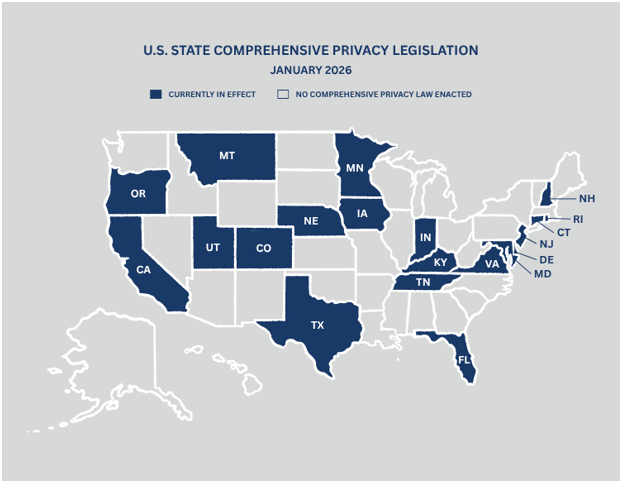
While these laws differ in their specific requirements, they generally mandate clear privacy disclosures, grant consumers rights to access and delete personal information, and provide opt-out rights for the sale or sharing of data, including through universal opt-out mechanisms such as Global Privacy Control.
For businesses using tracking technologies, the intersection of these regimes and wiretapping statutes creates compounding risk. A failure to obtain proper consent may trigger liability under both frameworks. Critically, the applicable consent standards are not aligned. Wiretapping statutes focus on consent to the “interception” of communications, while state privacy laws address consent to the “collection,” “processing,” or “sale” of personal data. As a result, a consent mechanism sufficient under one framework may be inadequate under another.
Absent federal preemption, businesses must prepare for a regulatory environment that requires jurisdiction‑specific analysis and flexible consent infrastructure capable of accommodating divergent legal standards. In an ever‑expanding digital marketplace, varied state requirements can create exposure even in jurisdictions far beyond a company’s operational footprint.
Conclusion
Tracking pixel litigation will continue to expand as plaintiffs refine their theories, push into new jurisdictions, and leverage increasingly sophisticated methods to identify targets. At the same time, many businesses remain unaware that the tracking tools they have used for years may expose them to substantial liability under wiretapping statutes and state privacy laws.
The legal landscape is undeniably complex, but exposure is not inevitable. A proactive compliance posture, encompassing technology audits, robust consent mechanisms, disciplined vendor management, and carefully aligned privacy policies, can materially reduce the risk. As this wave of litigation continues to build, companies best positioned to manage exposure will be those that act before claims arise.
