



1.Introduction
Shipping is an industry the world heavily relies on.[2] It has been categorized as high-risk industry where accidents or incidents[3] may have catastrophic consequences for society. This publication presents relevant statistics on maritime casualties which involve ships flying Indonesian flag sailing within Indonesia water from the period of January to December 2022. Safety of life at sea is at the core of the issue on maritime casualties. The issue is of paramount importance for Indonesia as the largest archipelagic nation, which has seen tragic maritime casualties when the Tampo Mas sank, killing 1,217 people (612 bodies were found and 411 people were missing with the ship) out of 2.174 people on board. Unfortunately, the Indonesian public at large may not be aware nor well informed on the issue of maritime safety in Indonesia. The main purpose of this overview is to briefly observe and identify issues of safety at sea, its root causes, and its impact in Indonesia. It hopes to provide information and raise awareness on the importance of safety at sea to the general audience in Indonesia and abroad.
II. Relevant Statistic
Number of Indonesian Flag Vessels
The Government of Indonesia’s effort to increase the number of vessels flying the Indonesian flag started with the enactment of President of Indonesia Instruction Number 5 of 2005 concerning the Empowerment of National Shipping Industry with enforcement of Cabotage principle, which was then followed by the enactment of the Indonesia Shipping Law Number 17 of 2008.[4] There were merely 6041 Indonesian flag vessels in 2005, whereas, there are now around 21.845 vessels in 2021.[5] The data of registered vessels in the Ministry of Transportation in 2022 are as follows:
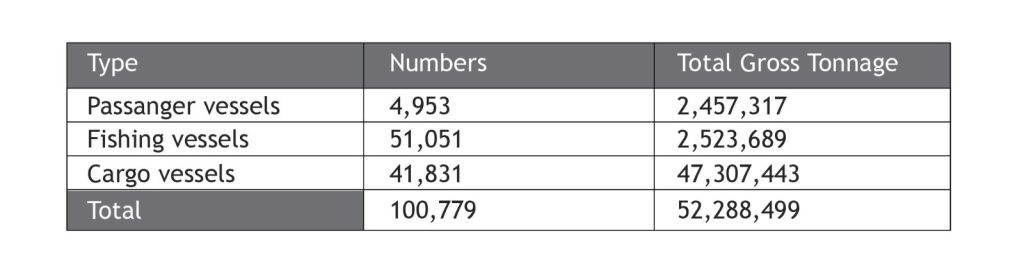
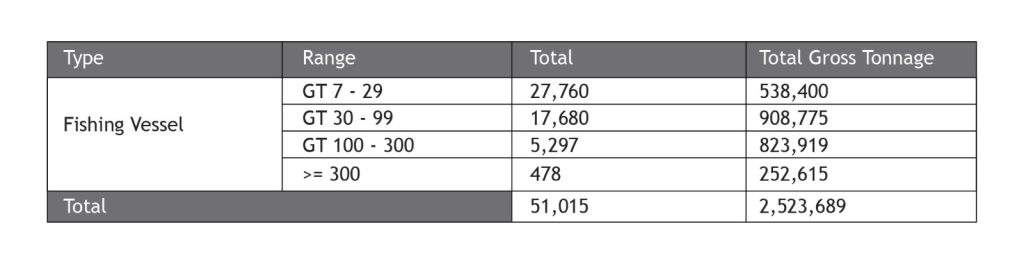
Based on the above, the highest number of vessels are fishing vessels followed by cargo vessels and passenger vessels. The tonnage of those vessels is varied that is detailed below:
Number of Accidents[8]
Government Regulation Number 62 of 2013 on Investigation of Transportation Accident gives authority to the National Transportation Safety Committee (“KNKT”) to investigate accidents.[9] According to the KNKT, the types of ship accidents are sinking, burning, and collision. The total shipping accidents investigated by the KNKT during the 2017 to 2021 period were 129 accidents, with detail as below:
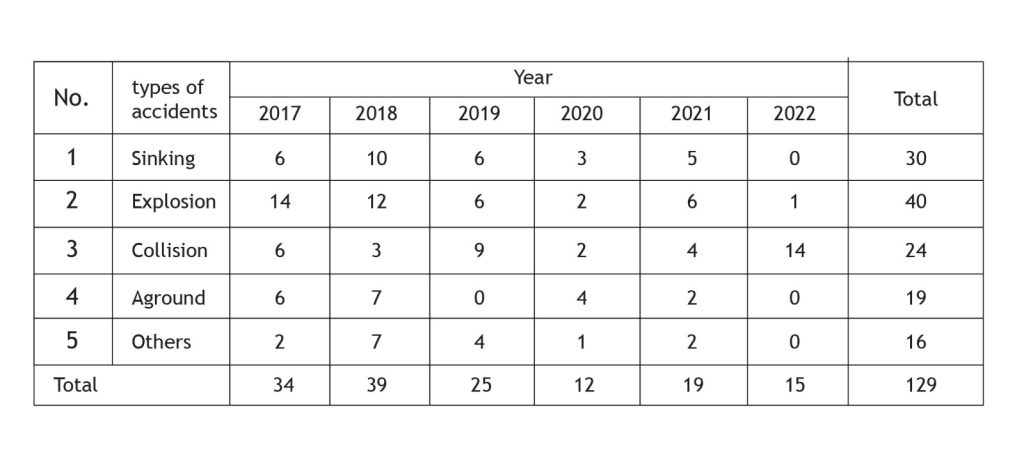
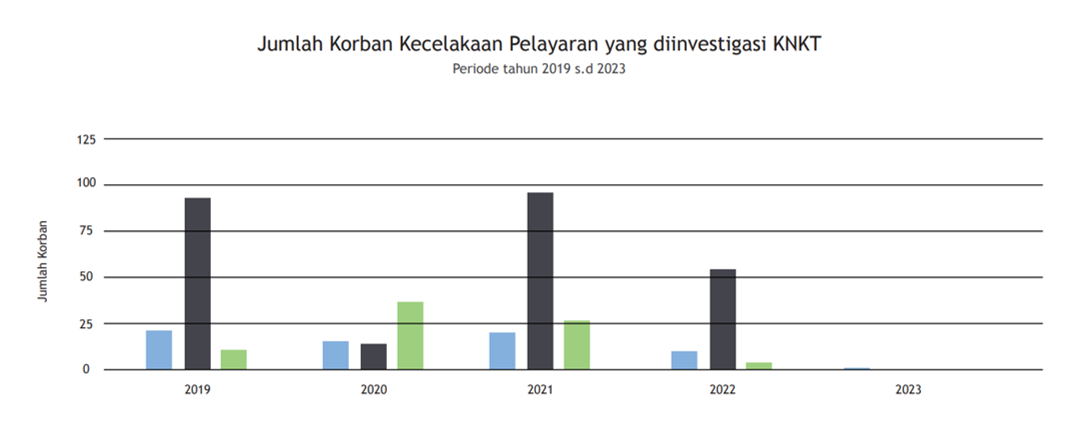
In 2022, there were a total of 15 accidents. Fourteen of the accidents being collision accidents and one was an explosion. Although the number of accidents were lower than 2021, 2019, and 2017; the total number of victims who died was 104 and 221 injured, making it the second highest year of total number of casualties in the last six years. The highest number of casualties was in 2018, with 325 number of victims, 299 of whom died.
III. Accident Causes and Stages of Maritime Safety
In 2022, KNKT investigation shows that shipping accidents is influenced by several causes such as technical issues, weather, and human factors. Technical factors are the most dominant cause of accidents from 2017 to 2021, with 39 accidents. However, the human factor is also one of the factors that is quite significant in causing accidents and totaled 35 accidents. The third cause is weather that affected ship accidents. [10] The majority of the recommendations given by the KNKT are related to supervision or control, with 39.6% of the total recommendations. The second most frequent recommendation related to facilities and infrastructure, with a high percentage of 29.9% of recommendations. The third is related to regulations, with a high of 27.4%. The pie chart below sets out the figures:
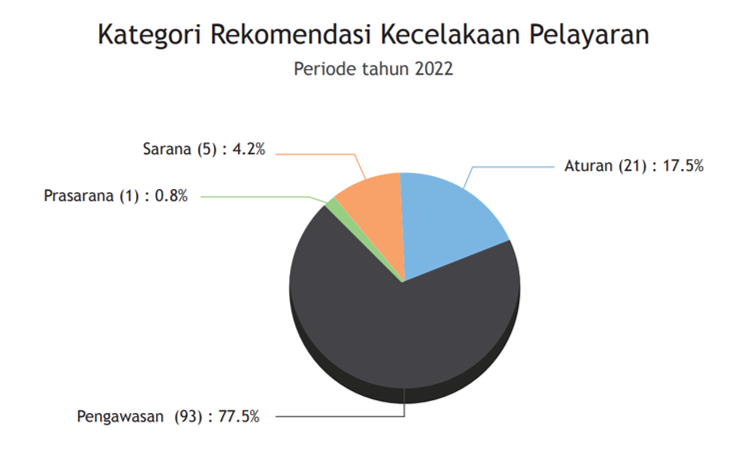
The investigation result by KNKT reflects the three stages for maritime safety management being: the first era – technological and human factors; the second era – socio-technical and cultural; and the third era – resilience.
The first stage is generally regarded as having started with the sinking of the Titanic in 1912. Following the accident, the International Convention for Safety of Life at Sea (SOLAS Convention) was adopted. SOLAS regulates the technical issues of maritime safety such as ship design, structure, and equipment of vessels. In this era, the predominant causes of accidents were explained through the domino theory by Heinrich and Grannis. The theory assumes that accidents are caused by simple linear models, in which accidents are the culmination of a series of events or circumstances which interact sequentially with each other in a linear way. It postulates that accidents can be avoided by taking action and eliminating one of the causes in the linear sequences.[11]
The second era began with a focus on socio-technical and cultural factors as the root cause of accidents. This then transitioned to safety management systems and organizational factors. Perrow is the main advocate in this era, who advocated those technological advances made organizations and system more prone to accidents, by making the system tight and inherently complex. The system, according to Perrow, are to be understood as more than merely technology, but how it is organized at the national and international level, including ship registers and flag states, as well as onboard organizational structure that may allow accidents to happen. In this era the predominant safety model was a complex linear model that assumes accidents are a result of a combination of unsafe acts and latent hazards. The highlight case in this era is the Scandinavian Star,[12] an accident that killed 159 people and took 27 years of investigation.
The third era is the Safety-II from a resilience perspective which assumes a complex non-linear model or systemic model. Accidents are treated as the result of flawed processes involving interactions among people, social, and organizational structures and engineering activities, and physical, and software system components. The world that we live in today is trying to make sense of accidents by understanding the process leading up to a successful operation and understanding how humans successfully adapt to a constantly changing environment and then channel resources to enforce those processes to prevent accidents. [13] One of the effort is through the establishment of accident investigation body such as KNKT that assist the practices and industry in understanding the root causes to improve the future process in managing safety that is adaptive.
