


In the first half of 2023, the Ministry of Health and Welfare (the “MoHW”) set up a public-private discussion group with the pharmaceutical industry to discuss drug price compensation plan for innovative new drugs (the “Discussion Group”), which results will be announced soon.
Furthermore, the expansion of the list of drugs exempt from pharmacoeconomic evaluation (“PE”) in January 2023 facilitated a more efficient listing process. This resulted in a pediatric drug being listed in approximately 4 months.
I. COMPENSATION FOR INNOVATIVE NEW DRUGS
A. Progress of “Compensation for Innovation” Discussion Group
The Government and the pharmaceutical industry have discussed possible compensation plan for innovative new medicines through five rounds of meetings of the “Compensation for Innovation” Discussion Group from January 2023 to March 2023.
One of the biggest issues was how to define the concept of “innovative new drugs.” In particular, the definitions of “innovative new drugs” conceived by multinational pharmaceutical companies and domestic pharmaceutical companies were different, and the Government decided to separate the discussion with multinational companies from that with domestic companies starting from the second round of discussions.
The Korean Research-based Pharmaceutical Industry Association (the “KRPIA”), which is composed of global companies, has argued that an innovative new drug should be defined as a new drug that meets three or more of the following five requirements:
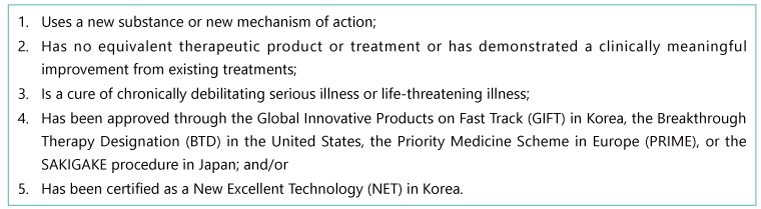
On the other hand, the Korea Pharmaceutical and Bio-Pharma Manufacturers Association (the “KPBMA”), which is composed of Korean pharmaceutical companies, has argued that innovative new drugs should meet both of the following requirements:

The Government initially planned to announce a compensation plan for innovative new drugs within the first half of the year after hearing from the pharmaceutical industry, but it is expected to do so in the second half of the year after careful consideration including budget estimation.
B. Recent Regulatory Developments
The purpose of the “Compensation for Innovation” Discussion Group is to encourage the development and listing of new drugs, and ultimately to ensure patients’ access to new medicines. This shows that the Government has begun to actively recognize the drug price system, which has traditionally been perceived as a means to curb medicine costs spending, as a means to boost the supply of innovative new drugs and ensure patients’ access to medicines.
However, the Government, with its limited financial resources, has to think about which drugs are to be considered as innovative new drugs based on their value. The announcement of the compensation plan is being delayed from the original plan because of reasons like budget estimation.
It should be noted that this year, the Government has announced its plans to reform the drug price post-management system from various perspectives. Regarding the price-volume agreement system, a working group has already been set up to discuss ways to increase the maximum reduction rate and differentiate the reduction rate according to the claim amount.
Also brought up are the repricing of the loss of exclusivity drugs for chronic diseases by referencing foreign drug prices, and the revising of ex officio adjustment of upper limit price based on actual transaction price examination. These reforms of the drug price post-management system are focused on cost reduction.
In the end, it seems that the reformations to the drug price scheme will likely be based on the structure that the expenditure for drug price compensation for innovative new drugs will be financed from savings to be made from the revised drug price post-management system.
In that case, the merits and demerits of the drug price system reform or the extent of its impact may vary considerably from one pharmaceutical company to another, or from one product to another. Therefore, it is necessary for pharmaceutical companies to continuously monitor, and find countermeasures against, policy trends across the drug price system including not only details like compensation measures for innovative new drugs, but also measures to reform drug price post-management system.
II. EXPEDITED LISTING PROCESS FOLLOWING EXPANSION OF SCOPE FOR PE-EXEMPTED MEDICINES
A. Accelerated Listing of a Pediatric Drug
On December 23, 2022, the Health Insurance Review and Assessment Service (the “HIRA”) revised the Regulations on Criteria and Procedures for Evaluation of Drugs (effective from January 1, 2023). Under the revised regulation, PE may now be omitted for any anti-cancer or rare diseases drug or used for children that has no drug or treatment with an equivalent therapeutic position and is proven clinically to meaningfully improve the quality of life and has a small target group of patients. Such drug can now be listed at a price equal to or below the lowest overseas referencing price without having to go through PE.
The revision above was applied for the first time and a pediatric drug was listed on May 1. This drug is used for the treatment of hypophosphatemic (XLH) rickets and osteomalacia, and patients who are aged 1-18 years who have been using the existing treatment (active vitamin D) for more than 6 months without improvements may be eligible for medical care benefits.
The dossier of the drug was submitted on January 2, 2023, and the drug was finally listed in only four months, completing all procedures including the deliberation by the HIRA, the Drug Reimbursement Evaluation Committee (the “DREC”), and the drug price negotiation with the National Health Insurance Service.
With respect to the above drug, an application was first submitted in March 2021. According to the evaluation standards at that time, it could not be listed due to reasons including PE, so the pharmaceutical company voluntarily withdrew the application.
However, the scope of PE exemption was expanded, effective January 1, 2023, and it became possible for such drug to be listed. The drug was placed on the DREC table just over a month after a re-application in particular because the relevant review had been completed to a large extent in advance through continuous consultation with the HIRA.
B. Proposal for Expedited Listing of Drugs
As Article 6-2(1) of the Regulations on Criteria and Procedures for Evaluation of Drugs regarding the scope of PE exemption is revised, some pediatric drugs that meet certain requirements are able to omit PE. However, the new prerequisite of a small number of target patients has indeed been under the criticism that the above revision is contrary to the original purpose of reformation, which is to widen the scope of PE-exempt drugs.
However, given that a pediatric drug, which was not originally considered as a PE-exempted drug was recognized as a PE-exempted drug and listed promptly in about 4 months as a result of such revision, the revision can be assessed as having some effects of deregulation.
From the Government’s perspective, it would be difficult to overlook the fact that public demand for an accelerated listing of rare anticancer and disease drugs is getting stronger. Therefore, we can expect that discussions related to the scope of PE-exempted drugs will continue in the future.
Pharmaceutical companies should systematically demand reasonable improvements to set the scope of PE-exempted drugs, and find a strategic approach in their method of filling out the dossier to expedite listing and continuously communicate with the HIRA.
