


Eat with safety first. Food safety is at the heart of the food industry regulatory system. China's current food safety supervision system is based on laws, regulations, departmental rules, and standard specifications based on the Food Safety Law. This paper aims to introduce and interpret the more important regulatory systems in the food safety supervision system, including the risk prevention supervision system, the production and operation licensing system, the food traceability, the recall system, and the corresponding legal liability system. Of course, except as described in this article, There are still a series of other important regulatory systems in the food supervision system, such as the self-inspection system, import and export supervision system, etc., and the space is not separately stated here.
Food Safety Law System and Food Safety Regulatory Body
The current and effective Food Safety Law was first enacted in 2009 and was significantly revised in 2015, and was awarded the “most stringent” evaluation. In 2018, the Food Safety Law was revised. However, this revision is mainly based on the reform of government institutions. The names of some regulatory agencies have been adjusted without substantial changes.
Administrative regulations that have a significant impact on the food safety regulatory system, the Food Safety Law Implementation Regulations (the “ Implementation Regulations ”) (promulgated in 2009, revised in 2016), are still largely based on the Food Safety Law of 2009. Has been included in the revised agenda several years ago. In March this year, the State Council executive meeting passed the draft of the implementation regulations, and its official text is expected to be introduced this year. The regulations will cover many important aspects of food safety and will have an important impact on the further establishment and improvement of the food safety supervision system.
In the process of establishing and adjusting the regulatory system, food safety regulatory agencies have experienced changes in the regulation of water management in Kowloon. After the revision of the Food Safety Law in 2015, food safety supervision was adjusted to the food and drug supervision department. Relevant departments include the Ministry of Agriculture, the health administrative department, customs and other systems that participate in supervision in specific areas. With the institutional reform of the State Council, the main regulatory authorities of the current food safety supervision system are accordingly adjusted to the Market Supervision Administration (hereinafter referred to as “the city ” . Supervision Bureau ").
Risk monitoring and risk assessment system
Risk monitoring and assessment is the front end of food safety supervision, which is mainly aimed at risk prevention in food production and operation. In practice, it is easy to overlook that in addition to providing macro-risk prevention, risk monitoring and evaluation will also have a practical and direct impact on the production and operation of enterprises.
Under the current system, the health administrative department of the State Council (or the people's government of the province, autonomous region or municipality directly under the Central Government) and the municipal supervision bureau at the same level shall formulate and implement the national (or administrative region) food safety risk monitoring plan, and the health administrative department of the State Council shall be responsible for the food. Safety risk assessment work and publication of food safety assessment results.
The process from risk monitoring to risk assessment to the actual impact of assessment results on food production and management activities is as follows:
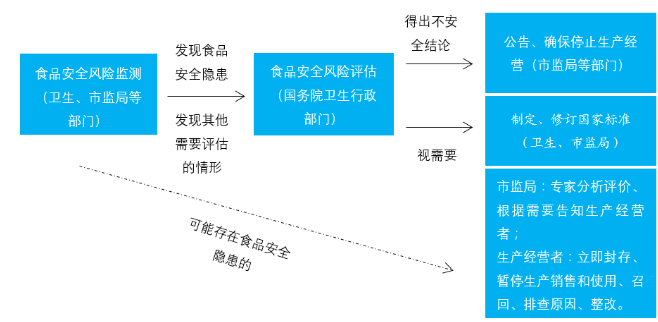
The current Food Safety Law and its implementing regulations do not actually stipulate the ways in which the risk monitoring results directly have an effect on the producers and operators. The relevant provisions in this regard are mainly the “Food Safety Sampling Inspection Management Measures” and “Food Safety Supervision Sampling and Risks”. Monitoring work practices. Accordingly, the results of food safety risk monitoring found that food may have potential safety hazards, the Municipal Supervision Bureau can organize experts in relevant fields for analysis and evaluation, and the analysis and evaluation conclusions indicate that there are safety hazards in related foods, and the Municipal Supervision Bureau can inform relevant food production according to the needs of the work. The operator takes control measures (as indicated by the dotted line in the figure above).
Strictly speaking, the purpose of food safety risk monitoring is to provide a basis for risk assessment, standard setting and evaluation of the overall status of food safety. The monitoring content includes both the items within the standard and the items not included in the statutory standards. Therefore, the monitoring results should not be directly used for food safety supervision and enforcement unless it indicates that there is a violation of food production and operation, but in practice, as mentioned above, risk assessment and inspection are likely to affect the actual operation of the enterprise. In this regard, laws and regulations are likely to be further developed, and special attention needs to be paid to the “Implementation Regulations” still in the process of legislation and the revised draft Regulations on the Administration of Food Safety Sampling Inspections issued on February 2, 2019.
Food safety standard system
Compared with other regulatory systems, the food safety standard system is one of the most important components of the food industry regulatory system. In terms of volume, this part is also the most abundant and most complex part. As of June 2018, China has issued 1,260 national food safety standards.
From the content point of view, food safety standards mainly include general standards, product standards, production and operation norms, and inspection methods, covering all major aspects of food production and processing, the most widely known in the food industry, and the food industry. The general concern of practitioners is GB7718.
As a unified concept, food safety standards first appeared in the Food Safety Law of 2009. Prior to this, there were multiple standard systems in China, including food hygiene standards, food quality standards, and industry standards. The Food Safety Law first stipulated that food safety standards were the only There are no mandatory standards other than the mandatory standards and food safety standards. Therefore, food safety standards are mandatory standards in terms of effectiveness.
In addition to being a mandatory food safety standard, there are a large number of recommended standards in China from the perspective of effectiveness, usually marked with “/T” on the standard number. From the perspective of the main body of the formulation, there are industry standards, local standards, and corporate standards. From a standard perspective, food safety standards must be applied in the presence of food safety standards. Of course, companies can also choose to develop more stringent standards. Regardless of the standard, once the product is selected and its standard is indicated on the label, the standard must be strictly applied regardless of whether it is a food safety standard or it may be considered as a non-conforming food.
Because a large number of standards and different standards can not be comprehensive, the application of food safety standards is a common difficulty in practice, especially in today's food industry, where the standard application of newly developed foods will become an industry practitioner. And the issues that regulators need to face.
Food production and operation full chain supervision
The Food Safety Law implements the concept of “full process and all-round supervision”, and extends the food-related production and operation links that are included in the supervision, and refines the requirements for each subject in each link, especially the system construction of the enterprise itself. Record keeping and self-checking. It is worth noting that the Food Safety Law and its implementation regulations incorporate and refine the regulations on food storage and transportation supervision, online food transaction supervision and sales management of edible agricultural products, and continuously improve the scope of food production and operation supervision.
- Licensing system
China has implemented a licensing system for food-related products with high risks such as the production and operation of food, food additives and packaging materials directly in contact with food. The producers and operators need to obtain corresponding food production and operation licenses or industrial production licenses ( For food related products). Therefore, both producers and operators of food, food additives, and food-related products (whether or not they actually operate in physical form) are required to obtain appropriate permits.
For special foods (including health foods, specialty medical formulas and infant formulas), the licensing conditions are more stringent. In addition to the food production and operation license, the production of the above special foods requires the application of more special regulatory licensing requirements. Each health food must be put into production and sale after registration or filing, and special medicine use formulas and infant formulas need to obtain the corresponding formula registration certificate. Around the product-based registration or filing regulatory system, the above special foods are subject to strict product access requirements in the production chain. It is important to note that the product registration and filing system for health food products has undergone a series of reforms in recent years. In general, the management of health foods has been more relaxed than before. The formula registration system for infant milk powder has been established and put into operation after several years of adjustment. On this basis, the State Administration of Market Supervision issued the "Regulations on the Registration of Formulas for Infant Formula Milk Powder Products (Draft for Comment)" published on June 26, 2019, and revised and detailed the original milk powder registration regulations. Chemical.
- Food safety traceability system
Article 42 of the Food Safety Law establishes a traceability system for food safety. The food safety traceability system refers to the system in which the food producers and operators record and store the information in all aspects of the food production and sales process in order to trace the responsibility. However, Article 42 of the Food Safety Law stipulates that the operational mechanism of the food safety traceability system is relatively general. The specific measures are scattered in the provisions of the Food Safety Law, such as the food raw materials, food additives, and food-related products in Article 50. The record system, Article 51 of the food factory inspection record system, Article 59 of the edible agricultural product purchase inspection record system, etc., may lead to incomplete information storage and information confusion in practice, and once a food safety incident occurs The first thing that the regulatory authorities need to check is the information and records of the food traceability.
- Recall system
According to the Food Safety Law, recalls are applicable to food producers and operators who find that food does not meet food safety standards or that there is evidence that may endanger human health. Food producers and operators should take measures such as harmlessness and destruction of recalled foods, and foods recalled because labels, signs or instructions do not meet food safety standards are allowed to be resurged and continue to be sold.
At present, the main regulations involved in the recall are the Food Recall Management Measures promulgated by the General Administration of Food, Drug and Drug Administration in 2015 (the “ Recall Measures ”) and the “Food Recall Management Regulations” promulgated by the General Administration of Quality Supervision in 2007 (“ Recall ” Provision ").
In practice, the recall is still a relatively complicated issue. Apart from the conflicts in the application of the law, the specific handling of the recall, especially for issues that are not directly related to food safety, such as labeling, must strictly comply with the requirements of the recall method. It is a problem that is often encountered in practice when the company is retracted to the manufacturer and can be corrected by the seller on the issue of low risk. In addition, the harmless treatment of recalled foods is also a problem that many food companies are thorny. The harmless treatment seems simple, but the boundaries of their specific requirements are not clear. A large number of requirements are reflected in the scattered low level of the regulatory authorities. The normative documents, which bring invisible responsibility to the food business enterprises, especially in the case of illegal food inflows into the market, how the food business enterprises can effectively protect themselves and prove that they have fully implemented the harmless treatment procedures. Is a problem that is often easy to face.
The new implementation regulations are expected to make some substantial changes in the food recall issue, which remains to be seen.
Inspection and inspection system and credit supervision system for food production operators
- Food safety inspection
The Food Safety Law stipulates that food safety supervision and administration departments at or above the county level shall conduct regular or irregular sampling inspections of foods, and strict regulations shall not be exempted from inspection. On this basis, through a series of legal norms, including "Food Inspection Work Regulations", "Food Safety Sampling Inspection Management Measures" (and its draft sampling test), "Network food safety violations investigation methods" including "food production and management" The Measures for the Administration of Daily Supervision and Inspection establish a more detailed food safety inspection and inspection system, which includes flight inspection, off-site inspection, cross inspection and so on. At the same time, in response to the increasingly popular online sales and Internet plus catering industry, the regulatory authorities have also introduced a number of special regulations, which will be included in the focus of food safety inspection.
With the development of information disclosure, the publication of inspection results has become extremely common, which means that food companies need to better respond to inspections in order to maintain their brand image. How to deal with the written or on-site inspections of the regulatory authorities and the adoption of appropriate prior or ex post measures are already part of the daily compliance preparations of many food companies.
- Food production and operation operator credit supervision system
Article 113 of the Food Safety Law establishes a food safety credit file system for food producers and operators. Food producers and operators who have serious violations of the law can notify the investment authorities, securities regulatory authorities and relevant financial institutions. Relevant departments successively issued the Memorandum of Understanding on Joint Disciplinary Actions against Severely Untrustworthy People in Food and Drug Production and Operations, and the “Guiding Opinions of the General Office of the State Council on Accelerating the Construction of a New Credit Mechanism Based on Credit for the Construction of a Social Credit System”. It is also clear that food producers and operators who have unbelievable behaviors will be included in the scope of joint punishment and increase their disciplinary efforts. Food safety credits of food producers and operators are gradually connecting with credit systems such as industry access, financing credit, securities issuance, and corporate credit reporting, and fully exert their restrictive effects on food safety and dishonesty. The revised implementation bill may also be further refined and standardized.
Responsibility and punishment mechanism
The Food Safety Law is titled "the most stringent in history" and its outstanding performance is in the punishment and liability system.
As far as civil liability is concerned, in the production and operation of products that are known to not meet food safety standards, in addition to the losses, they should also bear 10 times the consumer price or three times the amount of the loss. If the compensation amount is less than 1,000 yuan, then One thousand yuan. In practice, because the definition of loss is rather cumbersome, the tenth compensation system is widely used. This kind of obviously high punishment nature compensation system has brought a large number of professional counterfeiters while increasing the responsibility of violations. The focus of the compensation is usually on the label compliance of food, not the safety of the food itself. This has also caused many food companies to suffer. In the past two years, the attitudes of judicial practice and regulatory authorities have changed, but there is still a lack of uniform rules and judicial practices across the country.
In terms of administrative responsibility, in addition to personal punishment (restricted from employment), the relatively high-priority punishment system in other legal norms is adopted, and serious violations will face a penalty of 30 times the maximum value. Based on the punishment of the past two years, the cases of penalties are everywhere, and high-priority cases are also frequent. This is closely related to the separation of licenses, the strengthening of post-regulatory regulatory reforms, and the severe food safety situation.
In terms of criminal responsibility, an important aspect that deserves attention is the mechanism of penalizing people. In 2018, the State Food and Drug Administration and the Ministry of Public Security issued the "Regulations on Strengthening the Law Enforcement of Food and Drug Safety and Strictly Implementing Punishment of Food and Drug Violations", specifying the mechanism of administrative and criminal connection, and clearly stipulating that the unit engages in food. In case of illegal drug activities, in addition to penalizing the unit, it is also necessary to punish the directly responsible person in charge and other directly responsible personnel. It is especially important that the provision further clarify that the “direct responsible person in charge” decides from the illegal act. The person in charge of approval, inspiration, connivance, and command, and the “other directly responsible personnel” are those who specifically implement the illegal acts and play a greater role. They may be the production management personnel of the unit or the employees of the unit. Including the employed and hired personnel.
Conclusion
Food safety is of great importance. Strict legislation and severe punishment are the main features of the food safety supervision system. The current law enforcement practice also fully demonstrates this feature. Production and management of the food industry should establish and improve their own compliance requirements, pay full attention to changes in the food regulatory system, and achieve dynamic compliance in the process of operation and innovation, which is not only the requirements of laws and regulations, but also the enterprises and individuals. Responsibility and safety.
