

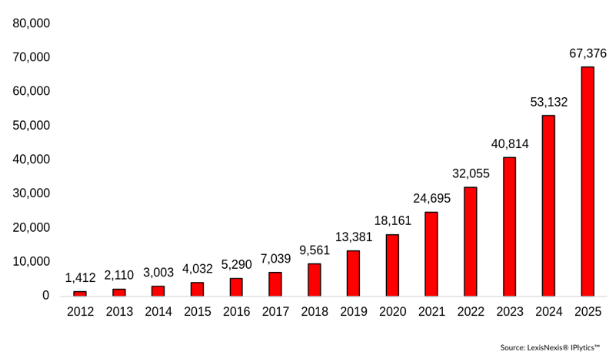
The role of 5G has expanded well beyond consumer devices, underpinning a growing range of industrial IOT, automotive and infrastructure applications. This shift aligns with the evolution of standard toward 5G Advanced, starting with Release 18, which builds on core 5G technologies while introducing new capabilities, improved performance and broader industrial use cases. Patent activity reflects this transition in scale and scope: by 31 October 2025, more than 67,000 active 5G patent families had been granted worldwide, up from around 53,000 in 2024.
Figure 1. Cumulative number of worldwide granted 5G-declared patent families by year of first publication
At the same time, 5G SEP licensing and litigation have intensified globally, with courts across key jurisdictions increasingly asserting authority over FRAND rate setting and evaluating the conduct of licensors and implementers. As SEPs play a more central role in these disputes, patent portfolio assessments and comparative data are becoming critical reference points for negotiations and judicial analysis alike.
Continuity and change in the 2026 5G patent rankings
The new “Who Is Leading the 5G Patent Race 2026” report provides an updated view of leadership in the global 5G patent landscape at a time when SEPs underpin an estimated US$15-billion annual licensing market. The race for 5G dominance is clearly reflected in public patent declarations and standards contribution submissions, which together form the analytical foundation of the analysis.
At the top of the 2026 rankings, leadership remains concentrated among a familiar group of companies when measured by the number of active and granted 5G-declared patent families. Huawei continues to hold the largest portfolio by volume, followed by Qualcomm.
However, the 2026 rankings also reveal notable movement beneath the surface when compared with last year’s analysis. Several companies strengthen or weaken their relative positions depending on whether portfolios are assessed by volume, value-adjusted metrics, technical contributions to 3GPP or across releases, technical working groups and geographic coverage. The full set of results is detailed in the “Top 50 5G Patent Rankings 2026”, which provides a broader view of how competitive positioning extends beyond the very top of the table.
Portfolio value reshapes perceptions of 5G leadership
Looking beyond simple patent-family counts, a value-adjusted view based on the Patent Asset Index provides a more differentiated perspective on 5G leadership. When 5G-declared patent families are assessed using this patent value metric, Huawei and Qualcomm – while both remaining at the top of the landscape – change their relative ordering compared with size-based rankings, and similar movements are visible for LG Electronics and Samsung. These differences illustrate why portfolio value has become an increasingly important reference point alongside volume when assessing competitive positioning in the 5G patent landscape.
Table 1. Top five ranking by active and granted declared 5G patent families, their strength measured by the Patent Asset Index and 5G-relevant 3GPP contributions
| Average Rank | Ultimate Owner | HQ | Rank by 5G patent families | Rank by Patent Asset Index of 5G patent families | Rank by 5G-relevant 3GPP contributions |
| 1 | Huawei | China | 1 | 2 | 1 |
| 2 | Qualcomm | United States | 2 | 1 | 4 |
| 3 | Samsung | Korea | 4 | 3 | 5 |
| 4 | Ericsson | Sweden | 5 | 5 | 2 |
| 5 | LG Electronics | Korea | 3 | 4 | 10 |
Technical contributions add another dimension to 5G leadership
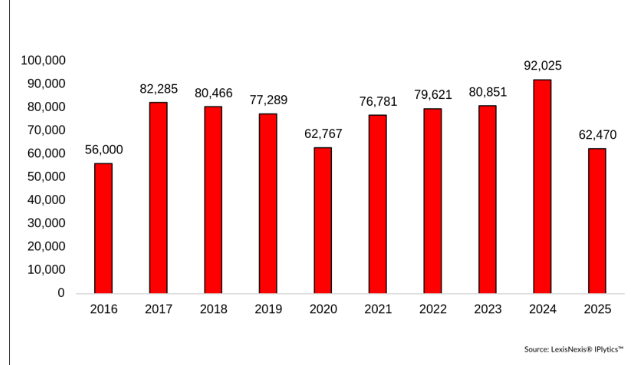
Technical leadership in the 5G patent landscape is not only reflected in patent ownership and portfolio value, but also in sustained participation in standards development. Over recent years, activity within 3GPP has remained consistently high, culminating in a record of more than 90,000 technical contributions related to 5G in 2024, underscoring the continued intensity of standardisation efforts. Analysing these technical submissions provides insight into which companies are most actively shaping the specifications that define the 5G standard. When viewed through this lens, the relative positions of leading patent owners shift again.
Figure 2. Number of submitted technical contributions related to 5G by year of publication as of 31 October 2025
Working group analysis reveals where influence sits
The value of a 5G patent portfolio depends not only on its size but also on the technologies it protects. Working group analysis provides a deeper view of where companies exert technical influence within the standard and how their portfolios align with foundational versus advanced features of the standard.
RAN 1 and RAN 2, which cover physical layer and radio protocol technologies, form the technical core required by all 5G devices. Companies such as LG Electronics and Samsung appear comparatively stronger in these groups, while others show greater concentration in RAN 3, RAN 4 or SA 2, indicating influence over higher-level coordination, performance or network architecture. Together, these perspectives highlight that technical leadership in 5G varies significantly across the standard and has direct implications for how portfolios are assessed in licensing and FRAND discussions.
Table 2: Top five ranking by active and granted 5G patent families related to working groups RAN 1 to 4 and SA 2
| Average rank | Ultimate owner | HQ | Rank of active and granted 5G-declared patent families | ||||
| RAN 1 | RAN 2 | RAN 3 | RAN 4 | SA 2 | |||
| 1 | Huawei | China | 1 | 1 | 1 | 1 | 1 |
| 2 | LG Electronics | Korea | 3 | 2 | 13 | 9 | 9 |
| 3 | Samsung | Korea | 4 | 3 | 2 | 6 | 11 |
| 4 | Qualcomm | United States | 2 | 6 | 7 | 7 | 5 |
| 5 | ZTE | China | 5 | 4 | 5 | 2 | 14 |
Why accurate data matters once rankings are used economically
As 5G patent rankings are increasingly referenced in SEP licensing negotiations, litigation and FRAND determinations, the quality and consistency of the underlying data become critical. Courts and negotiating parties are relying more frequently on portfolio-share assessments as part of top-down royalty calculations or when benchmarking comparable licence agreements. In this context, even small discrepancies in patent counts, ownership attribution or portfolio classification can materially affect perceived 5G patent shares and relative bargaining positions.
Much of this sensitivity stems from structural limitations in publicly available declaration data. The ETSI patent declaration database, which serves as the primary reference point for 5G SEPs, is based on self-declarations and does not independently verify essentiality, completeness or ownership consistency. Differences in declaration practices, incomplete patent-family coverage and inconsistent ownership attribution mean that without rigorous matching, normalisation and verification with the declaring entities, portfolio size assessments can be distorted. As a result, analyses based on ETSI declarations can arrive at materially different conclusions about portfolio size and relative market share, complicating benchmarking in licensing negotiations and FRAND assessments.
Industry efforts to improve declaration data reliability
In response to these challenges, parts of the cellular ecosystem have moved toward more systematic approaches to cleaning and validating declaration data. One such effort is our Cellular Verified initiative, which aims to improve the accuracy and consistency of 5G patent declaration records used in analytical and legal contexts. The initiative focuses on resolving discrepancies arising from inconsistent patent number formats, incomplete family coverage and outdated ownership information by applying rigorous matching, normalisation and corporate tree analysis. Importantly, the validation process incorporates direct cross checking with internal declaration records from 35 ETSI-declaring companies, helping to ensure that public declaration data accurately reflects underlying submissions (see “Why declaration data integrity is crucial for SEP stakeholders“).
If the foundational data input is already off, every subsequent patent value or essentiality analysis could be distorted, which is why reliable data matters more in SEP licensing than in almost any other patent context. The Cellular Verified initiative ensures a declaration database with 99.9% precision, validated by 35 ETSI 5G-declaring companies. Using verified patent declarations ensures that negotiations begin from a baseline and proceed with confidence and transparency.
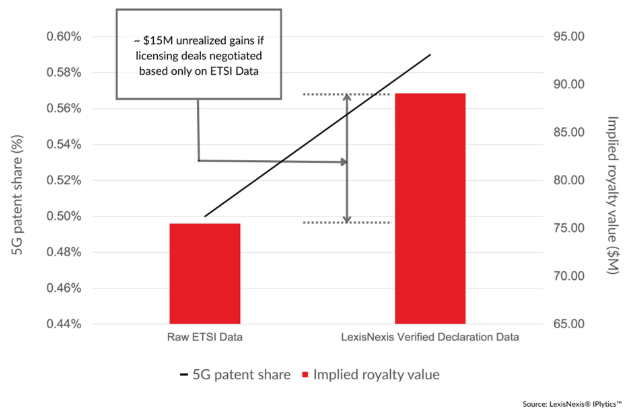
By contrast, raw ETSI data shows an aggregate ~18% error rate across major owners, driven by ~15% declared patent number-matching and normalisation misses plus ~4% patent ownership-declaration effects. On a conservative US$15 billion total cellular royalty market, each one percentage-point shift in share corresponds to roughly €150 million. A licensor with a 5% to 10% portfolio share therefore risks a US$135 to US$270 million per-year valuation drift if relying on raw ETSI data.
The importance of using accurate and normalised data is highlighted in Figure 3, which illustrates the scale of missing granted patent-family counterparts in raw ETSI records across key jurisdictions. These discrepancies underscore how unverified data can materially misrepresent portfolio size and magnify financial impact on royalty estimates.
Figure 3. For a licensor, even small uplifts in market share of declared SEPs, when based on verified declaration data, produce substantial increases in implied royalty value
Implications for SEP owners and implementers
For SEP owners and implementers alike, the 2026 5G patent landscape underscores the need for a more nuanced approach to portfolio assessment and licensing strategy. Rankings based on portfolio size, value-adjusted metrics and standards contributions each capture different aspects of competitive positioning, and no single measure provides a complete picture on its own. As licensing activity expands across industries and jurisdictions, stakeholders are increasingly required to justify assumptions about portfolio strength, market share and comparability with greater analytical rigour. In this environment, reliance on unverified or inconsistently processed data introduces avoidable risk, whether in negotiations, litigation or strategic planning. A more disciplined use of validated patent declaration data allows parties to benchmark portfolios more consistently, assess exposure more accurately and engage in FRAND discussions on a clearer and more defensible footing.
As 5G continues to evolve and 5G Advanced capabilities are rolled out, the complexity of the patent and licensing landscape is set to increase further. At the same time, early work on future generations of cellular standards is already under way, reinforcing the long-term relevance of today’s portfolio decisions. In this environment, understanding leadership in the 5G patent race requires more than a snapshot of rankings at a single point in time. It demands a multi-dimensional, data-driven view that captures scale, value and technical influence with sufficient precision to support informed licensing, litigation and strategic decisions.
Tim Pohlmann
LexisNexis Intellectual Property Solutions
