


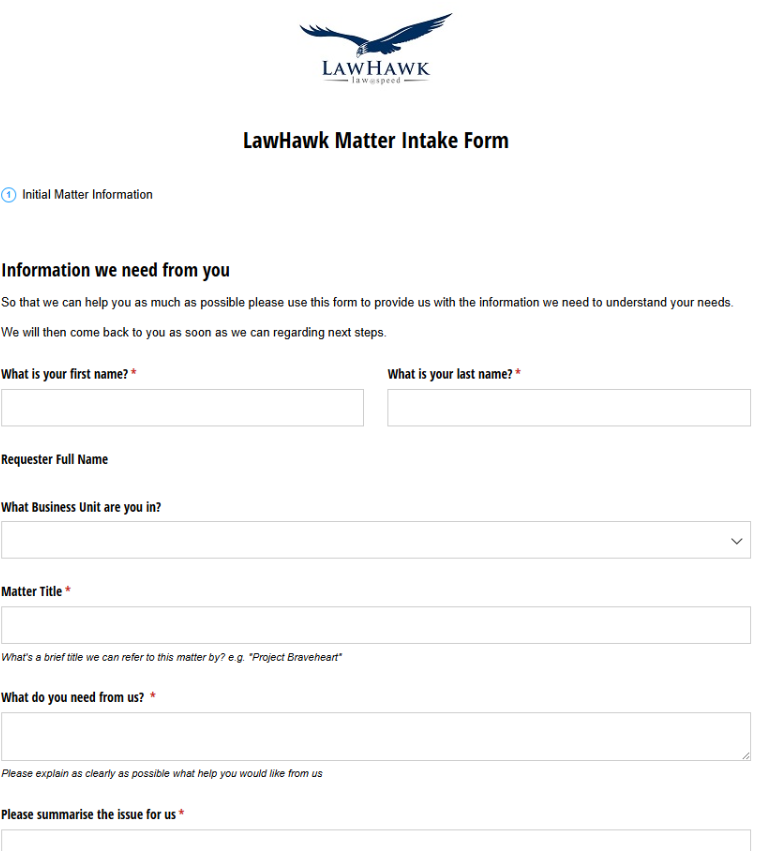
An Example Online Intake Form
In-house legal teams are under growing pressure to deliver strategic value, manage complex workloads, and operate efficiently – all in an uncertain business landscape.
Yet, many teams are still bogged down by a surprisingly overlooked issue: a fragmented matter intake process.
Streamlining how legal requests are received and managed can be a game-changer. It could also be a key to getting started on your AI journey.
Here’s why rethinking the intake process is becoming more important, how to trial it easily, the risks of ignoring it, and the benefits it can unlock.
If your legal team receives requests through a mix of emails, phone calls, or casual conversations, you’re not alone. Without a standardised intake process, in-house lawyers often deal with:
These inefficiencies don’t just frustrate lawyers—they erode the legal team’s ability to act as a proactive partner to the business, often reinforcing the perception of Legal as a cost centre rather than a value driver.
The need to address intake challenges is more important than ever due to six trends reshaping in-house legal work:
For legal teams who haven’t yet tackled this issue, recognising these pressures is the first step toward unlocking significant improvements.
One of the helpful things about generative AI is its ability to take unstructured information and turn it into something more useful.
However, just because it can do that, doesn’t mean it has to.
We have been testing Microsoft’s AI Builder components within Power Automate, hooking it up to data from Cognito Forms – which is what we use to gather information in process such as legal and contract intake.
With Power Automate there are a lot of options, as you can see below. Some are pre-built, but you can also choose to run your own prompt.
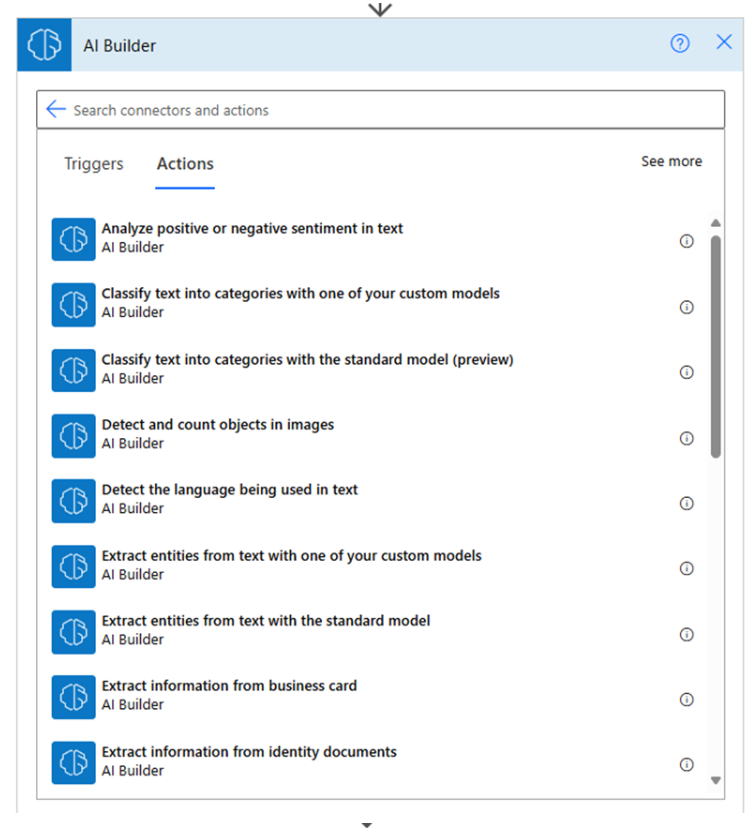
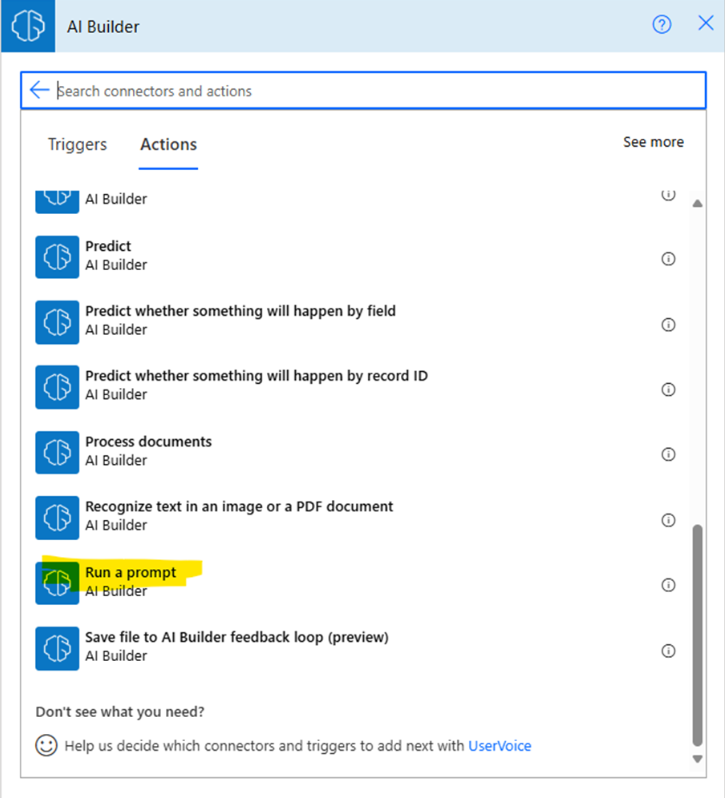
Because our Cognito Forms contain a lot of conditional logic, where we capture different and very specific information in different circumstances (and we give a lot of guidance to users about what we want and the format we want it in), we can be quite specific in the prompt we build about what type of information we expect to receive, what the user was asked to consider in answering, and what we’d like the AI to do with it.
This should mean that we give clearer instructions, and receive better ouputs, and should reduce the amount of work overall.
Ignoring intake inefficiencies comes with a steep price. While exact costs vary, consider the cumulative impact of:
Delaying action also puts your team at a disadvantage compared to peers adopting modern legal tech, making it harder to attract talent who value efficient, tech-enabled environments.
A streamlined intake process can transform how in-house legal teams operate, delivering:
These benefits don’t just solve today’s problems—they position the legal team as a strategic asset for the future.
If you’re new to this issue, the good news is that solutions are easily within reach. You don’t need a full matter management system to offer digitised intake as an option. You can set up a simple online form within days, which can be embedded in SharePoint for easy access by business users. Usage doesn’t have to be mandatory but you can easily start trialling and refining.
Rethinking your intake process doesn’t require an immediate overhaul. Begin with small steps. You can either build your own forms and prompts, or quickly leverage forms and prompts that we have already built in Cognito Forms. We could easily set up a customised trial within days. You can see an example Cognito Form embedded into a website page here.
As noted above, you don’t have to make an online intake form mandatory – it could be something that is just available for those who are happy to use it. Initially, perhaps only the legal team would test it, using information they are gathering from the business in other ways. Concerns about security of sensitive information can be mitigated during a trial by using dummy or anonymised data.
Even if there are no further steps, it will certainly be valuable to see what is possible and understand where there are issues that need to be resolved before a solution is viable for your organisation.
For in-house lawyers who haven’t yet considered their intake process, now is the time to act. A fragmented approach to receiving and managing legal requests wastes time, increases risks, and undermines your team’s potential.
By centralising and streamlining intake, you can unlock efficiency, reduce errors, and position Legal as a strategic partner.
The tools and strategies to solve this problem are more accessible than ever and are now being enhanced further by AI that your organisation is likely already paying for. Don’t let inertia hold you back. Start small, think big, and transform how your legal team delivers value.
