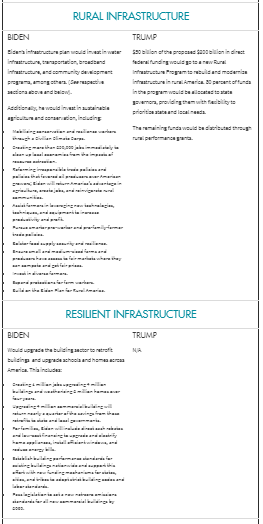
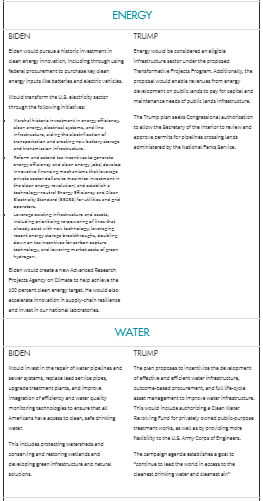
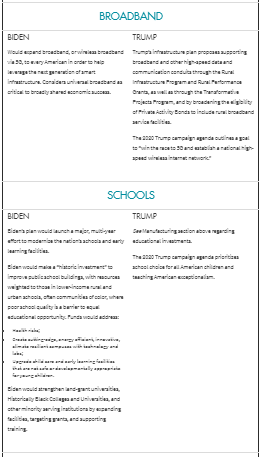
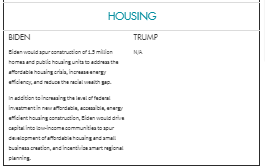
In an election year marked by twin public-health and economic crises and contentious, high-stakes debates on Capitol Hill and the campaign trail, the two presidential candidates offer starkly contrasting positions on several issues, including their plans for improving the nation’s infrastructure.
BIDEN
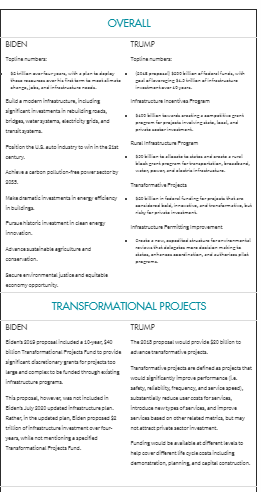
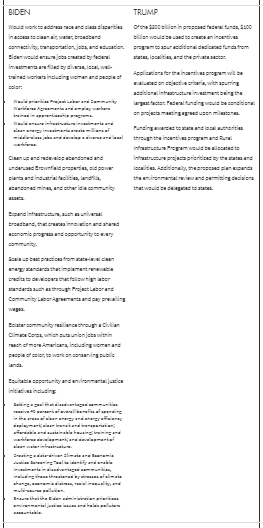
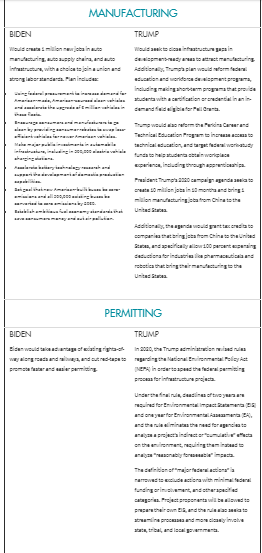
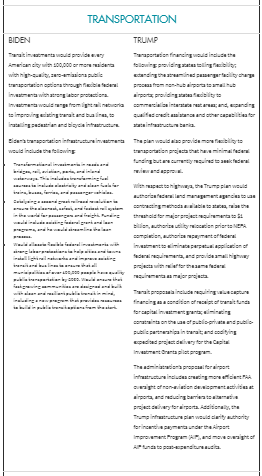
In July 2020, Joe Biden released an updated plan “To Build a Modern, Sustainable Infrastructure and an Equitable Clean Energy Future.” Revising and expanding upon his initial $1.3 trillion/10-year infrastructure plan that was released in November 2019, the new proposal increases investment to $2 trillion over four years, with the goal of executing the funds during his first term in office. Biden’s plan focuses on building a more resilient, sustainable economy that achieves net-zero carbon emissions by 2050, reinvigorates and modernizes numerous economic sectors, creates union jobs, and facilitates opportunities among disadvantaged populations and communities. In addition to roads, bridges, electrical grids, broadband, and transit, the proposal seeks to invest in and modernize the American auto industry supply chains, the power sector, buildings and housing, clean energy innovation, agriculture and conservation, and environmental justice.
TRUMP
During his 2016 campaign and since taking office, President Trump has often stated his desire to pass wide ranging infrastructure legislation. In February 2018, the White House released its “Legislative Outline for Rebuilding Infrastructure in America,” the president’s most comprehensive and detailed infrastructure proposal to date. The 2018 proposal sought to leverage $200 billion in federal funds into $1.5 trillion of infrastructure investments over a 10-year period using a mix of federal and private funds, and state and local tax dollars. In April 2019, Trump and Congressional Democratic leaders briefly agreed to a comprehensive infrastructure plan that would result in $2 trillion in infrastructure investment. However, after an outline had been developed, Trump withdrew from negotiations and the proposal stalled.
Nearly a year later, in the midst of COVID-19 relief discussions, President Trump once again floated the idea of a “very big and bold” $2 trillion infrastructure Phase 4 bill. However, the legislation did not materialize. In June 2020, the Trump administration sought to develop a $1 trillion infrastructure proposal, primarily within the Department of Transportation. The proposal centered on traditional infrastructure such as roads and bridges, as well as 5G deployment and rural broadband. However, the proposal never moved forward due in part to divisions among senior administration officials.
The 2020 Trump campaign also has not yet released a detailed infrastructure plan, but briefly references bringing manufacturing jobs back to the United States, creating “the world’s greatest infrastructure system,” and winning “the race to 5G” in its agenda that released in late August. That said, the aborted 2018 infrastructure plan provides the most detailed insight into the administration’s approach to infrastructure, and serves as a counterpoint to former Vice President Biden’s proposals.