


Introduction
In February 2023, as discussed in a previous blog article, an amateur rugby player was held liable by the English civil courts for injuring an opposition player “without any regard for [their] wellbeing or safety… and intent only on exactly revenge”.[1] Given the nature of the offending ‘tackle’ (which rendered the claimant paraplegic and was described by the judge as “deliberate”, “gratuitous” and “obviously dangerous”), it begs the question of when conduct on the field of play could (or should) constitute a criminal act and be prosecuted accordingly?
There have been various instances over the last 3-4 years where on-field actions have prompted allegations of criminality. For instance, during the 2019 Rugby World Cup in Japan, former Welsh international Jamie Roberts suggested that Sebastien Vahaamahina’s red card (for elbowing Aaron Wainwright in the face during a maul) in the France vs Wales quarter-final “belonged in a criminal court, let alone in front of a rugby judiciary”. Meanwhile, a sickening crash in the 2020 Tour de Pologne prompted the General Manager of Dutch Deceunick-Quick-Step (“DQS”) to publicly state that Dylan Groenewegen should be “thrown in jail” for deviating into Fabio Jakobsen’s line, causing him to collide with external barriers[2], and leaving the DQS rider with life-threatening injuries.[3]
It is worth noting that neither of the above resulted in criminal prosecutions and, where incidents occur outside the UK (such as those), they would be handled under local law in any event. That said, there is a bar – albeit a high one in England and Wales – whereby law enforcement will be obliged to intervene in relation to acts committed on the sports field. In this article, Henry Goldschmidt examines the uneasy relationship between sport and criminality under English law and how internal disciplinary, civil and criminal proceedings can overlap in respect of on-field violence.
“Off-The-Ball” v “On-The-Ball” Offences
Athletes do not enjoy blanket immunity from criminal liability (or civil liability, as recent case law has confirmed[4]) for their actions while participating in sport. However, there is a difference between sports-related illegal acts such as match/spot-fixing (i.e. fraud, which can result in custodial sentences) and on-field offences where an athlete is physically injured by an act of violence or recklessness by a competitor. This article focuses on the latter and, when it comes to the imposition of criminal sanctions, it can be necessary to delineate further between “on-the-ball” and “off-the-ball” offences.
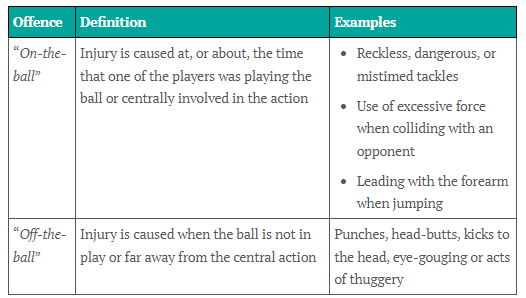
An incident like the Jakobsen crash would be tantamount to an “on-the-ball” offence – in that both riders were engaged in a sprint finish at the time, so there is close proximity to the play or action. Although there is commonality between “on-the-ball” and “off-the-ball” offences – in that they both involve actions outside the laws of the game – historically, English courts had held the former not to be sufficiently reprehensible to warrant criminal liability and more suitably regulated by the sport itself.
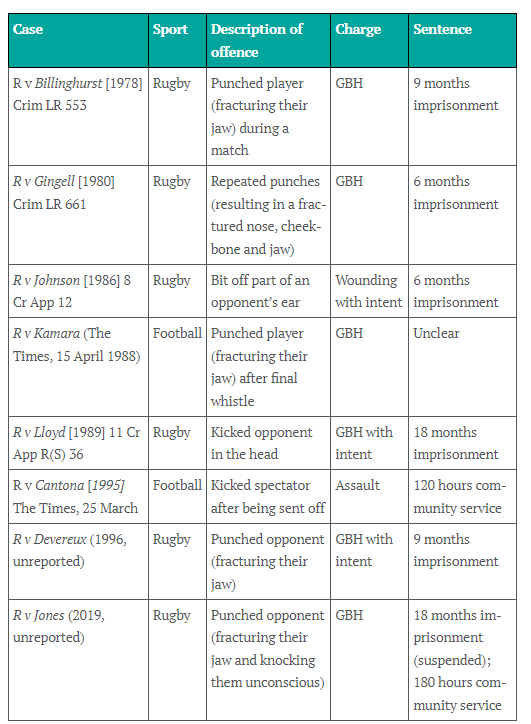
Indeed, criminal prosecutions for actions on the field of play – which date back to the 19th century (R v Bradshaw [1878] 14 Cox CC 83) – have almost solely been reserved for “off-the-ball” gratuitous or wilful violence.[5] These tend to be where the offences of common assault, assault occasioning actual bodily harm (“ABH”) and inflicting grievous bodily harm (“GBH”) have been proven “beyond reasonable doubt” (being the criminal standard of proof).
Examples of criminal prosecutions for ‘off-the-ball’ offences
R v Barnes: Non-Interventionist Approach
The reluctance of the English courts to find athletes criminally liable for acts committed on the field of play (certainly for “on-the-ball” offences) was typified by the Court of Appeal in the seminal case of R v Barnes [2004] EWCA 3246. The defendant had inflicted a serious leg injury on an opponent by making a late sliding tackle from behind but he maintained that it had been lawful and that the injury caused was accidental. At first instance, Barnes was found guilty of inflicting GBH under s.20 of the Offences Against the Person Act 1861, but his conviction was quashed on appeal.
In overturning the conviction, Lord Woolf held (emphasis added): “In determining what the approach of the courts should be, the starting point is the fact that most organised sports have their own disciplinary procedures for enforcing their particular rules and standards of conduct…. it is undesirable that there should be any criminal proceedings… a criminal prosecution should be reserved for those situations where the conduct is sufficiently grave to be properly categorised as criminal”.[6]
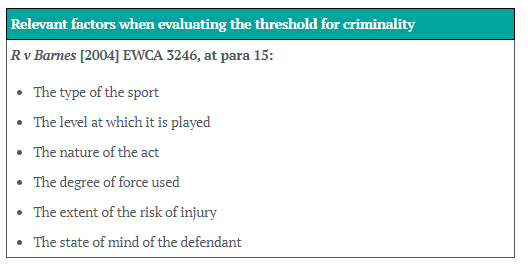
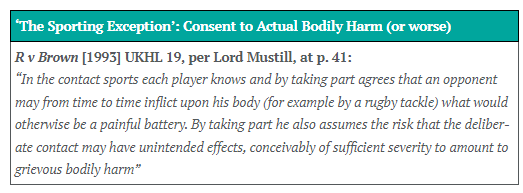
The notion of “playing culture” in highly competitive sports was also expressly recognised in Barnes – namely that conduct outside the rules of the game (i.e. fouls) can be expected to occur “in the heat of the moment… and even if the conduct justifies not only being penalised but also a warning or even a sending off, it still may not reach the threshold level required for it to be criminal”.[7] Such a notion is premised upon the idea of (implied) consent. It has long been recognised that sporting participants can consent to injury beyond that which may be consented to in other walks of life;[8] something affirmed obiter by the House of Lords in R v Brown [1993] UKHL 19.
Whether a participant has consented to the risk of suffering harm will depend upon the sport’s nature, the “playing culture” and the way the harm was inflicted. For example, in a contact sport like rugby, every tackle would, off the pitch, be a criminal assault; but tackling is inherent to the game and all participants acknowledge this prior to taking part. Indeed, even a dangerous late tackle would unlikely be criminal, despite being foul play, because it forms part of the “playing culture” tacitly accepted by participants. By contrast, any violence in the sport of golf would be far more likely be criminal, as golfers cannot be said to have consented to such contact, and it certainly does not form part of the “playing culture”.
R v Chapman: A Shift Towards Interventionism?
The six-month imprisonment of amateur footballer Mark Chapman in 2010 for an injury-causing tackle (i.e. “on-the-ball” offence) seemed prima facie to be a significant shift away from the non-interventionist approach advocated in Barnes. Barnes and Chapman[9] were similar incidents yet, while Barnes was acquitted, Chapman was not. The judge held:
“[Chapman committed] a deliberate act, a premeditated act. A football match gives no-one any excuse to carry out wanton violence”.
That “wanton violence” was established in relation to an “on-the-ball” offence suggests that certain acts will not receive a “get out of jail free card” on the basis of a binary demarcation. Arguably, this blurred the lines of criminality in contact sports, but the fact Chapman pleaded guilty to the charges (unlike Barnes) meant there was no trial on liability. It was a surprising approach by the defendant, without any obvious rationale.
However, the decision in Chapman is by no means irreconcilable with the suggested formula and objective test identified by Lord Woolf in Barnes – the latter being a more authoritative precedent in any event. Rather, it is apparent that only the most egregious of on-field challenges should warrant the interference of the Crown Prosecution Service (“CPS”), or where the disciplinary body organising the sport (e.g. the FA) is not deemed to have properly dealt with the issue through the imposition of sanctions.[10]
A generally non-interventionist approach was advised (and operationalised) in the “Agreement on the Handling of Incidents falling under both Criminal and Football Regulatory Jurisdiction”, first published by the CPS in 2015.[11] A more recent version of that document, entitled “Working Practices on the Handling of Incidents falling under both Criminal and Football Regulatory Jurisdiction”, was issued in August 2020.
Professional Or Amateur Status – Does It Matter?
Since Barnes, there seems to have been a general reluctance of the CPS to involve themselves in professional sport. Indeed, since 2004, the author is not aware of a single prosecution for an “on-the-ball” incident in professional football or rugby. The fact that professional sport in the UK tends to have more robust and sophisticated internal disciplinary mechanisms, compared to the amateur game, is the likely reason for this. If governing bodies shirk their responsibilities, or do not have the resources to self-police violence on the field of play (e.g. by failing to impose appropriate sanctions), criminal law may need to step in.
It might seem imbalanced that professional athletes may (indirectly) be provided with an additional layer of protection from criminal liability purely on account of their employment status. However, amateur athletes are perhaps more likely to escape punishment for undetected violent acts. Professional athletes also arguably have more to lose and the impact of a sporting sanction may have a significant impact on their lives.
Conversely, when it comes civil liability under the English common law, professional athletes are held to a higher standard – in terms of the duty of care they owe towards one another – than amateur participants.[12] Therefore, an almost identical act committed by a professional (on the one hand) and an amateur sportsperson (on the other) may only be deemed to be negligent by the former.
Conclusion
Under English law, a sportsperson’s conduct will only be criminal where, as Lord Woolf stated, it is “sufficiently grave” to be properly so categorised. Although the case of Chapman illustrates that the law in respect of amateur athletes is perhaps a little more unsettled, the bar has been set high for prosecutorial bodies to intervene – particularly as regards “on-the-ball” offences. To do otherwise, from a public policy point of view, might have unintended consequences, such as discouraging individuals from participating in certain sports and inhibiting the inherent social value of the activity.
Ultimately, what is deemed reasonably acceptable contact in sport will depend on the circumstances of the case, not least the “playing culture” (a benchmark that will continue to evolve[13]). The recent civil case of Czernuska v King[14] is illustrative of the non-interventionist approach of the CPS, particularly given the degree of force used (which was captured on video), extent of the injury (paraplegia), purported pre-meditation and amateur nature of the match.[15] Against those hallmarks, the fact that the incident would likely be considered “on-the-ball” may have saved the injuring player from concurrent criminal prosecution.
