


Activity
M&A activity in Africa experienced a sharp decline in 2023 when compared to 2022. Key factors which contributed to the slowdown in M&A activity in 2023 included rising inflation, the increased cost of capital and the major geopolitical events and general uncertainty affecting global markets. These factors have impacted M&A globally, with Africa being no exception.
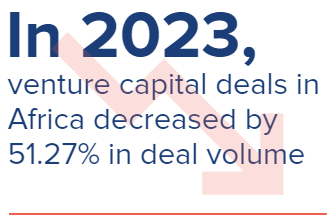
According to AVCA numbers, private capital transactions in Africa decreased by 54.5% from a deal volume perspective when compared to 2022 and by 56.2% from a deal value perspective. The downturn in investment activity in Africa was far reaching as most asset classes were affected by it. One of the key areas of decline was the significant decrease in venture capital activity, which had previously boosted the deal values and volumes across Africa in 2022. In 2023, venture capital deals in Africa decreased by 51.27% in deal volume and by 44.23% in deal value when compared to 2022.
2021 and 2022 were standout years for private capital in Africa and the 2023 decline in activity has brought activity levels closer to pre-Covid levels.
The impacts of the slowdown were also felt in capital raising where the total value of private capital fundraising in Africa declined from US$2 billion in 2022 to US$1.2 billion in 2023.
In South Africa, some highlight transactions for 2023 included:
- Bunge's acquisition of a 50% stake in Viterra from Glencore, with Glencore taking a 15% stake in the merged Bunge entity, with an estimated deal value of US$4.1 billion;
- Tempur Sealy's acquisition of a 45% economic interest in Mattress Firm from Steinhoff International for an estimated deal value of US$4 billion; and
- The ABSA and CSI and Staff Trust black economic empowerment transaction with an estimated deal value of US$11 billion.
Legal trends
With the uncertainty in global markets and increased cost of capital, investors have become increasingly cautious when it comes to what deals they do and the terms of such deals. Increased caution and risk aversion have led to deals taking longer to close as due diligence and negotiations have become protracted in most cases.
The meaningful slowdown in capital deployment in African venture capital has also resulted in businesses and founders having to focus efforts on capital preservation and slowing down their burn rates. Globally there was a compression in exit multiples in 2023 and again Africa was no exception to this. Where founders did manage to raise capital, valuation discussions and negotiations were often a sticking point and in many cases businesses had to decrease their valuations in order to secure funding (ie, down rounds).
The decline in activity and increased cost of capital also saw more bridge rounds and convertible instruments being utilised in venture capital as businesses struggled to raise full funding rounds and investors opted for hybrid instruments which would give them greater downside protection in the current market conditions.
The tougher funding environment in 2023 also gave rise to more recapitalisation transactions occurring where all previous funding rounds were converted from preference shares into ordinary shares and usually heavily diluted. Such transactions result in non-funding investors losing their liquidation preference and anti-dilution protections and are usually aimed at penalising non-participating investors who do not participate in the funding round by providing the company with their pro-rata amount (often referred to as a pay-to-play mechanism).
We expect an upward trend of M&A transactions in 2024, especially from private capital investors
Outlook for 2024
In the second half of 2023 inflation started cooling. The hopes are that in 2024, inflation will continue to ease and stabilise. In South Africa, the South African Reserve bank raised the repurchase rate (repo rate), being the rate at which private sector banks borrow Rands from the South African Reserve Bank, by 1.25% (from 7% to 8.25%) over the course of 2023 in order to combat inflation. This was a continuation of the rate hikes which were experienced in 2022 and in aggregate means the repo rate has increased by 4.5% since the beginning of 2022 (from 3.75% to 8.25%). The repo rate was last increased in May 2023 and the South African Reserve Bank resolved to not increase it and rather hold it steady at 8.25% in September and November of 2023. The holding steady of the repo rate has been positive and the hopes are that there will be cooling inflation and rate cuts in 2024 which would then create a more favourable environment for investment and more market and M&A activity.
The ongoing worldwide uncertainty and its economic effects will continue to have an impact on M&A transactions in Africa. We expect an upward trend of M&A transactions in 2024, especially from private capital investors, but the impact of the global uncertainty remains to be seen.
As the Lunar New Year begins, Asia's deal dragons are rousing after the uncertainty of 2023 sent them to their lairs.
Volatility of capital, demand and strategy seems to be stabilising after a tumultuous year for M&A in 2023, both regionally and globally.
Asia's dealmakers are now better accustomed to the new political and economic realities, while consumer demand and interest rates continue to stabilise.
The great power 'friendshoring' of recent years has settled into more predictable pathways. Dealmakers are more confident of the investment corridors into and out of Asia on which they should focus to avoid crossing red lines.
However, uncertainty remains. Over 50 notable presidential or general elections are scheduled this year, and tensions between the great powers remain elevated.
But these negatives should clarify strategic urgency, kickstarting investment in corporate and national security far beyond supply chains.
We expect security of digital infrastructure to join food production, traditional infrastructure, energy supply and transition minerals as urgent priorities for investment in response.
Valuation gaps dictate deal mechanisms
The valuation gap that emerged between buyers and sellers in 2023 means that many assets are being sold through auction processes in order for sellers to maximise valuation.
Most of the auction processes we are seeing are zero recourse against the seller and backed by warranty and indemnity (W&I) insurance. The decline in the cost and availability of W&I insurance has helped sellers to exit with minimal tail liability.
With fewer strongly performing companies to consider, we expect potential acquisition targets to undergo more extensive due diligence to assure buyers of future performance.
Unsurprisingly, sanctions related provisions are more common in transaction documents to mitigate geopolitical concerns.
Competition scrutiny may turn investors to Asia
Scrutiny of deals and operations by the Federal Trade Commission in the US increased notably in 2023 – particularly in the private capital sector.
In this environment, Asia deals may attract more attention from investors given more favourable or stable regulatory environments, with the region's competition regulators conducting fewer investigations – for now.
The increase in merger control filing thresholds in China in 2024 should also encourage deal making. China is also considering a further opening up to foreign investment in sectors, such as the financial service sector, and in targeted regions, such as the Shanghai Free Trade Zone and the Greater Bay Area.
Private capital prepares for a more predictable year
Private capital deal activity slowed dramatically worldwide and in Asia in 2023, as inflation put downward pressure on company operating margins and rising interest rates made it harder to earn an acceptable return.
Coupled with the lack of certainty around the future cost of capital and high interest rates, deals were more difficult to price, leading to a valuation mismatch between bidders and sellers.
Although much of this uncertainty remains, it is now priced in. The first half of 2024 may be the sweet spot for deals, as interest rate rises look likely to abate and price expectations become more realistic on both sides.
We expect to see a continued expansion of investments across Asia, particularly in India, South Korea, Japan and Southeast Asia. It is possible there will be a shift to secondaries in Asia too, but not on the same scale as the US, where deals are likely to be prioritised before the presidential election in November.
We are seeing a trend towards consolidation and specialisation among general partners (GPs) – either with specialised strategies or through market focus. Larger global GPs looking to expand in Asia may seek to acquire Asia-based funds to diversify portfolios both geographically and by type of alternative capital manager.
At a national level, Chinese State-owned government funds have been active in the last year compared to other funds. Chinese corporates are also pursuing corporate venturing opportunities, a move usually welcomed by the targets as corporate investors offer greater sector knowledge, industrial experience, technology support and opportunities for market collaboration than traditional private capital firms.
A crucible for energy transition investment
Transition generation, technologies and associated infrastructure are now established sectors in Asia. Investment interest remains strong, from global traditional energy companies and private capital groups to Asia-based entities such as national oil companies and the Japanese trading houses.
The world's largest buyers of LNG are all in Asia – China took the top spot in 2023, followed by Japan, South Korea and India. Japan and China have already joined Europe in establishing policies to ensure affordability and security of supply, so expect more national-backed deals as Asia's mega buyers look to lock in supply.
Billion-dollar deals are already rumoured in traditional energy companies, as large investors and corporates redirect investment into new energy technologies. This includes offshore wind in Japan and Korea where recent auction sales have attracted significant interest.
Asia remains the largest buyer of lithium globally, with Guangzhou trading more of the metal than established commodity exchanges in Chicago and London.
The slump in lithium prices at the end of 2023 could encourage more investors back to the deal table as supplier valuations look more attractive. The price is also good news for lithium buyers such as battery and EV makers seeking investment in processing and manufacturing infrastructure.
Building the foundations for the next digital revolution
Investment in digital infrastructure will remain strong, particularly in Southeast Asia. However, we expect to see a shift away from telecom towers transactions as sector consolidation slows the rate of deals, and towards fibre and data centre transactions, which are being driven by the rapid emergence of AI and the expansion of the digital economy and cloud-based solutions.
Additional factors, such as data localisation requirements (and the restriction of cross-border data flows) and the scarcity of suitable land in densely populated regions of Asia, are driving further growth in data centre deals.
However, through 2024 strategics, operators and investors will need to give increasing attention to risk factors, such as concerns over data security, the race for chips that can support AI applications, geopolitical uncertainty (eg, sanctions and trade controls which may limit access to certain data centres and chips) and environmental concerns over the energy consumption of data centres.
Japan
The conditions are right for Japanese M&A activity to increase in 2024, at home and abroad, as the cheap yen and still-low interest rates should support inbound M&A deals.
Recent corporate reforms (including the increased scrutiny of decisions on unsolicited bids and corporate takeovers) and the promotion of shareholder value are likely to encourage domestic deal activity.
The increase in corporate restructuring, carve-outs and management buyouts will likely continue in 2024, making Japan a favoured destination for global private capital.
The weak yen may eventually have a negative impact on outbound M&A activity – although it has not hindered Japanese corporations as yet. Japan's shrinking, aging population ensures that its comparatively cash-rich corporates will continue to look overseas for growth, sustaining outbound M&A.
China
With China’s economy slowing for the first time in decades, the focus has shifted to new growth sectors and strategies that will maintain the domestic economy.
But, while multinationals continue to re-position their China strategies and new investors prove more cautious, opportunities remain in this massive market.
Sectors such as green tech and energy transition, AI, and advanced manufacturing attracted solid foreign investment last year. Additional growth sectors this year will likely include healthcare, automotive manufacturing and chemical industries, where we see continued interest from both domestic and international investors.
We are also seeing new joint ventures and strategic partnerships, as parties seek to navigate regulatory complexities and optimize value.
China's state-owned enterprises are becoming a more important route to deal success domestically, and foreign investors should be familiar with SOE valuation requirements, statutory procedures (such as public bidding) and approval processes, all of which will impact deal structuring, execution and timeline. This same emphasis on domestic growth is evident in the activity levels of RMB funds raised by China private equity firms.
And, while huge outbound deals no longer dominate Chinese investors' strategies, targeted sectors in Southeast Asia and the Middle East remain attractive to Chinese private capital and corporate investors.
Amendments to PRC Company Law will come into effect on 1 July 2024, revising shareholders' capital contribution obligations, corporate governance structures and the powers and liabilities of directors and senior management.
The existing PRC Foreign Investment Law requires all existing foreign investment enterprises in China to convert their corporate governance structures to comply with the new Company Law by the end of 2024.
The Company Law will impact all foreign invested companies (particularly Sino-foreign joint ventures) in China but also adds new structuring options for investors through the introduction or formalisation of class rights under the new law.
Southeast Asia and Singapore
Southeast Asia plays a pivotal role in the global economy due to its strategic location, growing middle class, rapid digitalisation, rich natural resources and largely neutral geopolitical stance.
The World Bank expects Southeast Asia to remain on track to become the fourth-largest economy in the world by 2030, with Singapore benefiting as the region's financial, legal and administrative hub for dealmaking.
Private capital deal activity by funds, sovereign wealth funds and corporates is expected to remain strong, particularly in infrastructure (including digital infrastructure), renewable energy and healthcare through 2024.
That said, Southeast Asia is a complex market, comprising 11 countries, each of which has its own demographic, political, economic and geographical story.
Indonesia
Indonesia was a bright spot in 2023. GDP grew by 5% with a similar forecast for 2024 while foreign direct investment was up 13.7% year on year, rising to US$47.5 billion.
Investment flowed freely into the transition metals sector, particularly new nickel smelter projects and downstream projects such as EV battery manufacturing.
At the start of the year, the deal and IPO pipelines were already filling up prior to February's elections, with little change anticipated to the country's investment plans by new President-elect Prabowo.
Thailand
Thailand's 2023 M&A landscape was dominated by high tech deals by volume and value, alongside a rise in smaller-scale renewables investments, particularly in solar.
This year, we expect high tech M&A to remain strong, and EV and renewables projects to continue to boom in Thailand, driven by the ongoing focus on energy transition and investor confidence in sustainable growth.
Vietnam
Despite a 23% dip in M&A values in 2023, we anticipate a resurgence in deal activity this year, particularly in energy transition, infrastructure and digital infrastructure.
Vietnam has been preparing for an aggressive shift towards renewable energy through the decentralisation of power generation, an expansion in infrastructure development, and a commitment to achieving Net Zero emissions by 2050.
While the transition to renewables is underway, the immediate opportunity for 2024 lies in LNG-to-power deals, which are attracting significant interest from Japanese, US and private equity investors.
During the pandemic, Vietnam's infrastructure projects slowed, particularly those related to transportation. The government's transport plans are being revived as tourism recovers and investment inflows increase, and we expect substantial activity in airport and rail projects this year.
Vietnam is another of Asia's hotspots for data centre expansion and investment, driven by increased education levels and technology use.
India
India accounted for about 30% of deal value in the Asia-Pacific region between 2022 and 2023, remaining a bright spot in an uncertain global M&A market.
Private capital continues to bet on India too – with Middle Eastern funds such as Abu Dhabi Investment Authority, Mubadala and ADQ rumoured to be preparing to invest up to US$50 billion in India.
Upcoming elections in April/May 2024 might contribute to uncertainty around the investment climate. However, continued economic growth, favourable policies and the emergence of a strong pipeline of deal activity (such as the Reliance-Disney deal) should mean India is ready for take-off later in 2024, post-election.
Read more in our India report.
