


International Cooperation in the Field of Intellectual Property in Saudi Arabia
1. Introduction and establishment and operation of an IP agency
For the realization of the objectives of the Kingdom’s Vision 2030, Saudi Arabia established SAIP under the Council of Ministers Decision of 27 March 2017. The Decision aims to unify all IP matters under a single entity and transfer the duties and responsibilities from the Saudi Patent Office, Copyright Department and Trademark Department to the SAIP. On 12 November 2020, a Council of Ministers resolution has been issued to organizationally link the Saudi Authority for Intellectual Property to the Prime Minister.
The SAIP aims to regulate, support, develop, sponsor, protect, enforce and upgrade the fields of intellectual property in the Saudi Kingdom in accordance with international best practices, and it is organizationally linked to the Prime Minister. SAIP is responsible for the intellectual property strategies, policies, laws and regulations, grants intellectual property rights and leads their enforcement while providing support for the growth and generation of intellectual property use, and the protection of the Kingdom’s interests worldwide.
As Strategic Pillars, SAIP’s vision is to become an integrated body for intellectual property with global stature and a major hub for intellectual property in the Middle East and North Africa region by 2030.
- Improve intellectual property-related strategies, laws, and regulations.
- Raise the level of customer centricity and the attractiveness and quality of products and services.
- Contribute to empowering and making use of intellectual property rights.
- Strengthening the protection of intellectual property rights
- Strengthen the international strategic intellectual property partnerships.
- Raise the level of institutional excellence.
SAIP has been working to achieve accomplishments through registering and examining applications, conducting intellectual property awareness and enforcement campaigns in various regions, joining international treaties and local agreements, and reinforcing international strategic partnerships that are compatible with its field.
2. Preparation of IP policy and IP strategy
The National Intellectual Property Strategy (NIPST) was launched on December 22, 2022. The strategy will be implemented over a period of five years and is based on four main pillars (i.e. IP Creation, IP Administration, IP Commercialization, and IP Protection), and 12 initiatives consist of 54 projects. The strategy will be executed by 37 governmental and private agencies.
Saudi Arabia is keen to encourage and facilitate the effective creation, development, management, and protection of IP at the national level. Therefore, SAIP has started the works of the National Intellectual Property Strategy in accordance with Article 3 of the Resolution regulating the SAIP and defining its function. The goal of the national IP strategy is to strengthen Saudi Arabia’s ability to create economically and socially valuable IP assets to meet national needs and increase economic growth in order to achieve the objectives of the Saudi vision 2030.
3. Support for legal system creation
In accordance with Saudi Vision 2030, many laws were reviewed and new laws were enacted that have been years overdue. The new laws promulgated in Saudi Arabia reflect that the country is moving towards the codification of laws, which shows that the Saudi legislative and judicial systems have undergone several reforms.
- New Commercial Court Law
One of these recently issued Laws is the “Commercial Courts Law” which was enacted under Royal Decree No. M/93 dated 15/08/1441H (8 April 2020) and came into effect on 16 June 2020. The said Law governs the procedures of the Commercial Courts and applies to all disputes that fall within their jurisdiction. The Commercial Courts’ jurisdiction is broad and includes disputes and claims related to Intellectual Property Laws along with other claims related to Companies Law, Bankruptcy Law, other commercial disputes, etc.
It is important to highlight that Saudi Arabia is one of the few countries in the Middle East which has specialist courts for specific types of disputes as Intellectual property matters.
- Drafts of New Regulations:
a) Utility Models Regulations Draft
Utility model protection is not stipulated by the IP legislation in Saudi Arabia. The Saudi Authority for Intellectual Property “SAIP” presents a draft of “Utility Model Regulations”, which aims to provide protection for utility models, also known as utility innovations or mini-patents. The said draft regulations are pending since 2020 and are expected to be implemented in the near future.
b) Geographical Indications Regulations Draft
Moreover, the SAIP presents a draft for “Geographical Indications Regulations” in 2020 which aims to provide protection for the geographical indications, and prevent the illegal exploitation of the fame of local products that are closely related to the Kingdom, or imitating them in a way that leads to misleading consumers about the true source of such products.
4. Practical support and capacity building
The SAIP has currently more than 284 employees. In 2021, the SAIP hired 111 employees. The male employees represent 69% and the female employees represent 31%. There are 7 Korean Consultants and 74 trainees of Cooperative Training.
As to trademarks, the SAIP conducts formal examination and check the absolute and relative grounds. For Copyright and Industrial designs, the SAIP conducts the formal examination.
Regarding patents, there are formality and substantive examiners who strictly followed the examination checklists to ensure that all applications have been processed as per SAIP quality standards
It is important to highlight that the SAIP has applied for an appointment as an "International searching and preliminary Examining Authority under the PCT" on May 19, 2022, to the Director General and the appointment is to be sought on the Fifty-Fifth (23rd Ordinary) session. The Korean Intellectual property office "KIPO" is assisting in the assessment of the extent to which criteria are met.
As the application section 2(a), it stipulates that "the examiners have required educational and technological qualifications to carry out examinations in their area of expertise covering Chemistry, Biochemistry, Mechanical, Instruments, Electrical and Agricultural. The minimum educational qualification among SAIP examiners is a Bachelor's degree; 10% of SAIP examiners hold a Master’s and 5% of examiners hold Ph.D. degrees. The average years of experience for SAIP examiners is 12.9 years".
Saudi Arabia participated in many programs related to the IP with various organizations, including but not limited to the following:
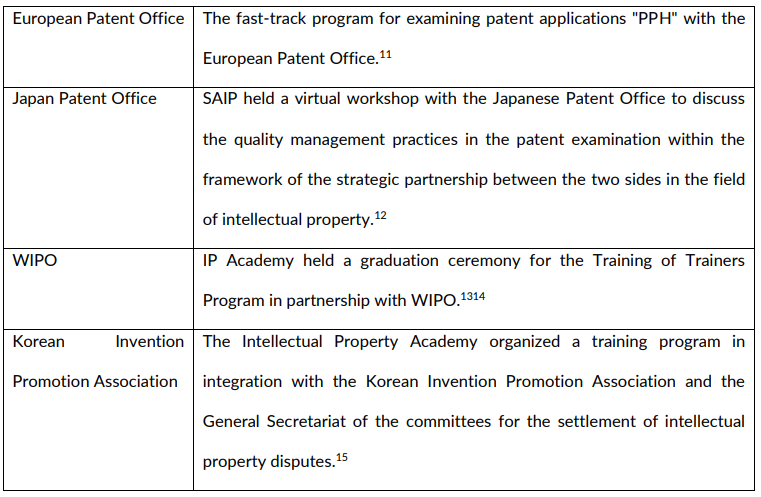
Moreover, Saudi Arabia’s efforts in IP Enforcement are witnessed through one of its programs “Intellectual Property Respect Officer” which aims to raise awareness and compliance, preserve intellectual property rights, and manage and maximize intangible assets in government agencies and commercial entities, by qualifying and training a representative from each government agency to be responsible for respecting intellectual property for the entity each represents. It is important to highlight that as per the Annual Report of 2021, a number of 76 IP respect officials were accredited by various government agencies, and many partnerships were concluded with the public and private sectors in various fields and sectors
It is worth mentioning that the “Intellectual Property Academy” of SAIP provided various workshops on March 2023 such as the training program for examining patent applications, which aims to enhance the practical skills and competence of patent examiners working in the main technical fields, Introduction to the Protection of Intellectual Property Rights in the Media Sector, Commercial Franchising and "Creativity of Patent Applications and the Mechanism of Benefiting from Examination Acceleration Programs", etc.
5. IT and system development
When it comes to the IT environment, SAIP has already handled most IP services through its online platform by relying on advanced informatization and has been in good shape for teleworking, virtual meetings, etc. Furthermore, according to the information provided, under the project named “Integrated IP Automation System”, SAIP is developing a new system, as part of the business automation improvement, to automatically maintain records for all applications, to improve SAIP's database, to advance S&E quality and to integrate external databases with the system.
It is important to highlight that all the services provided by the SAIP are carried out online through its portal, this includes but is not limited to the prosecution services of IP rights, conducting online searches for IP rights, as well as the Enforcement complaints.
- National Transformation Program “NTP” and the electronic system for Litigation
The Saudi government issued the National Transformation Program “NTP” 2020. The major achievements of the said program cover improving the quality of Justice Services through amending aspects of the judicial process by issuing new reconciliation rules, documentation law and the new commercial Court law and providing more than 150 services electronically via the “Najiz” portal, publishing legal principles and court judgments and implementing huge IT projects for digitalization and online platforms.
Also, the efforts of the Ministry of Justice in reforming the efficiency of the judicial and legislative system in Saudi Arabia are clear and follow the objectives of Vision 2030. The courts have increasingly moved to remote/ online systems and new matters have to be commenced through an online e-filing system and case progress is tracked and monitored through online platforms.
The Saudi Courts started using electronic summons or notifications in 2018 and consider them legal notifications. Moreover, hearing sessions are conducted online, either related to SAIP proceedings such as oppositions or the regular Court hearing sessions. The matter has enabled lawyers and courts to manage multiple daily hearings efficiently.
6. Establishment and Operation of joint projects and institutions
- Intellectual Property Respect Council
In 2020, the SAIP launched an initiative “Council for Respecting Intellectual Property” which aims to raise the level of communication with the private sector and discuss challenges, problems and opportunities to improve the authority’s services supporting the sector by holding periodic meetings with each sector. The said initiative comprises three councils of respect for intellectual property, as follows:
i. Council for Intellectual Property Respect for the Visual Production and Satellite Broadcasting Sector
With the aim of defining cooperation frameworks with the relevant authorities and providing the necessary support to protect rights holders and creating a method for effective communication between the relevant authorities.
ii. Council for the Respect of Intellectual Property for Trademarks
The participation of 49 entities from the public and private sectors, and the most prominent output was the establishment of a joint committee between the Saudi Authority for Intellectual Property and rights owners to cooperate in several fields. It was agreed to establish a center to monitor violations and issue periodic reports on enforcement and the most prominent modern methods of intellectual property violations.
iii. Council for Respecting Intellectual Property - Saudi Clubs
The most prominent outputs are the agreement to include Saudi clubs in the Intellectual Property Respect Officer Program.
- Standing Committee of Intellectual Property Rights Enforcement
The SAIP also establish the said committee which aims to improve the work of the enforcement ecosystem and enhance efforts aimed at developing work methods and procedures, achieving harmony and coordinating efforts between government and private agencies, by enforcing the yearning for intellectual property, and raising it to a level worthy of the status of the Kingdom.
- Partnerships with the Government Sector
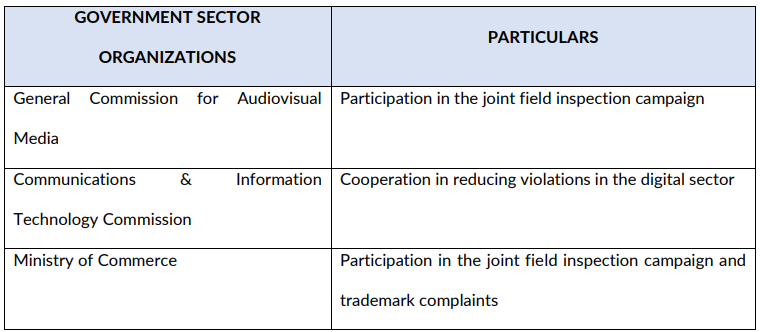
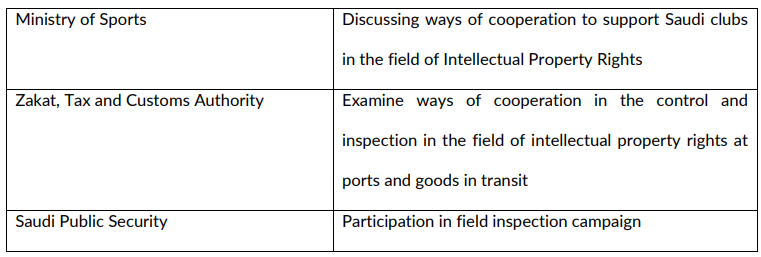
- Cooperation with the private sector
There is much cooperation with entities in the private sector in order to enforce intellectual property rights and limit infringements of intellectual property laws, particularly in the digital sector and e-commerce.
7. Conclusion of treaties and agreements
Saudi Arabia is a member state in many International Treaties such as:
- Patent Law Treaty (i.e. KSA is a member since May 3, 2013).
- Patent Cooperation Treaty (i.e. KSA is a member since May 3, 2013).
- Strasbourg Agreement (i.e. KSA is a member since October 16, 2020).
- Budapest Treaty (i.e. KSA is a member since October 16, 2020).
- Paris Convention for the Protection of Industrial Property - 1883 “Paris Convention” (i.e. KSA is a member since March 11, 2004).
- Saudi Arabia also holds patent prosecution highway (PPH) agreements with the United States, South Korea and Japan. A PPH pilot program was recently launched with the European Patent Office.
- The Locarno Classification, established by the Locarno Agreement – 1968 (i.e. KSA is a member since September 3, 2020.
- WTO Agreement on Trade-Related Aspects of Intellectual Property Rights - 1994 “TRIPS Agreement” (i.e. KSA is a member since 29 May 2012).
- Nice Agreement Concerning the International Classification of Goods and Services for the Purposes of the Registration of Marks (i.e. KSA is a member since July 22, 2021).
- Vienna Agreement (i.e. KSA is a member since December 3, 2020)
- Convention Establishing the World Intellectual Property Organization “WIPO Convention (1967), amended in 1979” (i.e. KSA is a member since February 22, 1982).
- Berne Convention for the Protection of Literary and Artistic Works 1971 (Berne Convention), i.e., Saudi Arabia is a member.
- Arab Convention for the Protection of Copyrights
- The Marrakesh Treaty for the purpose of reproduction, distribution and published works in accessible formats that serve persons who are blind, visually impaired, and print disabled
- Universal Copyright Convention
It is important to highlight that Saudi Arabia has not yet ratified some important international agreements, such as: the Madrid protocol, Hague Agreement Concerning the International Registration of Industrial Designs, WIPO Copyright Treaty (WCT), WIPO Performances and Phonograms Treaty, UPOV Convention for plant varieties. However, the SAIP is currently studying the appropriateness of the Kingdom of Saudi Arabia's accession to a number of international intellectual property agreements including but not limited to the following: Convention for the Protection of Producers of Phonograms Against Unauthorized Duplication of Their Phonograms, and the Madrid Protocol Relating to the Madrid Agreement Concerning the International Registration of Marks
8. Conclusion of MOCs/MOUs
SAIP has extended its cooperation with international partners and signed 7 Memorandum of Cooperation with the Korean Intellectual Property Office (KIPO), the US Patent and Trademark Office (USPTO), China National Intellectual Property Administration (CNIPA), Japan Patent Office (JPO), European Patent Office (EPO), the United Kingdom Intellectual Property Office (UKIPO), and the European Intellectual Property Office (EUIPO) This is in addition to signing TISC and IPTI cooperative programs with the World Intellectual Property Organization (WIPO). These MOUs focus mainly on the exchange of expertise and capacity building, which is crucial to becoming an IP hub in the MENA region. In addition to capacity building, two Data exchange programs have been signed: one between the Saudi Authority for Intellectual Property (SAIP) and the Korean Intellectual Property Office (KIPO) and the other with the Japan Patent Office (JPO). SAIP also has signed 4 PPH programs with KIPO, JPO, USPTO, and CNIPA to enhance work sharing and provide a fast track for Patent applications.
Regarding intellectual property matters particularly with Japan, emphasizing the continuing cooperation and strengthening the relationship with the SAIP, a Memorandum of Cooperation (MOC) in the area of intellectual property, a Joint Statement of Intent (SOI) on the Patent Prosecution Highway (PPH) and Policy on the Use of Exchanged Intellectual Property Electronic Data were signed on October 21, 2019. The Japan Patent Office “JPO” intends to develop an environment in which Japanese companies’ IP rights are promptly and smoothly secured and appropriately protected in Saudi Arabia.
As to the national aspect, the SAIP has also signed a Memorandum of Cooperation with various other governmental entities like Ministries of Industry, Commerce, and Tourism together with local and foreign universities. Moreover, there are regular meetings and webinars during which the SAIP is raising awareness of IP protection, discussing ways of cooperation between SAIP and other authorities, challenges and proposed solutions for the enforcement of IP rights.

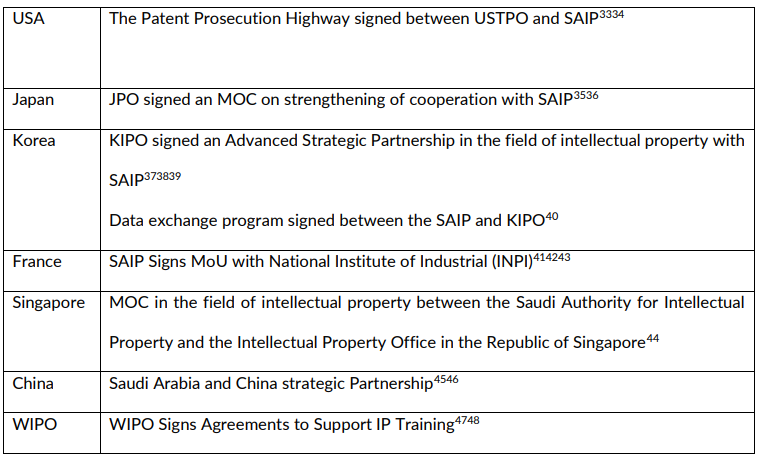
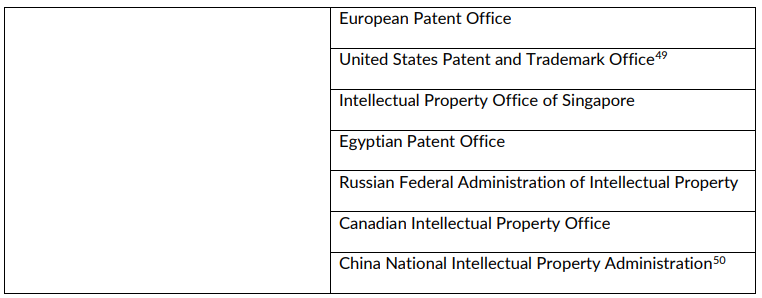
- ISA and IPEA Agreements:
Saudi Arabia has designated the following countries as ISA and IPEA Agreements to enable patent applicants to receive search reports for their PCT applications filed at SAIP and take the decision regarding entering the national phase.

9. Conducting forums and meetings
In 2021, as part of the international cooperation, a meeting was held with the American business sector in coordination with the American Chamber of Commerce, during which the efforts of the Kingdom of Saudi Arabia to develop the intellectual property ecosystem were reviewed, the efforts of intellectual property enforcement in the Kingdom were discussed, and the challenges facing the American business sector related to intellectual property were identified.
Moreover, the Kingdom's experience in enforcing intellectual property rights was presented with a number of enforcement authorities in the United Kingdom – the British Intellectual Property Office and London Intellectual Property Police as well as at the Embassy of the Republic of South Korea.
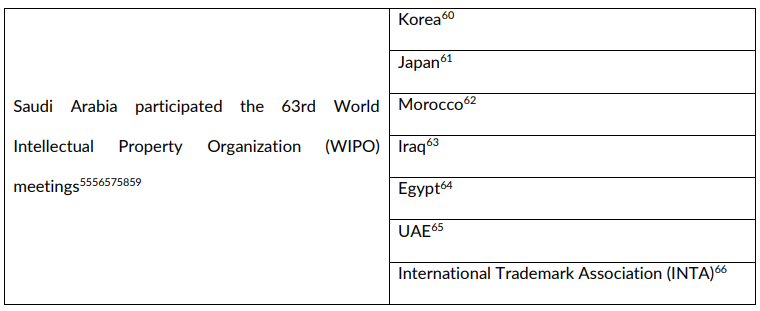
In 2022, the SAIP attended the 15th session of the Advisory Committee on Enforcement (ACE) at the WIPO headquarters to combat counterfeiting and piracy, contribute to the implementation of awareness campaigns on intellectual property, implement training programs, and exchange national experiences and information on intellectual property issues. Also, Saudi Arabia participated in the 63rd World Intellectual Property Organization (WIPO) meetings and had meetings with the following countries:
10. Conclusion
Saudi Arabia has been rapidly developing its IP environment in recent years and increasing its international presence. The Saudi Arabian Intellectual Property Authority (SAIP) plays an important role in promoting cooperation with IP agencies in various countries as part of its international efforts and actively pursuing accession to various IP treaties.
