


Foreword
"Dupe" is an Anglo-Saxon term that means "to deceive" or "to trick", ie. to give the appearance of something that is different from what it appears to be. In the current social and legal context, this term is increasingly being used to describe a cultural phenomenon that originated in the United States and has subsequently spread, very quickly, to Europe.
It refers to the practice of lesser-known brands gaining entry to the market by offering for sale products that are faithfully inspired by iconic or well-known models marketed by more popular brands. The dupe product is created to be as similar as possible to a designer product that is well- known by the public, but it can be purchased at a much lower price.
This phenomenon has important economic implications, with several large brands complaining that they have suffered significant economic damages because of its spread, and also raises the question of whether the traditional intellectual and industrial property tools are sufficient to protect IP right owners.
The industries most affected and the role of social networks and influencer marketing
Dupes are highly prevalent in the fashion and luxury industries, with the most imitated products falling into the categories of clothing, accessories, cosmetics and perfumery.
The phenomenon as a whole is spreading quickly, especially among young people and thanks to the key role of social networks. Indeed, there are many content creators and influencers who, being able to address their commercial communications to millions of users worldwide, reinforce the dupe trend by describing it as a successful sales model.
On the various social networks, in particular Tik Tok, videos with #dupe and #dupes hashtags have reached billions of views. The purpose of this content is to draw the attention of followers to a product.
which is a replica of an original product that is particularly popular and highlight that the purchase of the dupe product is economically accessible.
Obviously, this phenomenon has the potential to cause considerable economic damages to companies in the fashion and luxury industries, especially now when counterfeit goods are easily accessible on e-commerce platforms.
By way of example, Bottega Veneta's "Drop" carrings are a very popular product marketed by the well-known Italian company for the 2022-2023 autumn-winter season are a recent victim of the dupe phenomenon. The "Drop" earrings feature an original teardrop shape, are decorated with a gold finish and have a purchase price starting at 500 Euros, depending on the size of the model.
As is often the case with trendy and expensive products, third parties copied the "Drop", selling imitation products that are aesthetically identical or highly similar, but offered at a much lower price point. Indeed, oue dupe of Bottega Veneta's "Drop" carrings - the Chunky earring by Chritice-can be bought on Amazon for less than 20 euros.

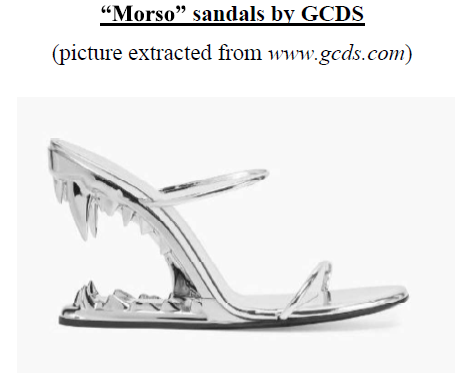
Maintaining focus on the fashion industry, the creative director of the brand GCDS recently launched a severe attack on a company engaged in the sale of low-cost fashion products online, called Shein, which sold platform sandals that slavishly imitate the famous GCDS "morso" (translated as "bite") sandals, reproducing the relevant shapes without any meaningful variation.1
Examples of dupe products are also abundant in the cosmetics and perfume industries, where the most imitated perfumes are "Burberry pour femme" and "Gucci Bloom".
The protection of industrial and intellectual property rights
The dupe trend gives rise to various legal issues, primarily that the manner in which dupes are offered on the market causes considerable damage to companies by infringement of their distinctive, and well-known, signs.
As indicated, a characterizing element of the dupe phenomenon is that the "offending" parties often refer to the characterizing elements of the original product and the related distinctive signs in their commercial communications.
In such scenarios, it is worth noting that according to the relevant case law both in Italy and in the European Union the comparative use of trademarks does not fall within the scope of trademark limitations provided under Article 14 of the European Union Trademark Regulation (EU Reg. No. 1001/2017-"EUTM Reg. " ) or Article 21 of the Italian Intellectual Property Code (Legislative Decree no. 30 of 2005-"IPC" ) However, these uses can be qualified as an infringement of trademark rights under Articles 9(2)(a) of the EUTM Reg.
Indeed, the invocation of a well-known brand for marketing a dupe product almost always implies a juxtaposition of high-end distinctive signs and products with lesser quality goods, which cause a potential erosion of the attractiveness of these distinctive signs.
In most cases, the companies that need to protect their rights against the dupe phenomenon are owners of registered trademarks with a certain degree of reputation. Accordingly, these trademark proprietors will be able to benefit from the enhanced protection provided for under Article 9(2)(c) of the EUTM Regulation or Article 20(1)(c) of the IPC.
These provisions provide that the owner of a well-known trademark is entitled to prevent a third party from using a sign identical or similar to its own trademark on the market, regardless of whether it is used for goods or services that are identical or similar to those for which the trademark is registered, when said use allows the third party to take unfair advantage of, or causes detrimental to, the distinctive character or the reputation of the trademark.
Even where there are no explicit references to the figurative or word trademarks of the brands owners, IP rights can be an important tool in cases where the dupes reproduce the shape of the products.
Naturally, if the relevant requirements are met², the shape of a product can be protected as a trademark (in some jurisdictions, even without registration).
A particularly unique product shape can also be protected by industrial designs, which covers the appearance of the whole or a part of the product, as resulting from the features of its lines, contours, colours, shape, surface texture and/or materials and/or its ornamentation.
To be eligible for protection as an industrial design under the Regulation on Community Designs 2002/6 the subject matter must be new and have individual character³. Registration of the design is not necessary, as the EU regulatory framework protects both registered and unregistered designs.
The duration of protection of an industrial design varies between registered and unregistered designs. While an unregistered design enjoys protection for three years from the date on which it was first disclosed to the public, the initial duration of a registered designs right is equal to five years from the date of filing of the application for registration. The registration can be renewed four times, up to a maximum of 25 years total protection.
Moving on, a particularly creative product shape can also be protected by Copyright. For example, Article 2(10) of the Italian Copyright Law (Law No. 633 of 1941) provides that clothing, accessories and jewellery products can be qualified as protectable works of authorship, provided that they fulfil the requirements of creative character and artistic value.
A final tool for protecting the shape of innovative products is unfair competition, which can be used separately, or in conjunction with the types of protection described above.
Italian law distinguishes four types of acts that constitute unfair competition, including slavish imitation, defined at Article 2598(1) of the Italian Civil Code. Slavish imitation occurs when a competitor faithfully imitates the distinctive external features of a product, causing confusion among consumers and, in doing so, gains an unfair advantage of the reputation of the imitated product.
This scenario is limited to the external features that have an individualizing effect, i.e. those which can distinguish the product of one company from those of another, and therefore enable consumers to associate a product with a certain company. This form of legal remedy can be used to protect all of the specific features of a product, such as its external shape, colours and packaging (the so-called "lookalike" cases).
To contrast, all other shapes that are not distinctive and/or are determined by the necessity for the product to perform the function for which it is designed are free to be reproduced by competing companies.
In relation to the dupe phenomenon, unfair competition by slavish imitation can be invoked whenever a dupe slavishly reproduces the original products, even in their formal and unnecessary elements, and thus causes confusion to the relevant public.
Concluding remarks
As described above, it is important that brand owners do not underestimate the risks posed by the dupe phenomenon, which has been fueled by the combined effect of influencers and large e- commerce platforms that promote these imitation products.
However, brand owners can be comforted by the fact that the traditional IP tools remain effective in fighting infringement and imitation products, provided that the brands owners themselves adopt adequate and preventive countermeasures. Indeed, in order to combat dupes, it is now more important than ever to protect the shape of iconic and creative products by registered intellectual property rights which, traditionally, are the most effective tools for enforcement initiatives.
