On 15 June 2022, the Fair Work Commission handed down its 2022 Annual Wage Review decision.
The key elements of the decision are:
- the national minimum wage will increase by 5.2% from $20.30 to $21.38 per hour from 1 July 2022; and
- a $40.00 per week or 4.6% increase, whichever is the greater, will apply to full-time minimum wage rates in modern awards.
Allowances will be increased in line with the formulas in awards.
The increases in modern awards commence from two different dates for different industries:
- from the first full pay period starting on or after 1 October 2022 – the following awards:
- Aircraft Cabin Crew Award 2020
- Airline Operations – Ground Staff Award 2020
- Air Pilots Award 2020
- Airport Employees Award 2020
- Airservices Australia Enterprise Award 2016
- Alpine Resorts Award 2020
- Hospitality Industry (General) Award 2020
- Marine Tourism and Charter Vessels Award 2020
- Registered and Licensed Clubs Award 2020
- Restaurant Industry Award 2020.
- from the first full pay period starting on or after 1 July 2022 – all other Awards.
However, if you have an enterprise agreement containing rates below the new award base rates under the Fair Work Act 2009 (Cth) (FW Act), you are required to pay at least the award rates.
Wage outcomes and trends
The national wage price index (WPI) shows that rates of pay (excluding bonuses) for all wage and salary workers across all industries in the private sector increased by 0.7% in the March 2022 quarter and 2.4% in the year to March in trend terms.
Data on enterprise agreement wage outcomes for the December 2021 quarter shows an average annual wage increase of 2.7% for private sector agreements and 2.3% for public sector agreements.
High-income threshold
The high-income threshold, which limits an employee’s eligibility to pursue an unfair dismissal claim (unless they are award or agreement covered), will also increase from $158,500 to $162,000 for dismissals that take effect from 1 July 2022.
The same figure is used for guarantees of annual earnings. An employer may provide such a guarantee to an employee whose earnings exceed this amount, and the effect is that an award which would otherwise apply to that employee does not apply. However, that employee remains covered by the award for the purposes of the unfair dismissal provisions.
The maximum compensation which can be awarded for unfair dismissal, which the FW Act stipulates is six months’ pay (capped at half the high-income threshold), will also rise from 1 July 2022 from $79,250 to $81,000.
It is important to remember that high-income earners still have access to other avenues to challenge a dismissal, including the general protections provisions in the FW Act, anti-discrimination legislation and the common law (e.g. breach of contract claims).
Superannuation Guarantee contributions
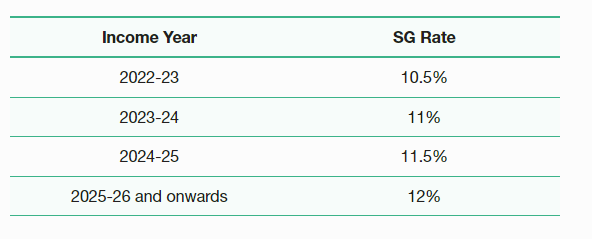
The Superannuation Guarantee (SG) rate will increase from 1 July 2022 from 10% to 10.5% and continue to increase annually until it reaches 12% on 1 July 2025.
Other threshold changes
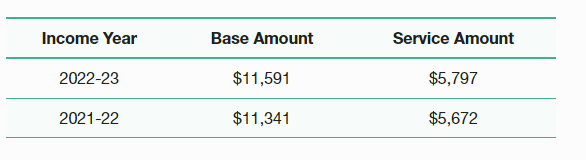
Tax-Free threshold for Genuine Redundancy – base amount and service amount
There are automatic tax-free amounts calculated according to a formula which specifies:
- a base amount; and
- an additional amount multiplied by years of completed service.
ETP cap
The ETP cap threshold will increase from $225,000 to $230,000 from 1 July 2022. The whole income cap remains at $180,000 as this is a non-indexed figure.
Maximum quarterly superannuation contribution base
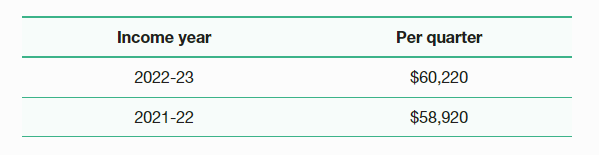
In accordance with section 9 of the Superannuation Guarantee (Administration) Act 1992, the maximum quarterly superannuation contribution base is indexed in line with AWOTE each income year. The new indexed amount is generally available each February.