


1. In August 2023, the Singapore International Arbitration Centre (“SIAC”) released a revised draft 7th edition of the SIAC Rules (the “Draft Rules”) for public consultation.
2. The Draft Rules are primarily aimed at improving the expediency and cost-effectiveness of arbitrations. Key changes include:
(a) a new “Streamlined Procedure” and a revised “Expedited Procedure” for low quantum or straightforward matters;
(b) expediting the emergency arbitration process; and
(c) a new set of rules for determination of issues on a preliminary basis.
New Streamlined Procedure and Amendments to the Expedited Procedure
3. A comparative table below summarises the differences in requirements and features amongst (i) the new Streamlined Procedure, (ii) the current Expedited Procedure, and (iii) the revised Expedited Procedure:
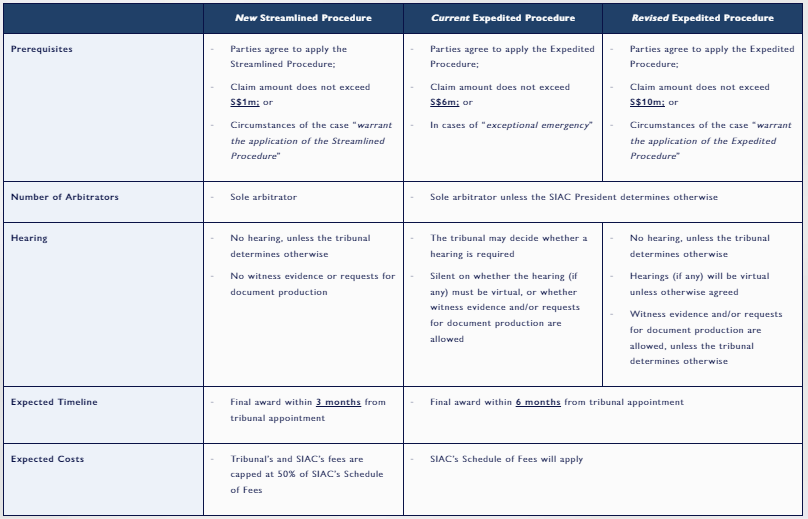
4. These new amendments are a welcome change for appropriate types of disputes, as parties can enjoy quick and cost-effective arbitrations while keeping proceedings private and confidential, a core benefit of arbitration. In particular, the Streamlined and Expedited proceedings would be suitable for low-value claims (i.e., below S$1 and S$10 million respectively) or claims which are of higher value but are relatively straightforward and/or involve limited or no factual disputes.
Changes to the Emergency Arbitration Process
5. The existing emergency arbitration procedure has also been updated to enable parties to enhance parties’ access to and speed of the mechanism.
6. Under the new Draft Rules, an application for an emergency arbitration can be made before the claimant commences the main arbitration (currently the emergency arbitration application must be made at least concurrently with the commencement of the main arbitration), and the emergency award must be issued within 10 days (instead of the current 14 days) of the emergency arbitrator’s appointment.
7. As emergency relief is typically sought by a claimant on an urgent basis to compel the respondent (i) to refrain from carrying out an act or (ii) to carry out an act in order to avoid suffering loss that cannot be adequately compensated by monetary means (e.g. where the respondent’s acts result in irreparable harm to the claimant’s reputation), these proposed changes to the process will boost the effectiveness of the emergency arbitration mechanism.
New Rules on Preliminary Determinations
8. A preliminary determination is a partial award made by the tribunal upon application by the parties to resolve, at a preliminary stage, certain key issues which affect other issues in the arbitration. The aim of such determinations is usually to streamline the rest of the arbitration by reducing the disputed issues and scope of the arbitration early on which will help parties save time and cost. A preliminary determination on such key issues may also be helpful for settlement considerations as there is now more clarity on where the merits lie and that may be an impetus for eventual settlement before the arbitration runs its full course.
9. While applications for preliminary determinations are customarily available to parties, the Draft Rules expressly codify the procedure, considerations and timeline for such an application. This lends greater clarity to the process, and should encourage parties to consider applying for a preliminary determination in appropriate cases – for example, where there is a key legal issue that materially affects the case, or where issues of liability and quantum can be bifurcated.
Concluding Remarks
10. These proposed amendments to enhance the expediency, cost-effectiveness and user experience of SIAC arbitrations are a welcome update to the SIAC rules which were last revised in 2016, and ensure that SIAC arbitrations remain relevant and attractive to international disputing parties.
11. As the consultation period on the Draft Rules has just come to an end in November, the Draft Rules (with minimal amendments, if any, based on the public consultation) are expected to come into effect in the first half of 2024.
