



On May 24, 2021, the Ninth Circuit in Hall v. Time dealt a significant blow to the plaintiff’s bar by rejecting several arguments routinely made in cases brought under California’s Automatic Renewal Law, Cal. Bus. & Prof. Code §§ 17600 et seq. (ARL).
The plaintiff in Hall claimed that Time Inc. and its parent, Meredith Corp., violated the ARL by renewing her People magazine subscription while failing to disclose the automatic renewal terms "in a clear and conspicuous manner" and in "visual proximity" to the request for her consent, and without first obtaining her "affirmative" consent. Cal. Bus. & Prof. Code § 17602(a)(1), (2).
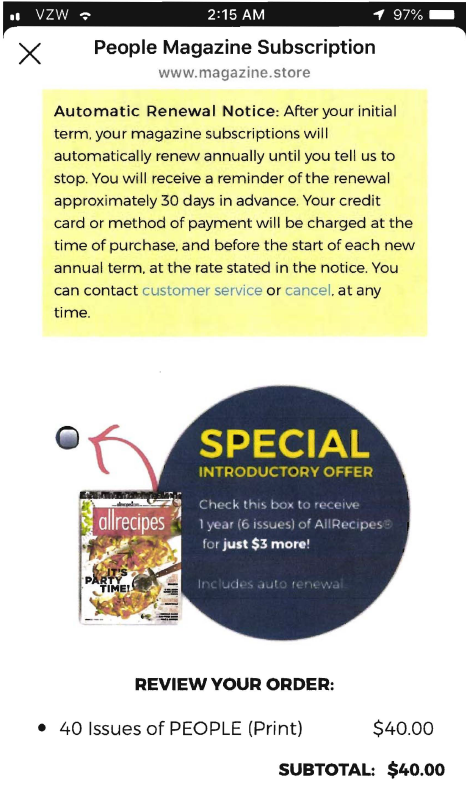
The district court had granted Defendants’ motion to dismiss, finding as a matter of law that the defendant did not violate the ARL, and the Ninth Circuit affirmed. The disclosure that both courts determined to be compliant appears as follows:
The Ninth Circuit's unpublished decision is based on several holdings, each beneficial to retailers who offer subscription programs.
First, the court held that Time's disclosure satisfied the ARL’s requirement that automatic renewal terms be "clear and conspicuous," because it appeared in a yellow text box with the bolded label "Automatic Renewal Notice" displayed at the top. Cal. Bus. & Prof. Code § 17602(a)(1). Given that it has now been blessed by the Ninth Circuit, retailers should consider adding similar design elements to their disclosures.
The Ninth Circuit next held that the disclosure complied with the ARL’s requirement that it be in "visual proximity" to the request for her consent, even though the terms were not directly above the form’s "Submit Order" button. Cal. Bus. & Prof. Code § 17602(a)(1). It was possible, for example, to scroll past the "Automatic Renewal Notice" and click the "Submit Order" button without having any automatic renewal terms on the screen. Regardless, the court explained that the statute "requires 'visual proximity,' not immediate adjacency," and that Time's disclosure satisfied this requirement.
The court also rejected the plaintiff's interpretation of the ARL's requirement that businesses obtain "the consumer's affirmative consent to the agreement containing the automatic renewal offer terms." Cal. Bus. & Prof. Code § 17602(a)(2). The plaintiff argued that the check-out page was insufficient because the ARL requires affirmative consent to the automatic renewal terms—not just consent to submit an order. While many retailers’ sign-up pages state, e.g., "By clicking 'Submit Order,' you agree…," the Defendants' "Automatic Renewal Notice" did not mention consent. (Even where the disclosure includes consent language, plaintiffs routinely argue such language is insufficient to satisfy the ARL's consent requirement and that, e.g., a check-box is required.)
Citing Supreme Court jurisprudence and California principles of statutory interpretation, the court rejected the plaintiff's attempt to "rewrite the statute:" "Had the legislature intended to require a consumer’s affirmative consent to the automatic renewal terms specifically, it could have omitted the words 'the agreement containing' from the provision. It did not, and we decline to rewrite the statute and impose a requirement that is absent from the text." Because the plaintiff in Hall consented to place her order, the consent requirement was satisfied.
Finally—and significantly for businesses that may not have complied with the ARL in the past—the court held that Time was able to cure its allegedly deficient original notice by sending a postcard to subscribers reminding them that their subscriptions would renew unless they cancelled. Retailers should therefore not hesitate to send updated notices if their previous notices could be bolstered.
California Supreme Court Upholds Decision in Mayron v. Google LLC
Hall is the second retailer-friendly ARL decision in the last several months. In December of last year, the Supreme Court of California denied review in Mayron v. Google LLC, cementing the Court of Appeal’s holdings that the California ARL does not provide a private right of action, and that the plaintiff could only state a claim under California's Unfair Competition Law (UCL) if Google's automatic renewal practices actually caused an actual injury to the plaintiff. See our alert about the Court of Appeal’s decision here. In light of Mayron, which is binding precedent, private plaintiffs cannot sue under the ARL merely for technical violations absent an economic injury caused by the violation.
Retailers Should Not Let Their Guards Down
Notwithstanding the terrific Hall and Mayron decisions, retailers should remain vigilant about automatic renewal compliance. In California alone, there have been over 75 ARL claims filed since January 2020, filed by both private plaintiffs and public enforcers. Moreover, New York recently enacted a comprehensive automatic renewal law that mirrors the California law (see our alert here), and the California legislature is considering even more stringent requirements. New legislation may escalate the already significant risk of litigation.
