On 1 January 2024, the Equality Act 2010 will be amended to reflect certain EU discrimination law principles which would otherwise have been lost as a result of Brexit. In this briefing, we explain the current position and how the legislation will change next year.
What’s the background?
A large proportion of the UK’s legal framework – including its employment law framework – was underpinned by the law of the European Union, primarily a type of law known as a “directive”. EU directives had to be implemented into UK law, either as an Act of Parliament or a statutory instrument. Certain other forms of EU law were directly applicable in the UK without the need for any implementing laws – for example, the rights set out in EU Treaties had what is known as “direct effect”. Decisions of the Court of Justice of the European Union were also binding on the UK.
Brexit required changes to be made to this legal framework. Acts of Parliament implementing EU directives remained in place. However, all the relevant statutory instruments were due to automatically fall away once the European Communities Act 1972 was repealed. To avoid legal chaos when Brexit happened, the Government decided to retain these statutory instruments and transfer them into UK law. It also chose to retain directly applicable EU law and decisions of the Court of Justice of the European Union made on or before 31 December 2020. Together, these laws and decisions were referred to as “Retained EU Law”.
However, the Government decided that the time was right to look again at whether Retained EU Law should be kept or repealed, and the Retained EU Law (Revocation and Reform) Act 2023 was passed this year to implement further change. The Act provides that Retained EU Law contained in around 600 statutory instruments and all directly applicable Retained EU Law will expire on 31 December 2023. On top of this, the Act makes a number of other provisions which are aimed at downgrading the continued impact of EU law on UK law, for example, by making it easier for the Court of Appeal and Supreme Court to depart from previous ECJ decisions and domestic decisions that have been influenced by ECJ decisions.
What does this mean for discrimination law in the UK?
UK discrimination law was not affected by the loss of Retained EU Law contained in certain statutory instruments. In fact, as far as employment law is concerned, only a handful of somewhat niche statutory instruments will be lost (you can read more about this in our briefing here). However, the loss of directly applicable rights and case law principles would have an impact on discrimination law.
To avoid uncertainty, the Government has taken action to ensure that existing EU discrimination law rights and principles are reflected in the Equality Act 2010 from 1 January 2024. Therefore, it is the form rather than the substance of the law that will change. Having these principles written down in the Equality Act 2010 should provide clarity to both employers and employees.
However, it is important to remember that EU law principles on discrimination law will continue to develop after 1 January 2024 and those new principles will not apply in the UK, nor be reflected in the Equality Act 2010. Therefore, a point will come where UK discrimination law begins to diverge from the position in EU member states.
What changes will be made to the Equality Act 2010?
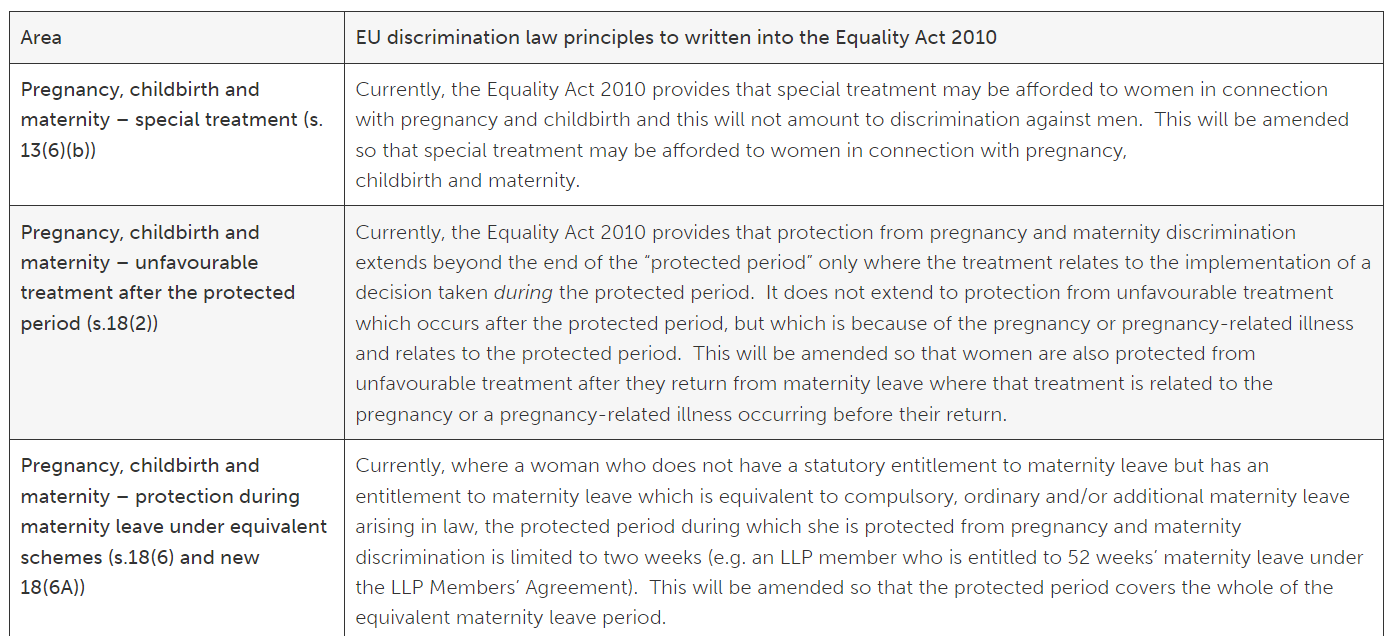
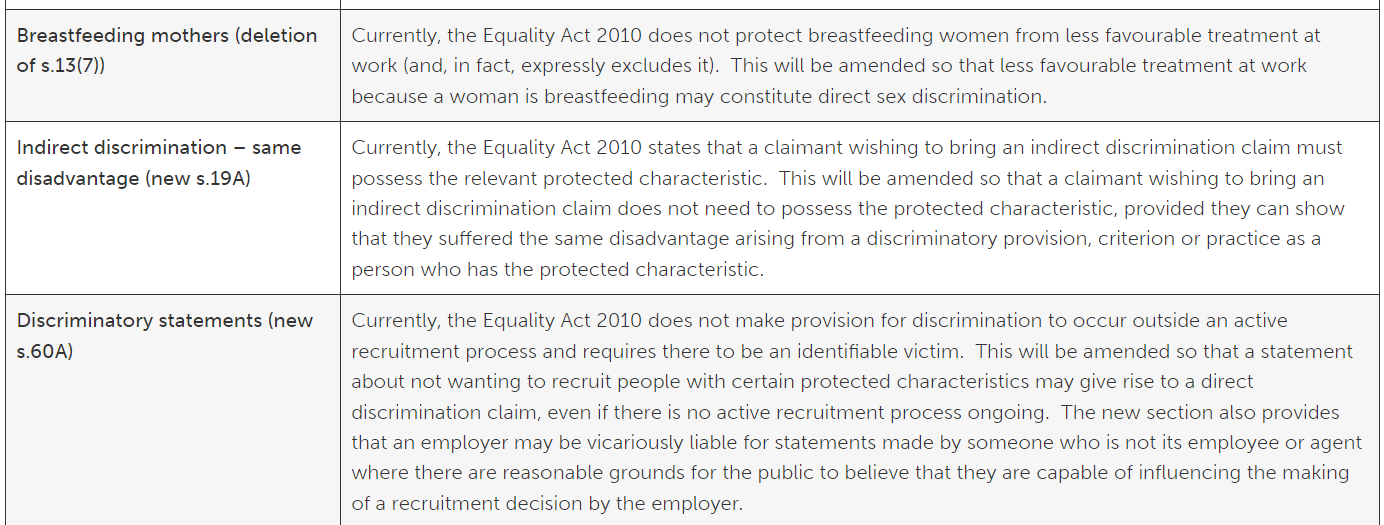
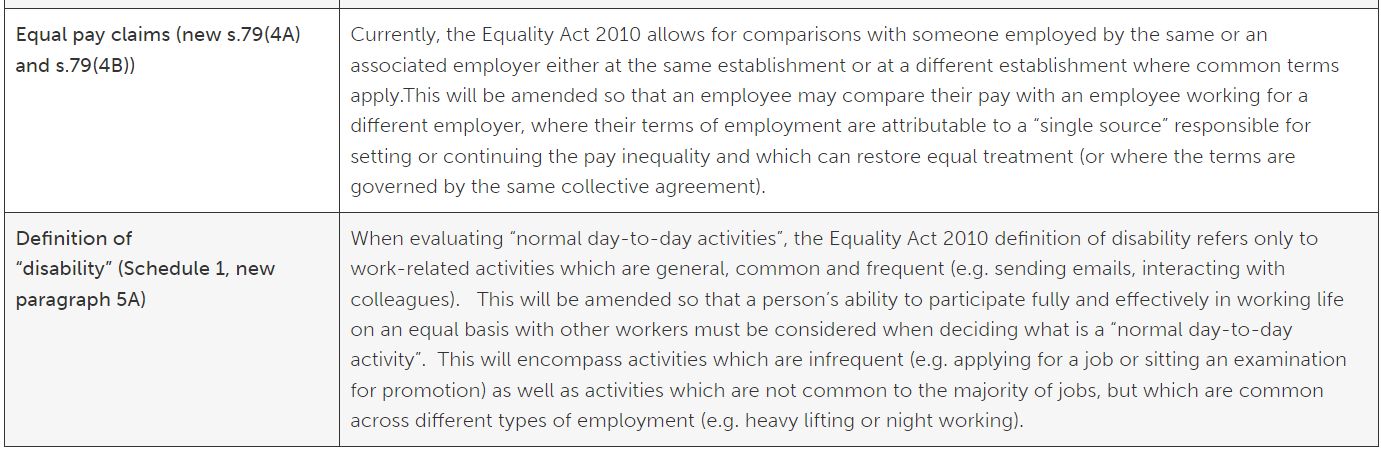
The table below summarises the changes that will be made to the Equality Act 2010 on 1 January 2024: