It is generally accepted that “sex sells”. It has also been claimed that “no publicity is bad publicity”, an idea floating around at least since 1890 when Oscar Wilde observed: "there is only one thing in the world worse than being talked about, and that is not being talked about". Combining these concepts often results in ‘shockvertising’ to create campaign ‘buzz’. However, with the world seemingly eager to hit the ‘cancel button’ at any given moment, we wanted to help clarify the UK rules around using sexualised imagery in advertising.
In a recent ruling, the UK's Advertising Regulator (the ASA) found that an advert for Demi Lovato’s latest album "HOLY FVCK" caused "serious and widespread offence". The advert featured the name of the album alongside images of Ms. Lovato in a bondage-style outfit reclining on a large, crucifix-shaped cushion. The advert was also found to have been targeted irresponsibly, with copies having been placed where children were likely to see them. In addition, the ASA found that the ad was likely to cause serious offence to Christians by linking a symbol of the crucifixion to sexuality. The ad was banned by the ASA, and the artist’s record label was warned not to cause widespread offence in the future.
Fashion brands too are known for "performance piece" campaigns, often featuring provocative and shocking advertising images (an interestingly similar example being French Connection UK's launching their FCUK acronym with the slogan "FCUKinkyBugger" in the early 00s). It can feel as if there is a fine line between ‘attention-grabbing’ and ‘offensive’ and the ASA is clear that the CAP Code is not necessarily breached just because some individuals are offended. But where exactly does this line start and how can brands ensure that they remain on the right side?
The basic UK rule is that advertisements must not “contain anything that is likely to cause serious or widespread offence” (CAP Code Rule 4.1). Advertisers will be relieved to note that sexualised imagery is not automatically deemed to cause offence. However, there are general areas to consider when assessing if “serious of widespread offence” will be caused:
- Offending specific groups - including those of a particular "religion or belief", "sex or sexual orientation" and "gender" among others. Similarly, innuendo that is used to demean a particular group is likely to be deemed by the ASA to cause offense;
- Sexual depiction of under 18s - including those who look under 18, is prohibited (this was increased from under 16s in 2018);
- Non-product related images – sexualised images in advertising for a fashion-brand are more likely to be acceptable than for patio furniture, the latter spills into ‘objectification’ which the ASA deems to be likely to cause offense; and
- Untargeted ads - what is suitable for adult viewing, will not be suitable for children and what is suitable for subscribers to a lingerie brand will not necessarily be suitable for the general public. Overly or explicitly sexual imagery is prohibited in outdoor, untargeted media (see for example the recent ruling against F&P GmbH, which involved outdoor ads for an online sex community, featuring people “wearing minimal clothing”); and images that are sexually suggestive must carry a placement restriction, so they do not appear within 100 metres of a school.
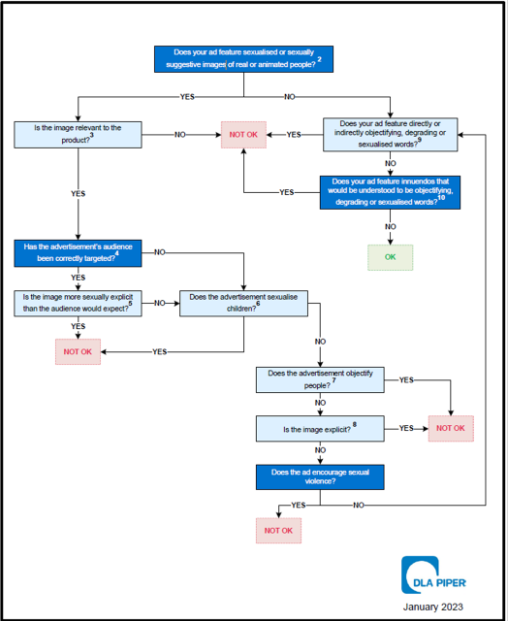
As well as considering their reputation, brands will need to consider the nuanced legal factors that apply if opting to use sexual imagery in their advertising. The categories above are the tip of the iceberg when it comes to the ASA’s position (which often changes to reflect society’s priorities; enforcement against adverts deemed to objectify women, for example, has increased hugely over the last ten years). To assist with this process, we have produced the flow-diagram below. This outlines in more detail the key concerns raised above. This is not a complete guide, nor should it be taken as legal advice; should you have concerns about specific content, we recommend speaking to your legal advisors.
Flowchart: Using sexualised images
In general, advertisements must not “contain anything that is likely to cause serious or widespread offence” (CAP Code Rule 4.1). Sexual imagery is not automatically deemed to cause offence, however it “must not be used in a way which is likely to cause serious or widespread offence”. This is a difficult line to tread,¹ as what is offensive can be very subjective. However, for brands who advertise to a large number of people, there are objective requirements that should be followed to ensure that any sexual imagery is: (i) generally appropriate; and (ii) seen only by an appropriate audience.