

Whether you are on an organized growth trajectory or are just starting, the legal structure would serve as an essential part of running a business. Every company in India must be registered under the Companies Act 2013. For this purpose, every establishment must understand its options and have a legal structure that is permitted by the Indian government. There are several different types of companies in India that range from sole proprietorships to public limited companies, each with their unique characteristics and advantages. One must choose the best legal structure from permitted models to do business and achieve success. In this article we discuss different types of business structures in India, what they are, their features, their benefits and more.
Choosing the right legal structure is aligned to the goals of the entity and the local and central laws where it desires to establish its base. Well-defined goals enable the entity to pick up the best legal structure for the fulfilment of such goals.
Sole Proprietorship
A sole proprietorship is as the name suggests, a single person ownership. It is a fairly simple and informal business structure. The ownership and operation in this structure is in the hands of an individual. It does not require formal registration.
- Legal Identity: Not separate from the owner
- Liability: Unlimited personal liability
- Taxation: Income is taxed as personal income
- Compliance: Minimal; no mandatory filings or audits
- Registration: Optional, but GST registration may be required
This is best suited for freelancers, consultants, small traders, and local service providers. It is easy to start, is low cost and gives full control. However, there is no legal separation, limited funding options and high personal risk involved.
Partnership Firm
A partnership firm is formed when two or more individuals agree to share profits and responsibilities. The Indian Partnership Act governs this structure.
- Legal Identity: Not distinct from partners
- Liability: Joint and unlimited liability
- Taxation: Taxed as a partnership under the Income Tax Act
- Compliance: Low; registration is optional but recommended
- Agreement: Partnership deed outlines roles, profit sharing, and dispute resolution
This is appropriate for small businesses with shared ownership. It works on a simple structure, and allows sharing of responsibilities. However the liability unlimited, and the potential for disputes is always present. It also limits the potential for scalability.
Limited Liability Partnership
An LLP is mixed structure. It offers flexibility of a partnership along with the benefits of limited liability. The Limited Liability Partnership Act regulates this structure.
- Legal Identity: Separate from its partners
- Liability: Limited to the extent of contribution
- Taxation: Taxed as a partnership; no dividend distribution tax
- Compliance: Moderate; annual filings and audits required if turnover exceeds threshold
- Registration: Mandatory with the Ministry of Corporate Affairs
This structure is used by professional services firms, small startups, and joint ventures. While it works on limited liability and offers flexible management, lower compliance than companies, it still has limited funding options, less investor appeal compared to companies.
Private Limited Company
A private limited company is one of the most popular structures for startups and business that focus on growth. It offers a corporate identity and limited liability.
- Legal Identity: Separate legal entity
- Liability: Limited to shareholding
- Taxation: Corporate tax rates apply; dividend distribution tax may be applicable
- Compliance: High; includes board meetings, annual filings, audits, and ROC filings
- Ownership: Minimum 2 and maximum 200 shareholders
Most businesses including startups, tech companies, and businesses seeking external funding opt for this model. It offers credibility, access to VC but if often ridden with complex compliance and high setup and maintenance cost.
One Person Company
This structure allows a single entrepreneur to enjoy the benefits of a corporate structure.
- Legal Identity: Separate from the owner
- Liability: Limited to the shareholder’s investment
- Taxation: Taxed as a corporate entity
- Compliance: Similar to private limited, but with exemptions for board meetings
- Ownership: One shareholder and one nominee
One person companies are usually sought by solo entrepreneurs wanting formal structure. It offers a corporate identity to an individual run business and works on limited liability principle. Some disadvantages include restrictions on fundraising and limited threshold of turnover.
Public Limited Company
A public limited company is suitable for large businesses that intend to raise capital from the public and list on stock exchanges.
- Legal Identity: Separate legal entity
- Liability: Limited to shareholding
- Taxation: Corporate tax rates apply
- Compliance: Very high; includes SEBI regulations, public disclosures, and governance norms
- Ownership: Minimum 7 shareholders; no maximum limit
Only large corporations, infrastructure firms, and businesses seeking IPO fall in this category. It opens avenues for the business by allowing inflow of public capital. However, it is burdened with stringent compliance and regulatory scrutiny which makes governance very difficult.
Section 8 Company
A Section 8 Company is a non-profit entity formed for charitable, educational, religious, or social purposes. It is governed by the Companies Act, 2013.
- Legal Identity: Separate from its members
- Liability: Limited
- Taxation: Eligible for tax exemptions under Section 12A and 80G of the Income Tax Act
- Compliance: Moderate; includes annual filings and audits
- Profit Distribution: Profits must be reinvested in the mission; no dividends allowed
Mostly NGOs, foundations, and social enterprises opt for this structure. It gives legal credibility to the organisation. This structure offers various benefits in the form of tax exemptions and access to grants. However, it does not permit profit accumulation or distribution and is often heavily regulated with restrictions.
Joint Venture
A Joint Venture is a strategic alliance between two or more entities, which may be Indian or foreign. It is not a distinct legal structure but can be formed using any of the above entities.
- Legal Identity: Depends on chosen structure (LLP, company, etc.)
- Liability: Varies based on agreement and entity type
- Taxation: Based on the legal form adopted
- Compliance: Depends on structure and foreign investment norms
- Agreement: JV agreement governs roles, contributions, profit sharing, and exit strategy
This structure is best suited for tech businesses. This model makes expansion more resourceful. It is also opted for cross border collaborations.
The advantage this model offers is shared resources, access to new markets. However, it may present some challenges in the form of complex agreements, increasing potential for conflict, regulatory approvals etc.
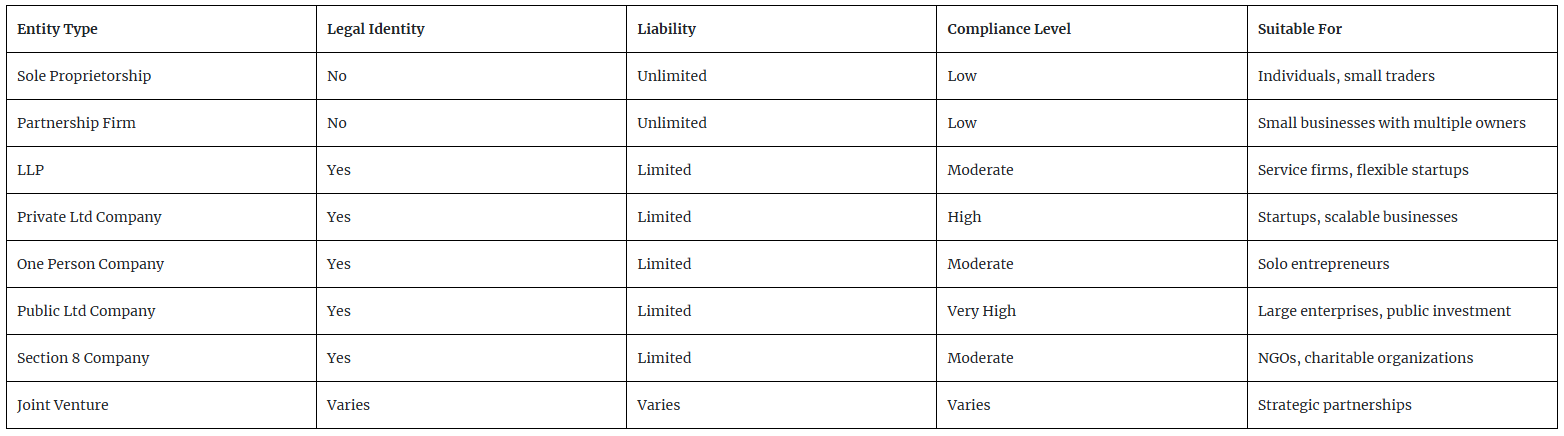
A brief overview:
 Conclusion
This article provides a brief overview of different legal structures. However, regardless of which business entity you think best suits you, a qualified lawyer is most suitable to address such questions. Nowadays more and more entrepreneurs decide to settle for do-it-yourself legal websites or the ones that incorporate structures in bulk, which are forbidden from giving legal advice, for a reason and this creates difficulties for business owners at a later stage. Don’t skip on business structuring legal advice. It is the smartest investment you’ll make before launching your venture.
