


The BREXIT brings under the spotlight the eternal ongoing debate on the concept of “frontier worker”.
Taking “arms against a sea of troubles”, will address the definition of frontier worker from the perspective of the right to stay and work, and from the perspective of social security coordination, when necessary illustrated by examples.
1 The concept of frontier worker before and beyond the BREXIT
1.1 Social security coordination regulations
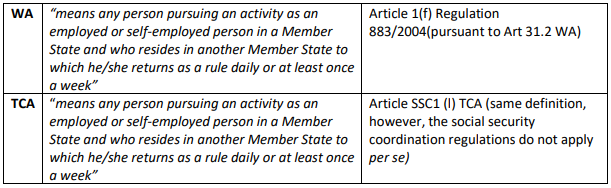
Formal definition: “means any person pursuing an activity as an employed or self-employed person in a Member State and who resides in another Member State to which he/she returns as a rule daily or at least once a week” (Article 1f Regulation 883/2004).
Practical definition: from the perspective of the social security coordination regulations, a worker is deemed to be a frontier worker, if the Member State (MS) competent for social security, and the MS of residence are not the same MS.
As regards the concept of residence, it is essential to distinguish between on the one hand, habitual residence in the meaning of Article 11 Regulation 987/2009, and on the other, the obligation to register residence with the relevant authority of a MS.
Examples of atypical frontier workers:
- ” reverse frontier worker” - German (and Czech) national, initially worked in Switzerland for a Swiss employer and resided in Germany, subsequently was transferred by the Swiss employer to work in Germany, and transferred his residence to Switzerland (see C-241/14 Bukovansky)
- posted worker in a situation of frontier worker as well- a worker employed and habitually residing in Belgium, is posted to Italy for an anticipated period of four years (exceeding the anticipated period of maximum of 24 months from Article 12 Regulation 883/2004). He is moving to Italy together with his family, cancels the rental agreement in Belgium, and consequently cancels the registration in Belgium as well. The case is addressed under Article 16 Regulation 883/2004. The MS competent for social security remains Belgium, however the residence in the meaning of Article 11 Regulation 987/2009 is “transferred” to Italy
1.2 Right to stay and work
The definition of frontier worker from the State of work’ national legislation must be considered.
From the EU perspective, as regards EU nationals and third-country nationals (TCN) residing within the territory of a MS and working in another MS, a common definition is “any person pursuing an activity as an employed person in a Member State and who resides within the territory of a neighboring Member State to which he/she returns as a rule daily or at least once a week”.
It must be noted that the “neighboring MS” criterion is not always contained by such definitions.
As regards third-country nationals, it must be distinguished between frontier workers (residing within the territory of a MS and working in another MS), and TCN residing outside the EU territory and admitted to work for a period does not exceed 90 days in any 180-day period. The latter are not frontier workers.
2 BREXIT
Situations initiated before 31 December 2020, and continue without interruption after that date, must be addressed from the perspective of the Withdrawal Agreement (WA).
Situations initiated as of 1 January 2021, must be addressed from the perspective of the EU-UK Trade and Cooperation Agreement (TCA). 2.1 Right of entry, work and exit (State of work)
2.1.1 Withdrawal Agreement
i) Definition of frontier worker:
"frontier workers" means Union citizens or United Kingdom nationals who pursue an economic activity in accordance with Article 45 or 49 TFEU in one or more States in which they do not reside (Article 9b WA-emphasis added)
Employed workers are “covered” by Article45 TFEU, self-employed workers by Article 49TFEU.
ii) Frontier workers beneficiaries of the WA:
“Union citizens who exercised their right as frontier workers in the United Kingdom in accordance with Union law before the end of the transition period and continue to do so thereafter” (Article 10c WA)
“United Kingdom nationals who exercised their right as frontier workers in one or more Member States in accordance with Union law before the end of the transition period and continue to do so thereafter” (Article 10d WA)
Employed workers-examples
- “classic case”: residence in a State A and work in one or more other States, except for the State A-situation covered by the WA (provided that the conditions under Article 10c or 10d are met). The State A can be the UK and the other States, one or more Member States. The State A can be a MS (e.g., France) and the other States, one of the other MS (e.g., Belgium and Luxembourg)
- multiple employment contracts or “global employment” (coordinated employment contract) -residence in a State A and work partially in the State A, and partially in one or several other States -e.g., UK employee residing in the Netherlands and employed simultaneously by a Dutch company (70%) in the latter country, and by a Belgian company, in Flanders (30%)- the UK employee will be issued a residence permit in the capacity of resident worker beneficiary of the WA in the Netherlands, and one in the capacity of frontier worker beneficiary of the WA in Belgium
Self-employed workers-examples
- a person who resides in a State A, and pursues a self-employment activity in a State Bsituation covered by the WA
- a person who resides in a State A, and pursues a self-employed activity in the latter State while providing services in other States as well:
1 occasional provision of services – the person is covered by the WA only in the State A (and it is not considered a frontier self-employed worker in the other States)
2 provision of services through a secondary establishment (stable infrastructure) in the State B -the decision whether the self-employed worker is established in the other State (and consequently is deemed to be a self-employed frontier worker in that State), must be made considering the duration, regularity, and periodicity of the provision of services, on a case-bycase basis (see to that effect the ECJ ruling in Gebhard, C-55/94, paragraph 27)
From the UK perspective, the specific rules under the “frontier work permit” scheme must be addressed.
2.1.2 Trade and Cooperation Agreement (TCA)
Frontier workers are submitted to the national legislation of the State of work.
From the EU perspective, the UK is a third country -see the explanation that concern TCN under point 1.2.
From the UK perspective, the UK national legislation must be strictly considered.
2.2 Social security coordination
2.2.1 Definition (frontier worker)
2.2.2 Beneficiaries and determination of the applicable legislation
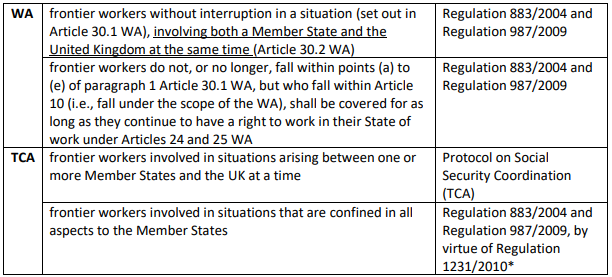
*” Regulation (EC) No 883/2004 and Regulation (EC) No 987/2009 shall apply to nationals of third countries who are not already covered by those Regulations solely on the ground of their nationality, as well as to members of their families and to their survivors, provided that they are legally resident in the territory of a Member State and are in a situation which is not confined in all respects within a single Member State”
Examples:
WA:
A UK national frontier worker, residing in France and working in Belgium, although referred to in Article 30.1, is not covered by the social security coordination regulations, because the situation does not involve both a MS and the UK at a time (see Article 30.2). However, if the frontier worker is beneficiary of the WA (pursuant to Article 10), the latter is subject to the social security coordination regulations by virtue of Article 30.3, as long as will she/he will continue to have the right to work in Belgium in the capacity of employed or self-employed worker (see Article 30.4)
TCA:
The same UK national frontier worker, residing in France and working in Belgium (situation initiated after 31 December 2020), will be covered by Article 11.3(a) Regulation 883/2004, by virtue of Regulation 1231/2010
