


In 2024, more changes in labour law are expected, which should be taken into account when planning the organization of the work process. Many of them are eagerly awaited by employees as they provide additional protection or rights in various situations. The changes are planned to come into effect throughout the year, so we cannot report on all of them at this early stage.
Below, you can find a brief summary of the most important labour law changes that will take place in 2024, along with recommended actions to adequately prepare for them by implementing the relevant tools in your organizations. We are making you aware of these changes now so that you can take the necessary steps to adapt your work processes to the new legal requirements well in advance.
We are constantly monitoring any remaining legislative changes that may occur during 2024, and as soon as we have reliable information, we will inform you of developments immediately. We encourage you to follow our website and TaylorWessing’s Poland profile on LinkedIn.
1. Minimum wage in 2024
As in 2023, the minimum wage in 2024 will increase twice. The minimum wage rates will be in effect from January to June 2024 and will change in the middle of the calendar year, from July to the end of 2024. The minimum wage rates that will be in effect this year are as follows:
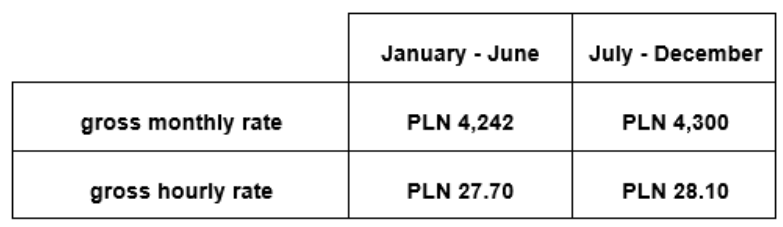
The increase in the minimum wage rates will affect not only the basic salary but also other employee benefits, the amount of which depends on the amount of the minimum wage. In particular, this applies to: (i) compensation for nighttime work; (ii) compensation for downtime; (iii) maximum amount of severance pay in case of termination of employment for reasons not attributable to the employees; (iv) compensation for violation of the principle of equal treatment in employment or for mobbing; (v) the basis for the calculation of social insurance benefits in case of sickness and maternity; or (vi) amount free from deductions from the employee's salary. It should be noted that the minimum wage rates also apply to civil law contracts (e.g. contracts of mandate PL: umowy zlecenia).
The projected average monthly gross salary in 2024 in the national economy will amount to PLN 7,824, which will mainly affect revision of the contribution assessment basis for pension and disability insurance, voluntary sickness insurance and the amount of the write-offs for the Company Social Benefits Fund. The annual contribution assessment basis cap for pension and disability insurance in 2024 will be PLN 234,720.
Recommended actions:
- Reviewing the amount of wages paid to employees and contractors.
- Adjusting the rates to the minimum wage requirement in 2024 and including higher amounts in the calculation of statutory employee benefits that depend on the amount of the minimum wage.
- Taking into account the new amount of the average monthly salary in the national economy in HR and payroll calculations.
Note: It will be necessary to go through the process again in the middle of the year after the next minimum wage rise in mid-2024.
2. Security for employees covered by special protection against termination throughout the course of labour law disputes in progress
In employment cases where an employee subject to special protection against termination of employment (e.g. pregnant employee, employee exercising parental rights, trade union activist or an employee at the so-called pre-retirement age) challenges the termination or seeks reinstatement, the labour court, at the request of the appealing employee, will grant security of employment by ordering further employment of the employee by the employer until the judgment in the proceedings has become final. The basis for granting security of employment will be only the plausibility of the existence of the claim. The labour court will only be able to refuse security if the claim is obviously unfounded.
Recommended actions:
- Compliance with the prohibition on the termination of employment contracts where the employees are covered by special protection against termination (this does not apply to cases of termination without notice through the fault of the employee and the conclusion of a termination agreement).
- Special care and due justification are required when changing the work and pay conditions of employees who are subject to special protection against termination.
3. The obligation to continue to employ the employee until the judgment is final in the event that the termination is declared ineffective or reinstatement is ordered
When declaring termination of an employment contract ineffective or reinstating an employee (any employee, not only an employee subject to special protection), the labour court will, at the employee's request, impose an obligation on the employer in the judgment to continue employing the employee until the dispute has been resolved. This change improves the situation of the employee in case the employer appeals against the judgment.
Recommended actions:
- Precise formulation of the reasons for termination.
- More frequent conclusion of termination agreements.
- Organizational openness to more frequent and difficult negotiations with employees in disputes with employers to reach settlement.
4. Lower court fees for employees bringing labour law proceedings
From the end of September 2023, labour law proceedings are less costly for the employees. Employees are not required to pay court fees on lawsuits filed with labour courts, even if the amount of their claim (the amount in dispute) exceeds PLN 50,000. Before September 2023, claims exceeding this amount resulted in having to pay court fees on lawsuits under general principles. Currently, employees are charged court fees only on appeals, complaints, cassation complaints and complaints seeking to set aside the final decision and only in cases where the amount in dispute exceeds PLN 50,000. This fee is charged on the amount in dispute above this level.
The abolition of court fees on claims in labour law proceedings will most likely encourage more employees than before to pursue their claims in the labour court, which may mean more frequent proceedings in labour courts for employers. An increase in the number of lawsuits in labour law cases will result in larger caseloads and longer waiting times for cases to be resolved. We can also expect a rise in the number of litigators who will make unfounded and/or exorbitant claims against employers. In particular, the number of appeals against termination of employment contracts and claims for overtime pay may increase. Employers will need to bear this in mind and may have to, to a larger extent than before, propose termination of the employment relationship by agreement of the parties on more favourable terms than by unilateral termination.
Recommended actions:
- Precise formulation of the reasons for termination.
- Preparing for longer negotiations with employees, creating space to work out conciliatory solutions in case of conflict situations with the employees.
- Awareness that employees are more motivated to assert their rights through the labour courts, so it is expected that, more often than at any before, it will be necessary to offer employees termination by mutual agreement, on terms more favorable than by unilateral termination.
5. Changes in occupational health and safety requirements (“OHS”) for workstations equipped with screen monitors
By 17th May 2024 at the latest, employers will be required to provide employees who use a portable computer system (such as a laptop or tablet) for at least half of their daily working hours with additional mandatory workplace equipment:
- a desktop monitor or a laptop or tablet stand, ensuring that the screen is positioned so that its top edge is at the employee's eye level, and
- an additional keyboard and mouse.
- Optionally, employers must provide additional workstation equipment - such as a disk station, printer, scanner, document holder, or footrest - if the employees request such equipment.
In addition, a chair and table that meet the parameters set forth in the Regulation of the Minister of Labour and Social Policy amending the Regulation on Occupational Safety and Health in Workstations Equipped with Screen Monitors (the “Regulation”) and other elements of basic workstation equipment, such as input devices or software with a user interface, remain mandatory elements of the workstation.
Under the updated Regulation, the minimum safety and ergonomic requirements for workstations equipped with screen monitors will be modified. These are detailed in the Appendix to the Regulation (the “Minimum OHS Requirements”). The most important aspects of the Minimum OSH Requirements include:
- Equipping the workstation in such a way that it does not cause undue strain on the musculoskeletal system and/or eyesight, and in such a way as to minimize sources of risk to the employee,
- adapting the technical parameters and settings of the screen monitor used, as specified in the Appendix to the Regulation,
- providing a separate matte keyboard of appropriate design, with contrasting and legible characters, and an additional mouse,
- providing a work surface with a matte finish and an appropriate design for the placement of workstation equipment, including varying the height at which the monitor and keyboard are placed,
- providing a stable, swivel work chair with an appropriate design, i.e., allowing for height and backrest adjustment and proper contouring. The chair's adjustment mechanisms should be easily accessible and simple to use, allowing adjustment by the worker while seated; and
- the use of appropriate lighting for the workstation that provides visual comfort and is appropriate for the type of work being performed.
- at the employee’s request, the workstation should be equipped with a footrest and a height-adjustable document holder.
In addition, employers will be required to provide employees with corrective eyeglasses or vision-correcting contact lenses as recommended by an ophthalmologist. Previously, this requirement applied only to eyeglasses. It is important to remember that this is not an additional benefit for employees but a mandatory health and safety component that follows directly from para. 8 of the Regulation.
With respect to remote employees, employers are not required to provide additional elements of a remote workstation. Pursuant to Article 67(24) § 1 of the Polish Labour Code, employers are required to provide remote employees only with work materials and tools, including technical equipment, necessary to perform remote work (e.g., laptop/tablet, monitor, keyboard, printer, relevant software, or office supplies). In contrast, an office chair or table is not considered to be an independent work material or tool, but rather is considered to be part of the equipment of the remote workstation that must be provided by the remote employee. This position was expressed by the Chief Labour Inspectorate in a letter dated 6th March 2023 (reference: GIP-GBI.0701.45.2023.3).
Pursuant to Article 67(31) § 7 and 8 of the Polish Labour Code, it is up to the remote employees to organize the remote workstation on their own, taking into account ergonomic requirements, to bring the remote workstation into compliance with the Minimum OHS Requirements, and to confirm to the employer that safe and hygienic working conditions are provided at the remote workstation. However, there is nothing to prevent an employer from deciding to provide remote employees with elements of equipment for their workstation, either by purchasing the relevant elements or by covering or fully or partially reimbursing the costs incurred by the employee for this purpose, in accordance with internal company regulations (regulations on remote work or an agreement to this effect). It will then be mandatory to provide remote employees with such elements of workstation equipment. Employers have discretion in this regard.
Recommended actions:
- Adapting workstations equipped with screen monitors to the new requirements, no later than mid-May 2024.
- Complying with medical recommendations and reimbursing the cost of not only eyeglasses but also contact lenses.
- Informing remote employees of the need to adapt to the new requirements for organizing a remote workstation equipped with a screen monitor, possibly considering supporting remote employees in adapting to the new requirements.
- Updating remote employees’ declarations on their being familiar with the occupational risk assessment and information containing the principles of safe and healthy performance of remote work.
6. Act on Protection of Persons Reporting Violations of Law, i.e., Whistleblowers
As announced by the Council of Ministers, works on the implementation of Directive 2019/1937 into the Polish legal system and the consequent imposition of additional obligations on entities hiring at least 50 people (i.e. not only employees, but also contractors and associates) is expected to be accelerated this year. The final draft act is expected to be published in Q1 2024, after which the draft act will be passed into law. It is expected to be enacted in the first half of the year, so it is important to pay attention to and prepare for the implementation of the additional obligations arising from it.
The main areas of the proposed Act on Protection of Whistleblowers include: (i) identifying the conditions under which whistleblowers will be covered by statutory protection, (ii) regulating the protective measures granted to whistleblowers, (iii) introducing rules for establishing an internal whistleblowing and follow-up procedure, (iv) setting the rules for external reporting of violations of the law to a competent public body, (v) setting out the rules for public disclosure of violations of the law, and (vi) defining the jurisdiction of public authorities in the whistleblowing and follow-up procedures. Fifteen mandatory areas have been identified that may give rise to a violation of the law through commission or omission by a potential perpetrator. The scope of the subject matter can be expanded in an individual whistleblowing procedure to include other non-mandatory areas (e.g., conduct inconsistent with ethical standards or reporting violations of the law in all matters relating to labour law cases, particularly unequal treatment, mobbing or discrimination, and other non-codified areas such as harassment or other unethical behaviour or acts inconsistent with the rules of social conduct in the workplace).
Fifteen mandatory areas have been identified that may give rise to a violation of the law through commission or omission by a potential perpetrator. The scope of the subject matter can be expanded in an individual whistleblowing procedure to include other non-mandatory areas (e.g., conduct inconsistent with ethical standards or reporting violations of the law in all matters relating to labour law cases, particularly unequal treatment, mobbing or discrimination, and other non-codified areas such as harassment or other unethical behaviour or acts inconsistent with the rules of social conduct in the workplace).
The proposed regulations bring in numerous other obligations that must be fulfilled to ensure compliance: (i) consulting the trade unions or employees’ representatives on the text of the internal procedures rule book; (ii) defining the rules for processing personal data; (iii) the possibility of authorizing an external entity to assume the obligations imposed by the proposed law if necessary; (iv) keeping a register of internal notifications on violations of law; (v) defining the follow-up actions to reports of violations.
Any whistleblower will be able to report violations to an external body bypassing the internal whistleblowing procedure, which should be made clear from the start. The draft Act provides detailed conditions for making external reports. Under the draft law, violations can be reported externally to the competent public authority. In case the competent public body cannot be determined, external reports are to be directed to the Ombudsman. Those external reports that may indicate that a crime has been committed will be made to the relevant provincial (or capital) police chief, while reports on potential violations of EU law, EU financial interests or tax issues can be made directly to the public prosecutor.
At the request of a whistleblower, a public body will be able to issue a certificate of whistleblower status and statutory protection.
Eventually, a whistleblower will be covered by statutory protection in the event of public disclosure of a violation of the law if they have first made an internal and then an external report and received no response within a set period of time or no follow-up action is taken.
Failure to comply with the obligations imposed (i.e. failure to implement the internal reporting procedure or establishing it unlawfully) or conduct contrary to the proposed law (i.e. obstructing, retaliating against, making a report or disclosing false information) will result in criminal liability - a fine, restriction of liberty or imprisonment for up to three years. These penalties depend on the alleged offence. It should be noted that failure to implement the internal reporting procedure on time or in full, or unlawful implementation, is punishable by a fine.
Recommended actions:
- Developing, consulting on and implementing an internal procedure for reporting violations of the law, according to the projected requirements.
- Including the mandatory elements of any internal whistleblowing procedure: (i) designation of an entity authorized to receive reports, (ii) identification of the ways in which reports will be communicated and processed, (iii) designation of an impartial entity authorized to verify the reports and undertake follow-up actions, including providing feedback to the whistleblower, (iv) obligation to acknowledge receipt of the report to the whistleblower within 7 days from date of its submission, (v) identification of follow-up actions that may be taken within the organization, (vi) maximum time limit for providing feedback to the whistleblower, max. 3 months from the date receipt of the report is acknowledged, and (vii) accessible and understandable information about the possibility of making an external report to the public body, law enforcement agency or ultimately to the Ombudsman.
- Ensuring that the manner in which personal data are processed in connection with the filing of a report of a potential violation of the law complies with GDPR and prevents unauthorized persons from gaining access to the information covered by the report and protects the identity of the whistleblower, the person to whom the report relates, and the third party named in the report.
- Employers will be able to conclude a contract with an external entity under which they will entrust the service of accepting reports, acknowledging receipt of reports, providing feedback and information on the internal procedure using technical and organizational solutions that ensure compliance of these activities with the proposed regulations. However, such contracts will not exempt employers from liability for failure to fulfil their statutory obligations. It will also be necessary to regulate the processing of personal data, as the external entity will be a separate personal data controller.
- Employers hiring between 50 and 249 people will be able, by separate agreement, to share resources for receiving and verifying reports and conducting investigations within one group. With that said, each employer will be required to keep a register of internal reports in-house (or authorize an external body to carry out this duty). Employers will be obliged to take appropriate follow-up actions as a result of the whistleblowing analysis.
- The proposed legislation will enter into force within 1 month from the date of publication of the Act in the Journal of Laws, while legal entities, the Ombudsman and public entities will be required to implement the relevant whistleblowing channels within 1 month from the date of entry into force of the Act.
7. Audits of the National Labour Inspectorate in 2024
The National Labour Inspectorate (“PIP”) plans to carry out a total of 60,000 audits in 2024. This will also be the year in which the PIP completes its three-year “Action Programme of the National Labour Inspectorate for 2022-2024”. In this programme, three priorities have been adopted at national level: a strategy for inspections and preventive measures in the construction sector, a strategy for chemical hazards control in the working environment, and a strategy for increased supervision over the workplaces.
New challenges for the PIP in the area of legal protection of work will include compliance with labour laws on working time and annual leave in local government units, as well as compliance with provisions on the company social benefits fund. New audited activities related to technical safety at work are planned in 2024 in the following industries: renewable energy sources (RES), heat and power plants using solid fuels (coal, biomass, RDF fuels), and the storage, sale and processing of scrap metal.
The PIP will continue to audit the list of workplaces where work is performed under special conditions or is of a special nature, as well as the records of employees performing work under special conditions or of a special nature. The PIP emphasizes that in 2024 it will pay particular attention to verifying compliance with the new legal solutions introduced into the Labour Code in 2023, including in particular the new rights of employees in relation to parenthood, the employment relationship and remote work. Inevitably, one of the most important tasks of the PIP will be to investigate the circumstances and causes of accidents at work - fatal, serious and collective. On the other hand, dealing with the employees’ complaints will remain a priority, in particular any indications of delays and underpayment of employees’ remunerations.
Recommended actions:
- Ongoing compliance with labour law, with particular emphasis on the areas most frequently audited by the PIP.
- Appropriate preparations for possible PIP audits, in particular by keeping complete, reliable and orderly records so that you have the relevant materials in the event of an audit.
- Familiarization with the Act on the National Labour Inspectorate or seeking legal advice to understand the employer's rights and obligations during the PIP inspection and the powers and duties of labour inspectors.
Note: Labour inspectors have the right to conduct labour law compliance audits without notice to the inspected unit and at any time of the day or night. Therefore, not every PIP audit needs to be announced. However, labour inspectors may give the employer advance notice of their intention to initiate an audit (by telephone, in writing or by e-mail). The way in which the audit is initiated is decided by the labour inspector, taking into account in particular the objectives to be achieved during the investigation.
8. ESG reporting in the field of labour law
Compliance with the ESG obligations will soon be mandatory. 2024 is a good time to take an interest in its implications for your business and the legal and labour issues that will be subject to non-financial reporting. Apart from the obvious need to ensure an appropriate, ethical and safe working environment in the organizations concerned, it will be important to document the implementation of these obligations.
It is worth noting that the obligation to prepare an ESG report for 2024 will be incumbent on large companies and companies that are public interest entities (i.e. entities operating under banking law, securities law, investment fund law, insurance and reinsurance law or law on the organization and operation of pension funds), employing a minimum of 500 people (and their balance sheet total exceeds PLN 85 million or annual revenues exceed PLN 170 million).
The obligation to prepare an ESG report for 2025 will also be imposed on entities that meet at least 2 of the 3 indicated criteria, i.e. employment of 250 people or more, a balance sheet total exceeding PLN 85 million or annual revenues exceeding PLN 170 million.
The obligation to prepare an ESG report for 2026 will be imposed on small and medium-sized enterprises listed on regulated markets that meet. at least 2 of the 3 indicated criteria, i.e. employment of more than 10 people, balance sheet total of more than PLN 1.5 million or annual revenues exceeding PLN 3 million.
At the initial stage of adjusting to the new non-financial reporting obligations, and in particular with regard to the related documentation requirements, the guidelines developed by Steward Redqueen with the support of the European Bank for Reconstruction and Development and the Warsaw Stock Exchange published in October 2023 in the report “Guidelines for ESG Reporting. A guide for companies”, the following factors are key in the context of the social dimension of sustainability and the impact of work culture: (i) recognizing the value of employees and providing them with good working conditions, (ii) complying with international labour standards, (iii) having a stable employment structure, and (iv) not infringing on employees' freedom of association and collective bargaining.
In light of the above, it is recommended that companies subject to ESG reporting have the following labour law policies: (i) diversity, (ii) employment, (iii) work-life balance and (iv) reintegration. It is also recommended to monitor the following employment areas: (i) equal pay index, (ii) labour turnover and (iii) freedom of association and collective bargaining. Another consideration is the monitoring of occupational health and safety, which is already one of the main obligations under the Labour Code.
It will also be important from a labour law perspective to ensure an appropriate ethical working environment, so the recommendations point to the need to develop an ethical code, an anti-corruption policy or a whistleblowing mechanism, which will be mandatory anyway when the relevant whistleblowing legislation is implemented.
Recommended actions:
- Analysis of existing non-financial reporting obligations, with particular emphasis on employment and ethical and safe working environment aspects.
- Preparation of an ESG reporting strategy, with particular emphasis on labour aspects.
- Verification of internal regulations (policies, procedures and rules and regulations), or identification of the need to develop relevant documents in the coming months / years.
9. Implementation of EU labour legislation
In the next few years, there will be a number of new labour law obligations that will revolutionize the process and organization of work and make it necessary for employers to take appropriate measures, including the implementation of appropriate mechanisms and relevant documentation in the entities concerned. This is such a far-reaching issue that it ought to be given full attention now while appropriate organizational strategies are developed as early as this year. Key EU legislation covers the following areas:
(a) Directive (EU) 2022/2381 of the European Parliament and of the Council of 23 November 2022 on improving the gender balance among directors of listed companies and related measures
The purpose of the Directive is to ensure a more balanced representation of women and men on the boards of listed companies by introducing effective measures aimed at accelerating progress towards gender balance, while allowing listed companies sufficient time to implement the necessary solutions. The provisions of the Directive should be implemented into Polish law by 28th December 2024 and will apply only to listed companies and will not apply to micro, small and medium-sized enterprises.
By 30th June 2026, listed companies should fulfill the incumbent obligations, i.e., establish parity in size:
- min. 40% of non-executive directors should be the underrepresented gender,
- min. 33% of all director positions (both executive and non-executive) should be filled by the underrepresented gender
Member States are required to ensure that the process of selecting candidates for directors is based on a comparative assessment of the qualifications of each candidate, using clear, neutral and unambiguous criteria, in a non-discriminatory manner and throughout the selection process, including when drawing up recruitment notices, at the pre-selection stage, at the shortlisting stage and at the pooling stage. Such criteria must be established before the selection process begins.
It is recommended to give preference to the candidate of the underrepresented gender when choosing between candidates who are equally qualified in terms of aptitude, competence, and job performance, unless other factors (e.g., legal considerations, internal diversity policies, as determined by an objective assessment that takes into account the specific situation of the candidate of the opposite gender and is based on non-discriminatory criteria) tip the scales in favor of the candidate of the opposite gender.
A Polish act implementing the Directive will have to set out rules for effective, proportionate and dissuasive sanctions for breaches by listed companies of the rules on parity in the bodies of listed companies, and provide channels for judicial enforcement of obligations under the Directive. Poland will be required to designate a body or bodies for the promotion, analysis, monitoring and support of gender balance on the boards.
The implementation of the obligations imposed by the Directive will be the subject of a report to the Commission by 29th December 2025, and every two years thereafter, each Member State will be required to submit an appropriate report on the implementation of the provisions of the Directive and the national legislation implementing it.
At present, the Polish draft law implementing the provisions of Directive 2022/2381 has not yet been published, but given that the deadline for its implementation is just before the end of 2024, we expect a draft act to be published soon, which should be taken into account when planning the process and organization of work in the new year.
(b) Directive (EU) 2023/970 of the European Parliament and of the Council of 10 May 2023 to strengthen the application of the principle of equal pay for equal work or work of equal value between men and women through pay transparency and enforcement mechanisms
The purpose of the Directive is to establish minimum requirements to strengthen the application of the principle of equal pay for men and women for equal work or work of equal value and the prohibition of discrimination in pay, in particular through pay transparency mechanisms and strengthened mechanisms for enforcing equal pay, irrespective of the gender of the employees. The provisions will apply to all employers in both public and private sectors. Polish regulations may exempt employers with up to 50 employees from certain obligations introduced by the Directive.
Employers will be required to have remuneration structures that provide equal pay for equal work or work of equal value. Remuneration structures must be such as to make it possible to assess whether employees are in a comparable situation with regard to the value of work on the basis of objective, gender-neutral criteria agreed upon with employee representatives, if such representatives exist. These criteria must not be based directly or indirectly on the gender of the employees. These criteria include skills, effort, responsibilities and working conditions, and other factors that are relevant to the job or position. They must be applied in an objective, gender-neutral manner that excludes any direct or indirect gender discrimination. In particular, relevant soft skills must not be undervalued.
As early as at the recruitment stage, candidates will have the right to be informed by their potential future employer of (i) the starting salary or salary range envisaged for the job, based on objective, gender-neutral criteria, and, where applicable, (ii) the relevant provisions of the collective bargaining agreement. This information should be provided in such a way as to ensure that candidates are able to negotiate salaries in an informed and transparent manner (e.g. in the job offer, prior to the interview, or by other established means). In addition, employers may not ask candidates questions about their salary in their current or previous employment.
Employers will be required to provide employees with easy access to the criteria that are used to determine employee compensation, salary levels and salary progression. These criteria will have to be defined in an objective and gender-neutral manner.
Employees must have the right to request and receive, in writing, information concerning their individual pay levels and the average pay levels, broken down by gender, for categories of employees performing the same work as they do or work of equal value to their work. If the information received is inaccurate or incomplete, employees will have the right, either in person or through their representatives, to request additional and reasonable explanations and details of the data provided and to receive a substantive response. Employers will be required to inform all employees annually of their right to receive information about compensation policies and the steps employees should take to obtain such information from their employers.
Employees will be able to disclose salary amounts for the purpose of enforcing the principle of equal pay, with employers being able to require that such information not be used for any purpose other than the exercise of employees' right to equal pay. Employees and employee representatives cannot be treated less favourably because they have exercised their right to equal pay or have assisted another person in protecting their rights.
Employers with at least 100 employees (although Polish regulations may change this number) are required to report the following information: (i) the gender pay gap, including supplemental and variable pay components; (ii) the median gender pay gap, including supplemental and variable pay components; (iii) the percentage of male and female employees receiving supplemental or variable pay components; (iv) the percentage of male and female employees in each pay quartile (i.e., each of the four equal groups of employees into which they should be divided according to their pay levels, from the lowest to the highest); and (v) the gender pay gap among employees by category of employees, according to the usual basic hourly or monthly wage and supplemental or variable components. The reliability of this information must be confirmed by the employee representatives, who must be given access to the methodology used by the employer.
Employees who consider themselves aggrieved by noncompliance with the principle of equal pay will be able to pursue their rights through the courts. Such procedures must be readily available to employees even after termination of employment. Polish legislation will ensure that any employee who has suffered damage as a result of a violation of rights or obligations related to the principle of equal pay will have the right to pursue a claim and obtain full compensation or reparation for such damage, as defined by Polish regulations.
Polish legislation will need to ensure that, in the event of a violation of rights or obligations related to the principle of equal pay, the labour courts may, upon the plaintiff's request and at the defendant's expense: (i) issue an order to cease the violation; and (ii) issue an order to take measures to ensure that the rights or obligations related to the principle of equal pay are applied. If the defendant fails to comply with the orders, the labour courts may impose a recurring fine to ensure compliance.
There will be an atypical, i.e. shifted, burden of proof in equal pay violation proceedings. It will be the defendant employer who will have to prove that there has been no direct or indirect pay discrimination when employees who consider themselves aggrieved by the failure to apply the principle of equal pay to them present facts to the labour court from which the existence of direct or indirect discrimination can be presumed.
It is expected that Polish legislation will introduce proportionate and dissuasive sanctions for violations of rights and obligations related to the principle of equal pay.
At the present time, the Polish draft act implementing the provisions of Directive 2023/970, which must be transposed into Polish law by 7th June 2026 at the latest, has not yet been published. In view of the additional obligations and the reorganization of the remuneration model in companies, we would like to draw your attention to the need to adequately prepare for the new challenges related to the principle of pay transparency. In companies that do not have a transparent remuneration structure, it is worth thinking now about gradually preparing for the implementation of this process.
(c) Directive of the European Parliament and of the Council on improving working conditions in platform work
In December 2023, the Council and the European Parliament reached a preliminary agreement on a proposed directive to improve working conditions through online platforms. If adopted, the legislation will establish mechanisms to determine the proper employment status of those working through online platforms and will formulate the first EU legislation on the use of algorithms in the workplace.
According to the agreed text, platform workers will be automatically presumed to be in an employment relationship (and not self-employed) if their employment relationship with the platform meets at least 2 of 5 specified criteria, i.e. (i) imposition of limits on remuneration, (ii) supervision of work performance, including by electronic means, (iii) control over the distribution or assignment of tasks, (iv) control over working conditions and restrictions on the freedom to choose working hours, and (v) restrictions on the freedom to organize one's own work and rules on the appearance or conduct of workers. In order to rebut the legal presumption, the platform will have to prove that in a particular case there is no employment relationship under national law and practice.
Platform employees have no transparent insight into how decisions are made or how personal data is used. According to the agreement reached, employees will be informed about the use of automated monitoring and automated decision-making systems. In addition, digital work platforms will not be allowed to use these systems to process personal data that: (i) relates to the emotional or mental state of a person working through an online platform; (ii) relates to private conversations; (iii) allows the prediction of actual or potential trade union activities; (iv) can be used to infer the racial or ethnic origin, migration status, political opinions, religious beliefs or health of the employee; and (v) contains biometric data (in addition to data used for authentication).
Under the proposed rules, these systems must be monitored by authorized individuals who are specially protected from adverse treatment. Human oversight will also cover important decisions such as account suspensions.
The agreement reached in December 2023 will have to be approved by the Council and Parliament. At that point, the actual legislative work and the need for both institutions to adopt the legislation will begin. Once adopted, Member States will have two years to implement the legislation into national law.
Source: compiled from EU Council press release, published on 13th December 2023.
