

This document is the culmination of a series of discussions that took place among the Leading Construction Lawyers International Alliance and several participants, including those listed below. Although the conclusions and recommendations set forth in this document represent the content of these discussions, the opinions and positions expressed do not necessarily reflect each individual contributor’s views. Readers should not construe the information contained in this document as legal advice.
1. Introduction
Formed in 2020 with the goal of providing a uniquely developed perspective, insight, and service to the global construction and infrastructure community, Leading Construction Lawyers Alliance (LCL) strives to share knowledge and insight in service of the industry. During early roundtable discussions among LCL’s founding team alongside prominent members of the international construction and infrastructure community, a single theme began to emerge—our participants were experiencing recurring frustration on design-build (DB) projects.
Although DB has been used, in some form, for at least 5,000 years, its modern resurgence as a formal delivery method has only lasted around 30 years in the United States. In that time, DB has proven to be a successful delivery method that allows owners to leverage the marketplace’s ingenuity to produce greater efficiencies and inventive solutions to project challenges. That is not to say that DB is right for all projects or all circumstances. At LCL, we were interested in exploring the causal relationships that lead to DB success or failure. In an effort to explore the reasons for challenges on DB projects, we commenced a series of roundtables beginning in early 2022 with a group of contractors. We followed this with a similar discussion among a group of individuals representing several large project owners in Europe and the United States. Ultimately, this process culminated with joint sessions involving owners and contractors alongside design community members.
We learned that recognizing the projects on which DB will be most advantageous; selecting and training the appropriate project teams (within both the owner and design-builder); and adopting better, more collaborative practices can generally cure challenges faced on DB projects. Both the strength and weakness of DB success is collaboration—genuine, meaningful teamwork in a partnership among the owner, design-builder, and designer that presents an opportunity for mutual investment in the project’s success. On DB projects, a team must tackle and solve problems in a way that leverages each project participant’s strengths. In short, the phrases “it’s not my problem” and “that’s your job” have little place on a DB project.
In this summary, we have approached the collaboration conundrum from two distinct perspectives that emanated from our joint sessions. Consequently, this summary presents the working group’s findings and best practices in two parts: Practical Collaboration and Contractual Issues. First, we examine the practical considerations associated with collaboration on DB projects, the hindrances to collaboration, and the way that these issues can be addressed, at least in part, in the DB setting. Second, we have examined the role of the contract, including how better risk allocation can help to achieve better alignment. Proper risk allocation and contractual terms are essential to create an environment ripe for better and more fluid collaboration. However, if inconsistent, they can be a critical source of difficulty.
In the following sections, we will elaborate on the concepts introduced above and suggest best practices for DB success. Our hope is that by highlighting the DB fundamentals, we can encourage the widespread adoption of better methods.
As a delivery method, DB is fundamentally different from traditional project delivery insofar as it requires a break from the more siloed approach employed in design-bid-build construction. In recognizing this, it is important that three factors remain present throughout the job:
(1) Assemble the right project team. While this requires the inclusion of an experienced design-builder, it is in many ways equally important to utilize an experienced and aligned team within the owner’s organization.
(2) Train teams in DB principles. Experience is invaluable, and where it is lacking, the use of outside resources, including a third-party facilitator, may be helpful.
(3) Maintain open communication and collaboration. Communication and collaboration must remain constant throughout the project.
The tone of collaboration is set much earlier in the process than most recognize—beginning with how the owner organizes itself internally, how it goes about procurement, and how it apportions risk in the parties’ contract. A contract that poorly allocates risk will place the parties at a distinct disadvantage when it comes to collaboration. For example, an owner who views the DB model purely as a vehicle to evade all design and construction risk is setting a course for a problematic project devoid of collaboration. Just as “risk dumping” can signal to the design-builder that the owner does not intend to collaborate, a contract that contains properly allocated risk and provisions designed to facilitate shared responsibilities can communicate to all parties involved that the owner will administer the project to provide the best opportunity for success. Properly allocated risk shows the parties that the owner has thought through its DB contract and that it is cognizant of the differences between DB and more traditional delivery methods.
2. Collaboration in Design-Build
While contracts may pay lip service to the concept of collaboration, it is up to the parties to prioritize collaboration. While project owners may be comfortable in the safe harbor of less collaborative means of project delivery, if they are going to embark on a design-build project, they should spend time preparing to organize and administer the project in a very different manner. Parties lacking experience should invest the necessary time and money learning the system and becoming immersed in how to perform differently.
This begins with understanding the essence of why and how the DB delivery method can deliver superior results. To the uninitiated, DB is simply a means of shifting the full responsibility of both the design and construction to one participant. This simplistic view both misses the true bene it and is the source of difficulty. On successful DB projects, the starting premise is that by bringing design and construction together early, the opportunity to collaborate and explore options as a team is present in a manner that does not exist in conventional design-bid-build delivery. This gives rise to a number of potential benefits:
- A design that accounts for constructability considerations, making it easier to deliver. The designer understands how the construction team plans to build the project, and the construction team understands the design. If done properly, the result will be less conflict and fewer claims.
- The possibility of fast-tracking the project. Early procurement and construction can commence as soon as sufficient design is available, without waiting for the design to be completed.
- Pricing can occur on an ongoing basis, thereby enabling adjustments to maintain budget expectations. This allows for design-to-cost as opposed to simply pricing the design.
2.1 Challenges to Effective Collaboration
Project difficulties can be anticipated where the parties have the following: (i) unclear roles in the project (e.g., “that’s not my job”); (ii) poor leadership (e.g., unclear strategy, lack of accountability, or shifting blame), (iii) a persistent claims culture (pushing difficult problems off until tomorrow); (iv) poor communication (which can be a product of turnover or internal turmoil), and (v) lack of training (a basic lack of understanding of the project delivery method). It is worth noting that these concepts apply equally to the owner and the designer as they do to the design-builder.
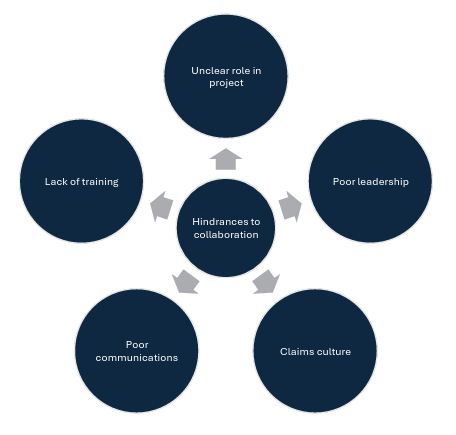
Each of these issues impairs the parties’ ability to work together effectively and, in many ways, creates a project culture focused on the good of the individual as opposed to the good of the project.
2.1.1 Lack of Clarity with Respect to Roles and Responsibilities Collaboration, as an overriding principle, consists of parties engaging with each other not only effectively but also efficiently. This necessarily requires that each party understands their respective role in the DB project.
We identified unclear roles, or roles not set out clearly in the contract, as one of the challenges to collaboration. This can lead to confusion within the project, duplication of efforts, and conflicts among team members. Regarding the latter, where conflicts arose, this usually led to a reinforcement of the claims culture and a starting point for the breakdown in collaboration. Project participants should consider using a responsibility matrix to outline explicitly the roles and responsibilities of key personnel on the project.
The use of a DB facilitator has been identified as a valuable tool to ensure all parties fully understand their roles throughout the project life cycle. We deal with this topic in detail (see Addressing Experience Gaps, Section 2.3.1 below)—it is essential for clarifying roles and for promoting and maintaining collaboration within the DB team.
2.1.2 Inadequate Leadership
Collaboration requires strong leadership with an understanding of the DB model. Without it, teams often lack direction, struggle with decision-making, and communicate ineffectively, all of which hinder effective collaboration. Poor leadership creates an environment where collaboration is unlikely to thrive.
The group agreed that collaboration requires buy-in from the organization’s top level (including from the corporate level within the owner, the design-builder, and the designer), which then filters down. Top-level buy-in sets the tone for collaboration and ensures that when problems arise (as they inevitably will), the DB team won’t revert to the “old way” of doing things. Early training for leadership on collaboration strategies will enhance the culture of collaboration for the project participants.
2.1.3 Claims Culture
The persistent claims culture sits at the opposite end of collaboration. The tendency to resort to litigation at the first sign of disagreement among stakeholders contributes to the construction industry’s reputation for budget and schedule overruns.
The group identified this as a major challenge to collaboration in a DB project. When disputes arise, the parties often abandon principles of collaboration as they revert to old methods to protect their interests. How, then, to move away from a claims culture toward one where collaboration is paramount? The group presented an interesting idea: apply lessons learned from alliancing models to non-alliancing projects. Alliance contracting may, but does not necessarily, involve the formation of a special purpose entity or joint venture approach, where all the relevant stakeholders have a shareholding or collective interest. The intention is that the parties will embrace risks in a more collaborative manner because interests are collective more so than individual.
When parties lack the option to revert to a claims culture, they are more likely to commit to collaboration during disputes. Promotion of early resolution mechanisms, such as dispute review boards or third-party facilitators, can encourage collaboration before conflicts escalate.
2.1.4 Ineffective Communication
Effective communication among project participants is key to successful collaboration on DB projects. Successful collaboration requires that project participants communicate effectively at all levels (project, management, and executive) and during all stages of the project. Designating a “design integration manager” to interact between the owner, contractor, and designer is one approach to improve communications.
Having a third-party facilitator with the required technical knowledge and communications skills and unaffiliated with any of the project participants can enhance the level of coordination and communication among project participants, particularly if the facilitator is engaged from the project’s start and conducts regularly scheduled meetings with all project participants during the project. To establish this role effectively, the facilitator position would need to be established and clearly laid out in the contract documents (see Addressing Experience Gaps, Section 2.3.1 below).
2.1.5 Training
Experience with the successful delivery of DB projects is one of the key predictors of DB success. In many ways, the topics discussed above—unclear roles in the project, poor leadership, claims culture, poor internal communication, and lack of training— all come down to a single root cause—a lack of experience with, and understanding of, the DB delivery system. In the absence of experience, parties often revert to that which they are most familiar with—in this case, the design-bid-build model. Resisting such an urge is crucial because it tends to be more adversarial and less collaborative and can eliminate the basic level of trust necessary for the success of the DB project. Accordingly, training and experience are essential for DB success.
By employing effective training measures, utilizing a team (within both the owner and design-builder entities) with a track record of DB success, collaboration, and clear communication can be made significantly less challenging. Training programs, which a “collaborative behavioral coach” can conduct, should begin before the project starts to promote alignment and team building among project participants and establish a culture of collaboration for the project’s duration. For greatest efficacy, training should not be limited to the project managers but rather should start at the highest levels of the owner and design builder teams and extend to field personnel. Training only for leaders and other senior personnel is a missed opportunity to generate everyday protocols and implement best practices at all levels.
Hiring practices are obviously an important ingredient to establishing a well-trained DB team. It is important to evaluate a prospect’s experience on successful DB projects and to understand how a given candidate approaches challenges and disputes in the DB context. Some participants also noted that they have segregated DB teams to allow their project teams to specialize solely on DB projects.
2.2 Best Practices for Effective Collaboration
(1) For DB success, it is critical that the parties acknowledge DB projects are different and adjust their thinking accordingly.
(2) Experience with, and an understanding of, successful, well-administered DB projects is paramount. Without that key component, parties may tend to revert to patterns of behavior that have proven successful in administering projects under other project delivery models, predominantly design-bid-build projects. This failure to adjust to the model can have a significant negative impact on the project.
(3) While collaboration is important on any construction project, it is critical to DB projects. An observed problem in these contracts is that they take the parties’ willingness to collaborate for granted. When the parties fail to collaborate effectively and view DB myopically—as a pure “risk dumping” exercise—the process can be doomed from the start. Thus, it is essential that owners and design-builders evaluate one another to ensure that each is committed to collaboration in practice. It helps if they procure the supply chain not just on price but also on a combination of price and technical offerings, including collaboration capabilities.
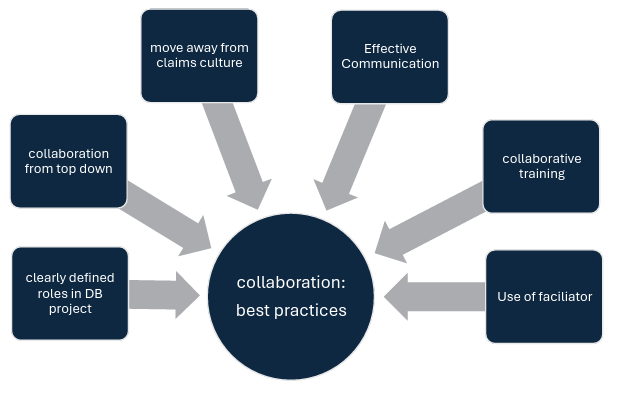
(4) From the identi ied hindrances to collaboration, we were able to extract several best practices for effective collaboration in a DB project. These include (i) clearly de ined roles in the DB project, (ii) buy-in from the top, (iii) elimination of claims culture, (iv) effective communication, and (v) collaboration-based training and, to that end, the use of a DB facilitator. Each project participant can and should drive these best practices. However, where a participant lacks experience and does not come to the project with a complete understanding of the importance of collaboration, the contract provisions can be a valuable tool. Similarly, it is important for the parties to establish a list of shared priorities in writing.
2.3 Contract Strategies for Collaboration in Design-Build Projects
To ensure that the parties implement the above best practices, it is critical that they ind ways to adopt contractual provisions, creating processes and procedures to ensure that collaboration is more than aspirational. With that in mind, we have looked to contractual provisions and structures that can set parties on a path or success by (i) strategizing to deal with experience gaps, (ii) understanding the tendencies to resort to project delivery models with which the parties have greater experience, and (iii) exploring more effective DB methodologies to flatten the learning curve when it comes to DB.
Readers should note that not all creative twists on the DB project delivery model are created equal. DB is best executed when the design-builder and designer unite to develop an innovative concept and formulate creative solutions to construction challenges to produce cost-effective, high-quality, inished projects. When design teams begin the process of working directly for owners, but at some later stage of design work under the design-builder, this often compromises the process. The result can be key project commitments and design decisions made in the absence of constructability input from the design-builder and a forced marriage in which fundamental components of the relationship are not able to develop effectively. In this context, trust among key stakeholders is often questionable, and alignment of the responsibilities can be misunderstood.
2.3.1 Addressing Experience Gaps
As a general guidepost, projects go more smoothly when the design-builder is brought in early, the program criteria are stated clearly, and the parties follow the agreed-upon process. The owner, design-builder, project consultants, and end user all need to have a good understanding of their respective roles and how they are meant to be played in the DB context. Where the design-builder is highly experienced, but the owner, who has never worked on a DB project, proceeds to administer the project as a traditional design-bid-build project, it is highly likely that problems will arise. Each party needs to assess and understand its own experience gaps and work to fill them in advance of the project. While you may not be able to remedy a counterparty’s lack of experience, you may employ contractual measures to address another party’s naivety. Where one or both of the parties lack effective designbuild experience, a DB facilitator should be considered.
A DB facilitator is a neutral party who assists the owner, design-builder, and designer in effectively managing the DB process. As a first step, the contract should consider the appointment of a highly experienced DB facilitator to act as the parties’ guide on effective project administration and collaboration, along with the development of a framework in which the facilitator and parties can operate. The facilitator should be the project’s steward, whose goal is to shepherd the parties effectively to substantial completion and guide their interactions in a manner that educates the project participants on effective collaboration throughout the project’s life cycle.
Although the facilitator’s goal is not to act as a decision-maker or to resolve disputes per se, their involvement should result in a reduction in the number of disputes as they streamline the process by supporting each side in managing/administering the project as a DB project encouraging them to avoid reverting to old design-bid-build tendencies. Similarly, the owner should consider consulting with the facilitator in the project and contract development’s early stages to ensure that collaboration practices are encouraged from the beginning of the project and built into the owner’s plans for how to set up the project and procure and manage the supply chain.
2.3.2 Prioritizing Early and Timely Claims Resolution
Contractual provisions that require parties to engage proactively and contemporaneously in claim resolution deserve more attention than they often receive during contract drafting and negotiation phases. Best contracting practices include the following:
(1) Providing claim escalation provisions where project-level personnel with direct knowledge of and involvement in the claim engage in direct dispute resolution negotiations, and when unsuccessful, quickly involve higher-level managers not directly involved in the dispute to assist resolution efforts by bringing a more objective business perspective and reducing inherent tension that often exists among those directly involved.
(2) Including a third-party neutral such as a facilitator and, for large public works projects, a dispute board for the project’s duration to assist in avoiding or, if necessary, expeditiously and contemporaneously resolving disputes and issuing timely implemented decisions where the law allows (and recommendations where dispute boards cannot issue binding decisions), subject to review in arbitration or litigation once the project is completed.
(3) With (1) and (2) in place, requiring that work continue during the pendency of disputes (subject to certain exceptions).
These provisions discourage the parties from taking “non-collaborative” positions, such as delaying the resolution of claims, taking economic advantage of a design-builder who is obligated to work through disputes, or ignoring solvable problems in favor of a prolonged dispute resolution process. The alternative to solving problems contemporaneously is solving them much later, which unfortunately permits parties to act without accountability to the project. Moreover, delays in any aspect of the decision-making prolong project execution and increase cost overruns. A real benefit of a proactive, collaborative approach to problem-solving is that the solution is more likely to be the best for the job, resulting in fewer disputes later.
2.3.3 Managing Project Unknowns Collaboratively
The risk of unknowns should not simply pass to the design-builder. This practice of “risk dumping” is antithetical to the collaboration required for successful DB. Prior to procurement, the owner should be analyzing problematic risk issues associated with the project with an eye toward identifying and containing the risk. They should share their assessment with the design-builder to allow them the opportunity to comment and identify additional risk concerns and to price the known components based on acknowledged risk guardrails. Among other things, the owner and design-builder should consider contingencies and allowances to address these risks.
2.3.4 Avoiding Punitive Measures
Collaboration works best when the parties chase the same goal with an appropriate incentive to reach it. Penalties function to create competing motives, can promote finger-pointing, and dampen open communication. An owner and design-builder with aligned incentives will be more motivated to work together for project success and less likely to pull in opposite directions. For example, if the design-builder receives a penalty for late completion in a manner that largely offsets the owner’s loss, the owner’s team may not be as motivated to work alongside the design-builder for the good of the project. Similarly, if the design-builder receives a bonus for of a particular phase’s timely or early completion, that incentive benefits the project as a whole. From this standpoint, it is important to ensure that all project participants similarly align.
2.3.5 Proper Risk Allocation
Principally, the contract permits us to address the problems mentioned above with respect to allocating responsibilities clearly and appropriately and defining roles clearly. It is important to consider risk allocation carefully from the outset. A deep discussion is necessary at the tender stage to set the stage for understanding and, ultimately, the project’s success (discussion on what to shift and what to retain).
The key considerations when allocating risks are:
- Risk is best allocated to the party in the best position to control/mitigate it;
- Without adequate/accurate pricing of the risk, the owner cannot fairly shift it to the contractor/design-builder.
These fundamental principles should guide any successful contract negotiation and help the parties to avoid problems with “risk dumping.” While an owner with bargaining leverage may theoretically be capable of unfairly shifting responsibilities for risks that the contractor cannot control or price, this practice ultimately acts to the detriment of both the project and the parties.
3. Optimizing Risk Allocation in Design-Build Projects
3.1 Project Delivery Matrices as a Responsibility Road Map
To address the issue of roles and responsibilities, a project delivery matrix that fairly and succinctly identifies the parties’ responsibilities can be an important tool to communicate and clarify risk.
The group determined that to understand respective roles in the DB project, contract documents must clearly and unambiguously de ine each role’s expectations. When these expectations are well defined, and each contributor is fully aware of their speci ic responsibilities, the likelihood of effective collaboration significantly increases. Clear documentation ensures everyone knows their duties, leading to better teamwork and project success.
Project delivery matrices can graphically depict who is responsible for what and who is responsible for interfacing work at every stage of the project. This could include thousands of interfaces, but it allows the parties to understand clearly the primary and secondary players and decision-makers at every step.
At the very least, the contract should require the parties to develop the matrix and work together to approve it. It can be most beneficial if the matrix is included in the contract itself; however, this may not be realistic in all situations. The matrix can also be a valuable tool to track the completion of various interfaces that must be resolved. Live updates of the matrix will result in transparency and traceability for the benefit of all team members.
3.2 Use of Completion Bonuses, Incentive Schemes, and/or Shared Savings
Incentives are more effective than punishments. Clauses geared toward motivating performance (e.g., completion bonuses, shared savings) are generally more effective at achieving timely performance than liquidated damages provisions are.
Examples of clauses that the parties can stipulate:
- Award Feeds
- Completion bonuses
- Shared savings
- Gain/pain sharing arrangements
3.3 Lessons from Progressive Design-Build for Risk Allocation
There has been a fair amount of attention surrounding intermural claims between designbuilders and engineers, which has resulted in a certain degree of panic within the professional liability market. Contract provisions do not drive these claims. Instead, the drivers are practice standards, behavior/conduct, or the fact that many of the claims scenarios arise out of pre-award services that have to do with preliminary design and, more specifically, the application of the professional standard of care to those preliminary designs. Very little guidance has emerged from public decisions that exist, but what is clear is that less-defined applicable standards lead to more risk and uncertainty.
On the bright side, it appears that the professional liability insurance market is embracing earlier design-builder involvement and the progressive DB model. Progressive design-build (PDB) is significantly more collaborative and less rigid. Unlike traditional DB, where the owner procures the contractor when the project design is around 35 percent complete, PDB involves earlier contractor involvement. PDB fosters collaboration because it requires
a) early team integration (before pricing is locked in),
b) collaborative development of the project scope and budget, and
c) joint risk identi ication and mitigation before contract execution.
In traditional DB, the focus is often on conceptual design and lump sum pricing. In PDB, collaboration starts earlier, and the owner has the flexibility to decide whether to proceed to the construction phase based on a more fully developed design and budget. PDB allows for more milestones and gates, delaying the commitment to price until the design and scope has crystallized.
4. Best Practices for Contractual Collaboration and Risk Allocation
(1) Define roles and responsibilities clearly. A well-documented scope of work for all parties can achieve this.
(2) Establish mechanisms for and require owners, design professionals, and construction teams to collaborate early and throughout the project to align expectations and identify risk items and mitigation measures.
(3) Procure the supply chain not only on price but on a combination of price and technical offerings, including collaboration capabilities.
(4) Recognize and mitigate experience gaps through proper, bespoke, DB training programs and hiring based on a track record of successful collaboration.
(5) Ensure thoughtful claims language design to encourage early problem-solving.
(6) Address the risk unknowns collaboratively through early investigation with an eye toward identifying and containing risk.
(7) Allocate contractual risks in a fair and equitable manner.
a. Consider using project matrices as a tool for clearly identifying the responsibilities of each of the parties.
b. Avoid punitive measures in favor of incentive structures.
c. Understand PDB and the benefits of early collaboration.
5. Conclusion
Although DB projects have faced challenges, the model is not to blame, and DB remains the delivery method that provides all stakeholders with the best opportunity to meet the owner and DB team’s core values. For the owner, that means delivering a high-quality project on time and within the project budget. For the design-builder, that means a pro itable project with appropriately managed risk exposures. Nevertheless, DB can become even more viable through a more disciplined commitment to DB fundamentals.
Better DB starts with both parties’ recognition that DB is fundamentally different from more traditional project delivery methods. All parties to a DB project need to come equipped to administer the project in accordance with the model and not based on a desire to dump risk for a better legal position in the dispute that will follow. Where owners seek to use their bargaining power to shift all of the project risk to the design-builder and then sit idly by as the contractor seeks input, approvals, or assistance from the owner, disputes are sure to result, and DB success is unlikely. However, where the parties seek to educate themselves on the effective use of the model and align themselves as project partners rather than adversaries, they can expect to tap into all of DB’s benefits by optimizing innovation from the marketplace and resolving project struggles in real time. This enables the parties to enjoy timely, cost-effective project completion with minimal claims.
