


This article is an extract from Lexology Panoramic: Patents 2024. Click here for the full guide.
Statistics
Since commencing operations in June 2023, as at 29 February 2024, the Court of First Instance of the Unified Patent Court (UPC) received a total of 274 cases.
Among these, 96 are infringement actions, with filings primarily in Munich, Düsseldorf, Mannheim and Paris local divisions. Additionally, 129 counterclaims for revocation were submitted, stemming from 39 individual infringement actions. The UPC has also received 23 applications for provisional measures and orders for inspection. Notably, Paris central division received 20 stand-alone revocation actions, while the Munich central division received four. The distribution of cases across divisions is detailed in the provided table, highlighting the varying caseloads across different locations.
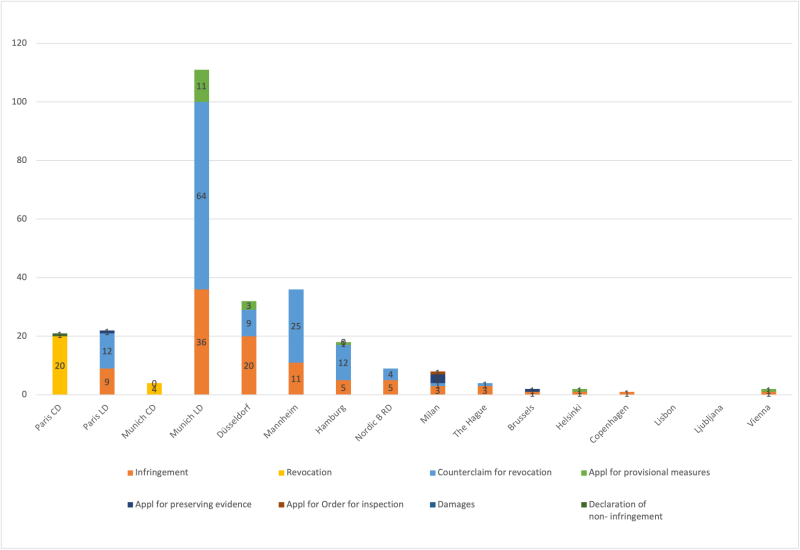
Moving to the Court of Appeal, there have been 12 appeals under the UPC’s Rules of Procedure (UPC RoP) 220.1 and 15 appeals under Rule 220.2, along with other procedural requests.
The UPC is involved in a wide range of different fields of technology. In terms of the IPC classes of the patents in dispute, communication technology is at the top of the list, followed by medicine and tobacco.
The fact that the plaintiffs in the pending cases are not all European companies is another indication of the undeniable success of the UPC. Most of the plaintiffs in cases before the UPC are based in the United States. Germany is the second most active country, followed by Japan.
Case law
The UPC produced several hundred published orders and decisions during the first nine months of its existence mainly concerning procedural issues, case management and provisional measures, but initial trends in its case law were already discernible.
Access to court files for the public
Transparency is an important topic for the UPC involving the balancing of the public interest in information (article 45, UPCA) and the private interest in the protection of confidential information (article 58, UPCA).
The UPC Registry maintains an electronic register – in principle accessible to the public (article 10, paragraph 1, UPCA) – which contains various case-related documents, such as pleadings of the parties to the proceedings, statements by witnesses and experts as well as court decisions and orders. The UPC decisions and orders are easily accessible to the public on the UPC website (Rule 261.1 lit., UPC RoP), whereas the pleadings and evidence submitted by the parties during the proceedings are only accessible upon the submission of a ‘reasoned request’ and after hearing the parties and a decision by the judge-rapporteur (Rule 262.1 lit. b, UPC RoP).
In two decisions, the Munich central division took a rather cautious stance with regard to the request for access to written pleadings and evidence under Rule 262(b), UPC RoP, stating that a specific and verifiable legitimate reason for making the files available must be provided (see UPC_CFI_1/2023, ORD_550152/2023, and UPC_CFI_75/2023, ORD_552745/2023).
In contrast, the Nordic-Baltic regional division set lower requirements: with reference to article 10, 45 UPCA (fundamental publicity of the register or the proceedings), it considered a ‘credible declaration’ by the applicant about his request to be sufficient, provided there were no compelling reasons for non-disclosure (UPC_ CFI_11/2023, ORD_ 543819/2023).
The case from the Nordic-Baltic regional division is pending before the UPC’s Court of Appeal in Luxembourg (UPC_CoA_404/2023, App_584498/2023). The Court already ruled that a member of the public must be represented before the UPC when applying for access to court files. The decision of this Court on the substantial requirements for such an application is still outstanding.
Jurisdiction of the UPC and its divisions
Opt-out/Opt-in – Jurisdiction of UPC over European patents
In re AIM v Supponor (UPC_CFI_214/2023), the Helsinki local division had to decide on the effectiveness of an opt-in (withdrawal of the opt-out) of the alleged European patent.
The subject of the proceedings was an infringement action and an application for interim relief. The underlying patent had been opted out during the sunrise period. Even before the UPCA came into force, national proceedings (infringement and nullity) had already been initiated in Germany in relation to the German part of the patent. On 5 July 2023, the plaintiff declared its withdrawal from the opt-out (ie, opted in), despite the still-pending national action. Against this background, the defendants challenged the UPC’s lack of jurisdiction.
The Helsinki local division followed this argument and considered the opt-in to be ineffective due to the national proceedings still pending on 1 June 2023, with the consequence that the opt-out remains effective and therefore the jurisdiction of the UPC is excluded. In particular, the Helsinki local division pointed out that neither article 83(4) UPCA nor Rule 5(8) RoP contain any restriction to the effect that they would only cover proceedings initiated after 1 June 2023. Finally, the Helsinki local division clarified that the question of whether national proceedings preclude an opt-in depends solely on the patent concerned regardless of the parties involved.
In a reverse scenario, the Vienna local division decided in re Cup&Cino v Alpina Coffee Systems (UPC_CFI_182/2023, ACT_528738/2023) that an opt-out of the European patent, which was entered in the register after preliminary injunction proceedings based on the patent had already been initiated before the UPC, is not effective and therefore does not stand in the way of the UPC's jurisdiction.
Subject matter jurisdiction of the UPC
The Hamburg local division denied the UPC’s jurisdiction for proceedings to determine the amount of damages because the preceding infringement proceedings were conducted before national courts. The reason given was that the proceedings to determine the amount of damages arising from a patent infringement do in principle fall within the jurisdiction of the UPC, but only as annex proceedings, (ie, only if the infringement proceedings were also conducted before the UPC (UPC_CFI_274/2023)).
Central and local divisions
According to article 33(4), UPCA revocation actions have to be filed in a central division, unless:
- such an action is already pending between the same parties before a local division; or
- an infringement action based on the same patent is pending between the same parties before a local division.
The divisions took a rather literal approach with regard to timing and the concept of ‘same parties’.
In re Amgen vs Sanofi/Regeneron (CFI_1/2023), Sanofi had filed a revocation action against the patent in the Paris central division a few minutes before Amgen filed an infringement action based on the same patent against Sanofi and Regeneron in the Munich local division. The Munich local division decided that the Paris central division was in charge of the revocation action of Amgen and only accepted the revocation counterclaim that Regeneron (a different party to Sanofi) filed in the infringement proceedings before the Munich local division at a later stage.
In re Edwards v Meril (CFI_255/2023), Edwards had sued several entities of Meril for infringement in the Munich local division. Meril (by another group company) filed a revocation action against the same patent in the Paris central division. Edwards argued that the revocation action was filed by the same party that was sued in the Munich local division and that the revocation action should be dealt with by the Munich local division. The Paris central division rejected this argument and any allegation of abuse of the system by Meril and pointed to the case management powers of the UPC and its divisions in order to control parallel and bifurcated proceedings.
Case management
Service of complaint
The UPC is designed so that the registry of each court in which an action is filed is responsible for serving a statement of claim. This is to be made by email, if the defendant has provided an email address for the purpose, or, more usually, by registered letter, further to Regulation (EU) 2020/1784 (Service Regulation). If service is on a defendant outside the European Union, the Hague Convention or diplomatic or consular channels must be used.
Practice already shows, however, that these methods are sometimes insufficient to achieve service. In such cases, the ultimate fallback for the court is to order service of a statement of claim by a method or at a place not otherwise permitted under the UPC’s Rules of Procedure and the Service Regulation (Rule 275, UPC RoP). Different divisions of the UPC have already, however, taken different approaches to using this fallback option.
Pursuant to the Munich local division decision in re Philips v Belkin, applications based on Rule 275 do not require service to be affected in accordance with Rules 270 to 274 (CFI_5/2023).
The Mannheim local division disagreed in re Panasonic v Xioami. Contrary to the opinion expressed in Philips v Belkin, Rule 275.2 cannot permit service without having previously attempted service in accordance with the provisions applicable to service abroad (eg, Rules 273 and 274). The attempt of service had to be made in accordance with the Hague Convention, pursuant to Rule 274(a)(ii), since China and Hong Kong SAR do not fall within the Service Regulation’s scope. Rule 275.2 is an exceptional provision and does not allow to disregard international treaties binding on the UPCA’s member states, such as the Hague Convention (CFI_219/2023).
Confidentiality
A party can use Rule 262A, RoP to apply to the court to restrict access to certain information contained in its pleadings or the collection and use of evidence in the proceedings (in terms of content) or to declare inadmissible or to restrict access to such information (in terms of personnel) to certain persons (eg, to employees of the legal department). This is intended to ensure the confidential treatment of business and trade secrets in judicial proceedings as set out in article 9, Directive (EU) 2016/943.
The German divisions were restrictive with regard to Rule 262A RoP. The Munich central division (CFI_80/2023) and the Hamburg local division (CFI_54/2023) limited the number of persons who should have access to the confidential information to the minimum number of three persons plus the respective UPC representatives required to guarantee the procedural rights of the parties. The Hamburg local division also ruled that the existence of a trade secret does not have to be established to the court's satisfaction for the application for a confidentiality order pursuant to Rule 262A RoP, but, in accordance with the wording ‘alleged trade secrets’ in article 9, paragraph 1 and 2 lit. a of Directive (EU) 2016/943, only has to be ‘predominantly probable’ (UPC_CFI_54/2023).
Deadlines
The UPC divisions endeavour to comply with the deadlines and time limits set by law in order to fulfil the promise of fast and effective proceedings before the UPC. Extensions are only granted in well-founded cases and not routinely. Such extensions were granted, for example, by the Munich local division in the initial phase of the UPC in order to compensate for access and delivery problems with the UPC’s case management system (CMS).
The UPC’s Court of Appeal (CoA_320/2023) has considered such an extension to be usually necessary if the complaint was initially served without attachments and this service was effective. In this case, the time limits for the defendant only begin to run as soon as he has received the complete claim documents. Similarly, the Hamburg local division (CFI_52/2023) granted the defendant an extension of the deadline in the event that the action in its final redacted form was served with a delay due to a request for confidentiality by the plaintiff.
Stay
The UPC divisions may stay nullity proceedings filed with the UPC if a rapid decision by the European Patent Office (EPO) in opposition proceedings is expected in respect of the patent in suit. The UPC divisions have also been cautious in this respect to date.
The Munich central division emphasised that a stay of the UPC revocation action is not only possible if a final opposition decision by the EPO is imminent. However, it rejected a corresponding request for a stay, at least at an early stage of the UPC proceedings, with the proviso that this should be discussed again in the interim conference (CFI_80/2023).
The Paris central division also rejected the stay in view of parallel opposition proceedings on the grounds that this could in principle only be considered if the opposition proceedings were about to be concluded and the UPC revocation action had only just begun (CFI_263/2023).
Bifurcation
If an infringement action has been filed with a local division, a revocation counterclaim or revocation action against the same patent between the same parties can only be filed with this local division. The local division then has the choice in accordance with article 33(3) UPCA, namely either to hear the two actions together with the involvement of a technical judge or to refer the revocation counterclaim to the central division (bifurcation).
So far, the local chambers have tended to call in a technical judge (sometimes at a very early stage of the proceedings) and avoided bifurcation. It is therefore interesting to ask whether the defendant can bring about a bifurcation, (ie, a split of infringement and nullity actions between different divisions of the UPC, if this is desired for any reason).
One option is to file a revocation action with the central division before filing the infringement action. The jurisdiction of the central division is thus established and is not affected by the subsequent filing of an infringement action with a local division (CFI_1/2023). However, an infringement (counter)action may exceptionally be filed with the central division if a revocation action is already pending there.
A second option in the event that an infringement action is already pending before a local division is for a group company of the defendant not affected by the infringement action to bring an action for annulment before the central division. The Paris central division has ruled that group companies are not usually the same parties and that such an action does not constitute abusive behaviour (CFI_255/2023). It remains to be seen how the chambers dealing with parallel infringement and nullity actions will manage these cases in order to avoid contradictory results (R 295, R 340 RoP).
Provisional measures
While there were fears beforehand as to whether the UPC would be particularly patent proprietor-friendly when granting provisional measures or whether due to the wide territorial scope of the UPC provisional measures would only be granted when high hurdles had been met, the first decisions show that the courts are taking a very considered and balanced approach taking into account all facts and the specific situation of the case.
Ex parte provisional measures
The Milan local division (CFI_127/2023, CFI_141/2023 and CFI 286/2023) and the Brussels local division (CFI_329/2023) authorised inspections or orders for preserving evidence ex parte. In each case, a high degree of urgency was assumed, as a trade fair was being held or was about to be held at which the possibly infringing product was or was to be exhibited. The requirements regarding the probability of infringement and the legal validity of the patent were rather low in each case. However, confidentiality of the inspection results was ordered and the plaintiffs were instructed to file a main action within a period of 31 calendar days or 20 working days.
The Düsseldorf local division issued a preliminary injunction ex parte in two proceedings within a few days (CFI_177/2023, and CFI_452/2023). The background in each case was also the exhibition of the challenged product at a trade fair. However, the decisive factor for the preliminary injunction being granted without hearing the defendants was that the respective defendants had previously commented on the infringement allegation and/or the legal validity of the patent in a protective letter or in response to a warning letter. The local division did not consider these counter-arguments to be convincing and therefore did not consider a hearing to be necessary. Seizure orders were also issued in both cases. In both cases, the enforcement of the preliminary injunction was made dependent on the provision of security in the amount of the value in dispute stated by the plaintiff.
Inter partes preliminary injunctions
Currently, in inter partes preliminary injunctions proceedings, it takes around three to four months until a first instance decision is issued. Usually, a technical judge is added to the panel of judges if the validity of the patent is contested in such preliminary injunction proceedings.
The leading case for inter partes preliminary injunctions is re. 10x Genomics v NanoString (UPC_CFI_2/2023), which started immediately after the opening of the UPC before the Munich local division and has already reached the CoA.
The Munich local division granted the preliminary injunction and provided a thoughtful decision with a comprehensive discussion of all the factors that a court should consider before granting a preliminary injunction. The factors are:
- Merits of the preliminary injunction: The Court must be convinced that the alleged patent is infringed (the burden of proof is on the claimant). The Court must – in view of the invalidity arguments of the defendant – be convinced that there is a ‘preponderant likelihood’ that the patent is valid, (ie, it is more likely that the patent is valid than that it is not (burden of proof for invalidity is on the defendant).
- Necessity of the preliminary injunction: The Court must be convinced that a preliminary injunction is necessary because the plaintiff acted without undue delay after becoming aware of the infringement and the balance of interest (potential damages) is in favour of the plaintiff.
- Proportionality of the preliminary injunction: The Court must conclude that the preliminary injunction is proportional by weighing all of the factors above plus all other specific circumstances of the case, such as the behaviour of the patentee and the alleged infringer, interest of the public, and the complexity of the case.
The UPC Court of Appeal (UPC_CoA_335/2023) has overturned the above decision of the Munich local division and rejected the application for a preliminary injunction.
However, this decision is apparently not based on a different legal standard for such inter partes preliminary injunctions but rather a different assessment of the facts and a different prognosis on the validity/invalidity of the alleged patent. Whereas the Munich court thought that the alleged patent was most likely valid, the UPC Court of Appeal concluded that the alleged patent was likely to lack an inventive step.
With regard to the legal standard the CoA more or less agreed with the Munich local division:
A sufficiently certain conviction [. . .] requires that the court considers it at least predominantly probable that the applicant is entitled to institute proceedings and that the patent will be infringed. A sufficiently certain conviction is lacking if the court considers it to be overwhelmingly probable that the patent is not valid.
Enforcement and penalties
The UPC issued two orders on the enforcement of provisional measures so far.
In re NanoString Technologies v 10x Genomics (proceedings no. UPC CFI 2/2023, APP 577241/2023), the Munich local division clarified that a court order on a provisional basis, such as a preliminary injunction, is directly enforceable (under Rule 354.1, UPC RoP) as a result of service via the CMS without any further court order or warning of enforcement.
In re myStromer v Revolt Zycling (proceedings no. UPC CFI 177/2023), the Düsseldorf local division granted a preliminary injunction in ex parte proceedings imposing a penalty payment up to €250,000 on Revolt Zycling for each case of non-compliance with the order.
As the defendant violated the order, the Düsseldorf local division issued an order for penalty payments on the plaintiff’s request. In its order on the penalty payment (order of 18.10.2023, APP 552740/2023), the Düsseldorf local division clarified the following legal issues:
- If the debtor violates an injunction issued by the court penalty payments can be imposed on the debtor on the basis of the UPCA and the UPC’s Rules of Procedure, irrespective of the provisions of national enforcement law. National enforcement law becomes important if a debtor does not pay the penalty payment already imposed on the debtor and the penalty payment is therefore to be enforced (cf. grounds of the decision, I.2.b).
- Imposing penalty payments requires an unwritten requirement for the debtor to be culpable since the penalty payment does not only have a deterrent function but is also a punitive sanction for the violation of the court order (cf. grounds of the decision, II.5.a).
- For the calculation of the penalty payment, in particular, the type, extent and duration of the infringement, the degree of fault, the benefit to the infringer resulting from the infringing act and the risk of possible future infringing acts for the infringed party must be taken into account.
Conclusion and outlook
Despite some organisational problems and an often difficult-to-use CMS system, the UPC has made a promising start and has so far mostly lived up to its promise of providing an effective but balanced system for patent disputes. What is next on the horizon?
Many of the issues that have already been decided at first instance are pending on appeal, meaning that the last word has not yet been spoken. In addition, the first main proceedings and decisions are due in the second quarter of 2024. Finally, the first proceedings involving non-practicing entities and standard essential patents have also reached the UPC. It is to be expected that the number of cases will continue to increase the more case law is available and the better potential users of the system can assess it. It will then have to be seen whether the UPC and its judges can maintain the effectiveness they have shown so far.
