


The nutrient cycle of agriculture, where farmers recycle organic waste into fertiliser or feed, is perhaps the most ancient circular economy of all. However, with the agriculture sector accounting for approximately 18% of Australia’s emissions1, the need for innovative and scalable solutions to reduce its greenhouse gas emissions is more imperative than ever.
One such solution lies in the use of anaerobic digestion, which converts biomass into biogas.2 Biomass refers to organic materials that come from various sources, including the remnants from agricultural activities, the food industry, forestry operations and waste management systems.3 Biogas is a type of fuel made from the conversion of biomass through the anaerobic digestion process.4 Biogas is able to be utilised in the generation of electricity, steam and heat5 and can also be upgraded into ‘renewable natural gas’ (RNG) for injection into natural gas networks or to fuel vehicles.6 The transformation of biomass into biogas has the potential to create self-sustaining, closed-loop farming systems to promote a more circular economy.
What is anaerobic digestion?
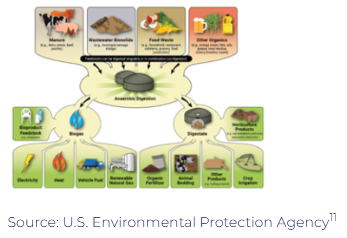
The word anaerobic means ‘without oxygen’.7 Hence, anaerobic digestion is carried out in an oxygen-free sealed digester, whereby microorganisms break down biomass and convert it into biogas.8 Biogas is composed of 50 to 75 per cent methane, as well as carbon dioxide (CO2), hydrogen sulphide (H2S), water vapour and inconsequential amounts of other gases.9 The captured biogas can then be used as a fuel on-site for such purposes as producing heat or generating electricity (including to power the anaerobic digester itself).10 The anaerobic digestion process is illustrated in the diagram below.
Upgrading biogas into ‘renewable natural gas’ (RNG)
While the captured biogas from the anaerobic digestion process can be used to generate electricity, steam and heat, it can also be purified and upgraded into RNG.12 This is done by removing the low-value components of CO2, water vapour, H2S and other trace gases.13 RNG is typically composed of 96 to 98 per cent methane.14 The uses for RNG include being injected into existing gas distribution networks and as a replacement for natural gas (such as in electricity generation, cooking and heating)15 or being converted into either compressed natural gas or liquified natural gas to be used as a vehicle fuel.16
Biogas upgrading – a better alternative to biogas flaring
In May 2023, the RACE for 2030 Opportunity Assessment reported that approximately 40% of anaerobic digestion facilities in Australia were flaring their biogas rather than using it.17 Flaring the biogas converts it into carbon dioxide,18 which is reported, over a 20-year period, to be 80 times less harmful to global warming than methane.19 However, carbon dioxide is still a greenhouse gas.20 Flaring is therefore a tragic waste of biogas that, as outlined above, has a multitude of potential useful applications.
Biogas upgrading in Australia and certification schemes
The RACE for 2030 Opportunity Assessment also found, as of March 2019, that while Australia had over 200 operating anaerobic digestion facilities, there was not a single operating commercial biogas upgrading plant (RNG Plant).21 The Jemena Malabar Biomethane Facility became the first Australian project to upgrade anaerobic digestion-generated biogas into RNG and inject it into a gas network.22 The project is also reported to be the first biomethane facility in Australia to register under GreenPower’s renewable gas certification scheme.23 Additionally, to offset the electricity consumed in producing RNG, the project generates Large-Scale Generation Certificates.24
Whether anaerobic digestion facilities and RNG Plants will be eligible for registration under various Federal or State schemes (including those noted above) will depend on the specifications and details of the individual project. Such schemes may provide financial incentives for the development and operation of these types of projects.
Barriers to developing RNG Plants
The shortage of RNG Plants in Australia may partially be due to gaps in domestic knowledge in the design, operation and maintenance of the anaerobic digestion systems, which differ in complexity.25 There is also the necessity of feedstock security which, except if the project developer produces the feedstock itself, cannot be guaranteed unless RNG Plants have entered long-term arrangements with feedstock suppliers.26
In an effort to overcome these issues, project developers and feedstock suppliers may choose to enter into arrangements to jointly develop RNG Plants. One example of such an arrangement is the renewable fuels joint venture between Apeiron Bioenergy, who will provide know-how on feedstock collection, and Jet Zero Australia, who will concentrate on investing in processing and refining of non-edible crops.27
It’s time to act
Biogas represents a powerful, yet underutilised, solution to some of the agricultural industry’s most pressing environmental challenges. Through the use of anaerobic digestion and the upgrading of biogas to RNG, the potential for a circular economy in the agricultural sector is within reach. Harnessing the full potential of biogas is not just an opportunity for cleaner energy – it is a key step towards a more sustainable, self-sufficient agricultural system that can help mitigate climate change and fuel the future.28
