


On 26 March 2021, the Government issued Decree No. 31/2021/ND-CP (“Decree 31”) to provide guidance on the implementation of the Investment Law 2020. Decree 31 replaces the previous Decree No. 118/2015/ND-CP (which provided guidance on the Investment Law 2014), and takes effect from the issuance date (i.e., 26 March 2021).
Decree 31 generally provides more detailed guidance regarding the implementation of the Investment Law 2020 on, among others, the industries and sectors which contain market access restrictions and/or conditions applicable to foreign investors, as well as procedural requirements and processes applicable to inbound investments into Vietnam, including M&A transactions by foreign investors.
We explain some of the notable features of Decree 31 as below.
1. List of Restricted/Conditional Sectors Applicable to Foreign Investors
In line with the “negative list” approach adopted for the first time under the Investment Law 2020, Decree 31 provides for the two following lists of sectors (the “Lists of Restricted/Conditional Sectors Applicable to Foreign Investors”):
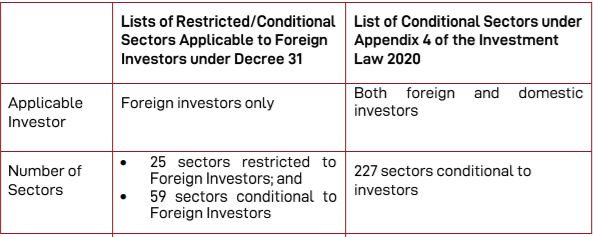
- Section A of Appendix I lists 25 sectors which have not been opened to foreign investment (i.e., foreign investors are not allowed to invest in these sectors) (the “List of Sectors Restricted to Foreign Investors”). Some examples of such sectors include “public opinion/polling services”, “blasting services”, “investigation and security services”, and “exercising import right, export right and distribution rights over commodities which fall under the list of commodities that foreign investors and foreign-invested companies are not permitted to import, export and/or distribute”; and
- Section B of Appendix I lists 59 sectors which are conditionally opened to foreign investment (i.e., foreign investors may invest in these sectors, subject to satisfying certain prescribed conditions) (“List of Sectors Conditional to Foreign Investors”). Some examples of such sectors include “postal and telecom services”, “advertising services”, “mapping services”, “education services”, “offshore wind power sector”, “real estate business”, “tourism services”, “logistics services” and “e-commerce activities”.
The above lists are crucial to determining whether a foreign investor and/or a “deemed” foreign investor 1 (collectively, “Foreign Investor”) would be allowed to invest in a particular sector in Vietnam or not, and if yes, whether such investment would be subject to any market access condition or procedural requirement. For example, according to the Investment Law 2020, if a Foreign Investor acquires shares/equity interest (whether by subscribing for new shares, contributing for an additional equity interest, or acquiring shares/equity interest from an existing shareholder/equity owner) in a company incorporated in Vietnam which conducts business in a sector included in the List of Sectors Conditional to Foreign Investors and such acquisition results in an increase in the level of foreign ownership in that company, that Foreign Investor will need to obtain from the relevant local investment authority an approval for share subscription, equity interest contribution or share/equity interest acquisition as set forth under Article 26.2 of the Investment Law 2020 (“M&A Approval”) before it can proceed with the acquisition.
Notably, Decree 31 confirms the “negative list” approach introduced by the Investment Law 2020.As a result, Foreign Investors may invest in any sector on the same basis as domestic investors, as long as such sector does not fall into any of the categories of the List of Sectors Restricted to Foreign Investors and List of Sectors Conditional to Foreign Investors.
This approach is considerably pro-investor, especially for foreign investment in sectors for which Vietnam had not previously made market access commitments under its international treaties.In particular, according to Decree 31, when engaging in any sector in respect of which Vietnam has not made any market access commitments under its international treaties and domestic laws also provide for no specific market access restrictions or conditions, Foreign Investors are entitled to the same treatment as domestic investors.Decree 31 makes clear that such market access restrictions or conditions can only be prescribed under certain types of Vietnamese legislative instruments, being laws and resolutions of the National Assembly, ordinances and resolutions of the Standing Committee of the National Assembly, and decrees of the Government.
While this “negative list” approach is an encouraging development in terms of attracting foreign investment, its implementation has not yet been tested in practice.In particular, it is not yet clear on how local licensing authorities would react to an investment proposal by a Foreign Investor that involves a novel business sector which has not been covered under any existing international treaty commitments of Vietnam 2.Prudent investors should consider pre-confirming any development in the practical implementation of Decree 31 at the time of their investment.
2. Relationship between the Lists of Restricted/ Conditional Sectors Applicable to Foreign Investors under Decree 31 and the List of Conditional Sectors under Investment Law 2020
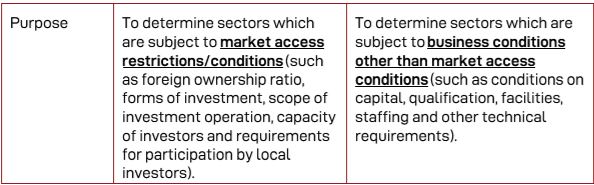
Similar to the Investment Law 2014, Appendix 4 of the Investment Law 2020 sets out a list of sectors where investment is conditional (the “List of Conditional Sectors”). Questions are often raised as to the relationship between the List of Conditional Sectors and the Lists of Restricted/Conditional Sectors Applicable to Foreign Investors, so we summarise some key differences between these below:
3. Conditions and principles for M&A transactions in Vietnam
Decree 31 provides greater guidance on the conditions for investors when subscribing for shares, contributing for an additional equity interest, or acquiring shares/equity interest in Vietnamese companies. In particular:
- With respect to domestic investors: Domestic investors are required to follow the requirements and procedures under the Enterprise Law and relevant regulations applicable to the particular corporate structure of the target company of the investment. M&A Approval is not applicable to investments by domestic investors.
- With respect to investors investing in public companies and companies listed on a securities exchange: Regardless of the nationality of the investor, securities regulations will apply to these M&A transactions. Although it is not entirely clear, it may be interpreted that M&A Approval is not applicable to these cases.
- With respect to Foreign Investors: Foreign Investors may be required to satisfy certain conditions and/or follow certain requirements and procedures under the Investment Law 2020, including obtaining an M&A Approval.
More specifically, Decree 31 provides for additional guidance to the Investment Law 2020 on the conditions applicable to M&A transactions by Foreign Investors, including:
(i). the terms of market access if the target company operates in any sector listed in the List of Sectors Conditional to Foreign Investors. In such case, if the investment by the Foreign Investor results in an increase in the level of foreign ownership in the target company, the Foreign Investor must obtain an M&A Approval before it can proceed with the investment; and
(ii). conditions relating to national defence and security, and land use where the target company has the right to use land located on islands, at national borders or in coastal areas, or in “other areas which may affect national defence and security” (as described below), except for industrial zones, export processing zones, high-tech zones and economic zones established in accordance with the Government’s regulations. In this case, a Foreign Investor must obtain an M&A Approval before it can proceed with its investment, irrespective of the level of foreign shareholding after the investment.
It should be noted that Decree 31 further clarifies where the condition relating to national defence and security may apply. According to Decree 31, the phrase “other areas which may affect national defence and security” (as above mentioned) is described as areas such as those on which there are national defense or security installations or military zones in accordance with laws, or economic – national defence zones in accordance with the Government’s regulations.
Notwithstanding the above, the specific areas which may be considered affecting to national defence and security remain vague, and are likely to afford broad discretion to licensing authorities in practice.
4. Termination of investment projects based on fraudulent transactions
Decree 31 also clarifies the grounds for the investment registration authorities to terminate (in part or in whole) an investment project which is implemented on the basis of a sham/fraudulent transaction, as stipulated under Article 48.2(e) of the Investment Law 2020.Under this provision, the competent investment registration authority may only terminate a certain project if there is a final and binding court judgment or arbitral award declaring that such project has been implemented on the basis of one or more sham/fraudulent transactions.
Pursuant to Decree 31, investment registration authorities are now one of the entities/persons who have the right to request courts to declare relevant transactions null and void during the implementation of projects.
