


Introduction
Singapore's journey towards fair workplace practices began over two decades ago. The Tripartite Guidelines on Non-Discriminatory Job Advertisements were introduced in 1999. In 2006 the Tripartite Alliance for Fair and Progressive Employment Practices ("TAFEP") was established, and in 2007 the Tripartite Guidelines on Fair Employment Practices ("TGFEP") were introduced with the aim of protecting employees against various forms of workplace discrimination. The TGFEP also aims to educate employers as to the best practices to adopt to create fair workplaces. In 2013, the move to couple education with administrative consequences began and the Ministry of Manpower ("MOM") started taking action against employers who breached the TGFEP by suspending their work pass privileges. In 2014 the Fair Consideration Framework ("FCF") was introduced to set out specific requirements for all employers in Singapore to consider the workforce in Singapore fairly for job opportunities so as to emphasize the importance of a strong Singaporean core. To send a stronger signal against workplace discrimination, in 2020, the penalties for breaching the TGFEP and FCF were enhanced, including increasing the minimum period of mandatory work pass debarments from six months to 12 months against errant employers, and up to a maximum of 24 months.
This workplace fairness framework has enabled Singapore to make headway on addressing workplace discrimination. However, discriminatory work practices still occur. The interim report of the Tripartite Committee on Workplace Fairness highlights that in 2022 TAFEP received approximately 250 complaints relating to workplace discrimination and the most common discriminatory grounds were nationality, age and sex.
Seeking to address how best to create a strong and robust system that will promote workplace fairness, the Tripartite Committee on Workplace Fairness ("Committee") was formed in July 2021. The Committee's Terms of Reference were to: (a) Determine if the best policy to enhance workplace fairness is legislation; (b) Review the scope of requirements for employers; (c) Develop the regulatory and claims regime; and (d) Conduct engagements to gather feedback and understand concerns. The Committee's interim report (which can be accessed here) was released on 13 February 2023 and contains 20 recommendations to enhance workplace fairness.
Notably, the Committee recommends that legislation be enacted to implement its recommendations to tackle workplace discrimination. The proposed legislation will run in unison with the TGFEP. The recently enhanced TGFEP can be accessed here.
Feedback to the recommendations set out in the Committee's interim report can be submitted via https://go.gov.sg/tcwfinterimfeedback, by 13 March 2023.
This Update outlines the recommendations made in the Committee's interim report and considers the steps that employers should consider in order to remain fair employers.
Committee's Recommendations
The aims of the Committee's recommendations are to entrench the long-standing fair employment standards and strengthen key areas in the existing workplace fairness framework. The proposed workplace fairness legislation will draw a clear line at unacceptable discriminatory acts by prohibiting specified forms of discrimination. The TGFEP will ensure that the overarching principles of workplace fairness remain, cover forms of workplace discrimination that fall outside the ambit of the legislation, provide guidance on complying with the legislative requirements and capture other important tripartite guidelines on fair employment.
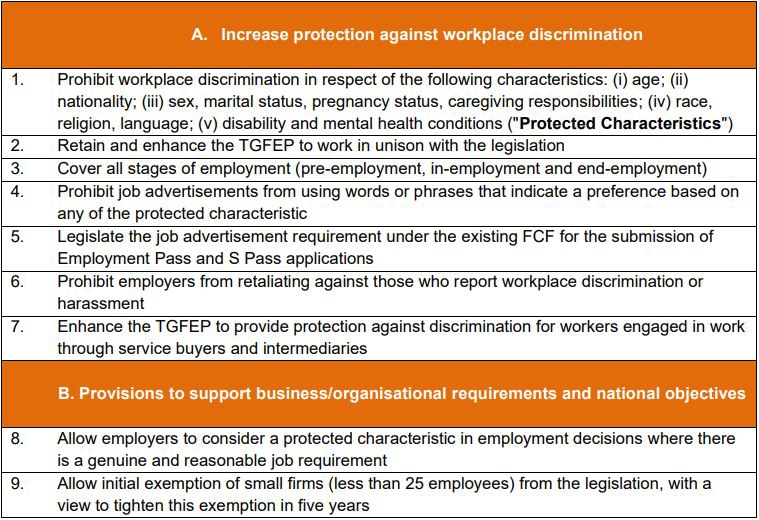
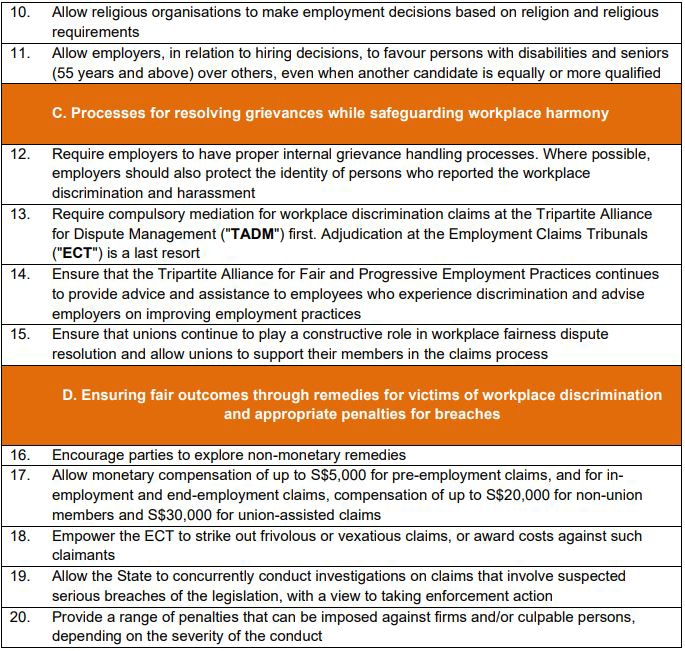
The table below provides a summary of the 20 recommendations from the Committee's interim report. The recommendations are divided under four key areas.
Key takeaways from the Committee's recommendations
(a) Scope of proposed workplace fairness legislation
The Committee recommends that the legislation initially apply to all firms who have more than 25 employees. Employers will be prohibited from discriminating against job applicants and employees based on the protected characteristics during all stages of employment (the recruitment phase, in-employment and end-employment).
(b) Pre-employment practices and exceptions
The TGFEP requirement for job advertisements to be free from discriminatory words or phrases will be enshrined in the proposed legislation. Additionally, to reaffirm the importance of a strong Singaporean core, the job advertisement requirement under the existing Fair Consideration Framework for the submission of Employment Pass and S Pass applications will also be legislated.
However, the Committee recommends that some exceptions apply during the recruitment phase. Employers will be allowed to make decisions based on the protected characteristics if there is a genuine and reasonable job requirement, and religious organisations will be allowed to make decisions based
on religious requirements. Additionally, during the recruitment phase, employers will be allowed to favour seniors (those 55 years or over) and persons with disabilities over another candidate, even if another candidate may be equally or more qualified.
(c) Resolution of grievances – mediation over litigation
The Committee recommends that the legislation enshrines non-litigious dispute resolution as the continued preferred method for resolving workplace discrimination grievances and disputes. Hence, employers must have in place adequate internal grievance processes. To ensure employees feel confident to raise workplace discrimination issues, employers should try to protect the identity of those who report workplace discrimination and harassment, and employers cannot retaliate against employees who raise grievances.
In cases where the internal grievance process fails to reach an amicable resolution and the aggrieved party still wishes to seek redress, the legislation will mandate workplace discrimination claims to then be subject to compulsory mediation at TADM. As a last resort, litigation before the ECT is an option. Linked to the amicable resolution of grievances is the recommendation that parties should explore non-monetary remedies, such as an apology letter. Where financial compensation is required, the sum of up to S$5,000 is allowed for pre-employment claims and, for in-employment and end-employment claims, up to S$20,000 for non-union members and S$30,000 for union assisted claims. Further, the State will be allowed to concurrently investigate claims that involve suspected serious breaches of the legislation and take appropriate enforcement action. The range of possible enforcement action is tailored to meet the severity of the legislation breach and includes corrective orders, administrative penalties and civil penalties.
What does this mean for employers?
Now is an opportune time for employers to conduct a hygiene check on their Human Resources and employment processes and documentation to identify risk areas that can be remedied or mitigated.
Possible areas employers may wish to review include:
(a) Eliminating bias in employment practices
Employers must ensure their employment practices are crafted to avoid unfair practices. Human Resources personnel involved in the recruitment process, conducting performance appraisals and the end of employment processes should receive appropriate training and adequate documentation. Consideration will also need to be given as to the process to be implemented when assessing applications from persons with disabilities and persons over 55 years of age.
Performance and promotion practices should also be reviewed to ensure that employees are only assessed based on work-related matters and not discriminated against based on any of the protected characteristics. Reporting managers need to be trained to base performance reviews on transparent, objective and quantifiable matrices, and as advised in the TGFEP, employers should keep records of their employee's performance and conduct.
In relation to off-boarding, employers should consider good employment practices such as conducting and documenting exit interviews in all cases. Written standard operating procedures, that are free from any discriminatory language, is advisable for all of these practices.
(b) Grievance Handling
Employers must set up proper grievance reporting, investigative and disciplinary (GRID) processes as already advised in the TGFEP. The Committee's interim report outlines that grievance handling requirements under the legislation will require a proper inquiry and documentation process, informing employees of the grievance handing procedures, communicating the inquiry outcome to the affected employee, and protecting the identity of the person who reported the workplace discrimination or harassment.
(c) Harmonious workplaces
The recent amendment to the TGFEP, made on 13 February 2023, emphasises the importance of workplace harmony and the need to exercise sensitivity in relation to the supporting of non-work-related activities within the workplace. This amendment, plus the Committee's recommendations, emphasise the importance of employers providing their employees, at all levels, with training regarding appropriate workplace behaviour. This will ensure that all employees are aware of the standards expected of them regarding their behaviour towards other colleagues, the types of behaviour that are discriminatory and why that behaviour is discriminatory.
Implementation timeline
The Committee is due to release its final report by the end of 2023. Legislation is predicted to be tabled in Parliament in 2024.
Concluding Words
The recommendations in the Committee's interim report provides a strong indicator of the parameters of the forthcoming workplace fairness legislation. Further details will likely be furnished in the Committee's final report. In the interim, it is advisable for all employers to review their employment practices to ensure they are fair, up to date and tally with the Committee's recommendations for anti-discriminatory practices.
