


In a decision that may encourage continued sales from suppliers to distressed entities, the Eleventh Circuit in Auriga Polymers Inc. v. PMCM2, LLC1 joined the Third Circuit,2 the only other circuit to directly address the issue, in concluding that post-petition payments for the value of goods received by a debtor within 20 days before the petition date, authorized by 11 U.S.C. section 503(b)(9), do not reduce a creditor's "subsequent new value" preference defense.
I. Preferences in a Nutshell
A preference is a cause of action authorized by section 547(b) of the Bankruptcy Code.3 Under section 547(b), a trustee or debtor-in-possession4 may avoid any "transfer" of an interest of the debtor in property that: (i) is to or for the benefit of a creditor, (ii) is on account of an antecedent debt owed by the debtor before such transfer was made,5 (iii) is made while the debtor was insolvent,6 (iv) is made on or within 90 days before the date of filing the petition7 and (v) enables the creditor to receive more than such creditor would have received in a chapter 7 bankruptcy if the transfer had not been made.8 Preference claims make conducting business with a flailing entity a dubious prospect. Fortunately, section 547(c) of the Bankruptcy Code offers certain protections for a debtor's unwary counterparties. One such protection is the so-called subsequent "new value" defense embodied in section 547(c)(4) of the Bankruptcy Code.
II. The Subsequent New Value Defense
The subsequent new-value defense, embodied in section 547(c)(4) of the Bankruptcy Code, is intended to protect creditors who provided the debtor with new value after receiving an otherwise avoidable preferential transfer. A creditor must prove three elements for the subsequent new-value defense: (i) that the creditor gave new value after receiving the transfer, (ii) that the new value was not secured by an otherwise unavoidable security interest and (iii) that the debtor did not make an otherwise unavoidable transfer to or for the benefit of the creditor on account of the new value. If the creditor can satisfy these elements, then the creditor can reduce the preference exposure by the subsequent new value delivered to the debtor. For a number of years, this, seemingly straightforward defense, suffered from a number of conflicting decisions.
The majority rule is illustrated by the Fifth Circuit's decision in Matter of Toyota of Jefferson, Inc., and is best demonstrated in the context of an example.9 In Toyota of Jefferson, the bankruptcy trustee disputed the district court's decision limiting the amount of its preference recovery to $90,169.10 During the preference period: (i) the debtor made a $30,830.75 payment on a loan from the creditor, (ii) the creditor advanced the debtor an additional $82,993.00, (iii) the debtor repaid the $82,993.00, (iv) the creditor advanced another $90,169.00 and (v) finally, the debtor repaid the $90,169.00.11 The bankruptcy trustee argued that the creditor should not be entitled to reduce its preference exposure with either of the two advances made during the preference period because the debtor had repaid those advances.12 In other words, the debtor argued that the creditor should not be entitled to reduce its preference exposure, pursuant to section 547(c)(4), because the subsequent new value provided did not remain unpaid.13 The Fifth Circuit rejected this statement, noting that the proper inquiry is not whether the subsequent new value goes unpaid, but whether the repayments were not "otherwise unavoidable."14 The Court then upheld the district court's decision that the creditor's preference exposure was $90,169.00, as no subsequent new value existed to reduce exposure for that payment.15
The minority rule stemmed from dicta in the now infamous Third Circuit opinion in New York City Shoes.16 The Third Circuit's decision in New York City Shoes actually turned on the simple issue of when a postdated check was considered transferred.17 The Third Circuit reversed the lower courts in holding that there was a rebuttable presumption that a postdated check was not transferred on the date of delivery.18 The Third Circuit went on to conclude that the creditor was not entitled to a subsequent new-value defense because the record failed to rebut the presumption.19 Despite that narrow holding, a number of courts seized on dicta from the opinion suggesting that the subsequent new value a creditor provided must remain unpaid. This had the unfortunate effect of creating, essentially, a second new-value analysis. The typical new-value analysis, as illustrated by Toyota of Jefferson, keeps a running tally of potential preference payments by the debtor and subsequent new value provided by the creditor, with the preference exposure being the end result of the tally.20 Plaintiffs seizing on the New York City Shoes dicta employed a different new-value analysis which erased, rather than offset, any new value provided by the creditor to the extent it was paid. The chart below depicts the majority and minority analyses using the Toyota of Jefferson payments.
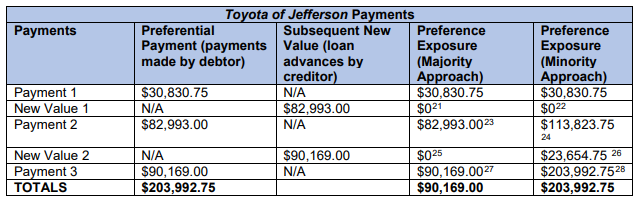
Decades later, the Third Circuit finally acknowledged the New York City Shoe's language as dicta.29 Uncertainties still persist. For example, under the minority approach, what if the subsequent new value remains unpaid until the debtor files for bankruptcy, but then is paid postpetition? What if, under the majority approach, the subsequent new value was paid postpetition by a transfer that was "otherwise unavoidable?" Enter section 503(b)(9).
III. The Impact of 503(b)(9) Administrative Claims on the Subsequent New-Value Defense
Section 503(b)(9) allows a creditor an administrative expense claim for the value of goods received by the debtor in the 20 day period preceding bankruptcy. Because administrative expense claims must be paid in full to confirm a plan of reorganization, they are, in some sense, unavoidable transfers. Against that backdrop, the question is whether a creditor's subsequent new-value defense is reduced to the extent such creditor receives payment pursuant to section 503(b)(9) on account of such new value? The Eleventh Circuit, in Auriga, held that payment of section 503(b)(9) administrative expense claims do not reduce a creditor's subsequent new-value defense.30
IV. Enter Auriga
In Auriga, the debtor was a major manufacturer and distributor of carpet and hard surface flooring products and the creditor was a vendor who supplied the debtor with certain materials.31 After filing for bankruptcy, the debtor confirmed a liquidating plan vesting all of its assets, including avoidance actions, in a liquidating trust.32 In the 90 day period before the debtor filed for bankruptcy, the debtor paid the creditor more than $2.2 million and the debtor received over $3.523 million in goods during that period.33 The creditor filed an administrative expense claim pursuant to 503(b)(9) for the goods transferred within 20 days of the debtor filing for bankruptcy and received a payment in the amount of $273,38234 (the difference between the full $694,502 administrative expense claim and the disputed $421,119) during the course of the bankruptcy case.35 The creditor forthwith filed a general unsecured claim for the remaining unpaid goods delivered more than 20 days prior to the petition date.36
The liquidating trustee filed a complaint, seeking to avoid the $2.2 million in pre-petition payments as preferences under section 547(b).37 The liquidating trustee and the creditor entered into a stipulation whereby the parties agreed that the $2.2 million in payments were all avoidable preferences, but that all but $421,119 of such payments were protected by the creditor's subsequent new value defense.38 Because that $421,119 was part of the creditor's section 503(b)(9) administrative expense claim, the liquidating trustee disputed the creditor's ability to also use it as part of its subsequent new-value defense.39 Thus, the case was limited to the narrow issue of whether payment of a section 503(b)(9) administrative expense claim constituted an "otherwise unavoidable transfer" negating a required element of the creditor's subsequent new-value defense.40
The bankruptcy court, consistent with its ruling in an earlier adversary brought by the liquidating trustee, held that funds held in reserve to pay section 503(b)(9) claims are "otherwise unavoidable" transfers for purposes of a section 547(c)(4) defense, and cannot be used to offset preference liability.41 The bankruptcy court, in reaching that decision, emphasized the silence of 547(c)(4) as to whether the "otherwise unavoidable" transfer take place prepetition or postpetition.42
The Eleventh Circuit reversed, noting the bankruptcy court's reliance on its previous decision in In re BFW Liquidation43 was misplaced given that the Court never said anything about the timing of "otherwise unavoidable" transfers in that case.44 The Court held that post-petition payments made pursuant to section 503(b)(9) are not "otherwise unavoidable" transfers for purposes of section 547(c)(4)'s subsequent new-value defense.45 In reaching this conclusion, the Court reasoned that a number of components of section 547 suggested the relevant transfers must be prepetition, including: (i) the statute's title, (ii) the requirement that new value be given prepetition (suggesting otherwise unavoidable transfers must also occur prepetition), (iii) that the statute of limitations begins to run on the petition date and (iv) that "transfer" should be presumed to have the same meaning throughout section 547(c)(4).46 The Eleventh Circuit joins the Third Circuit as the only two circuits to have directly addressed this issue, and both concluded that payment of section 503(b)(9) administrative expense claims does not preclude goods delivered within 20 days before the petition date from being subsequent new value.
Conclusion
While the Eleventh's Circuits decision in Auriga and the Third Circuit's decision in In re Friedman's Inc. should provide non-debtor suppliers and trade vendors some comfort, remember that the remaining circuits have yet to weigh in on this issue.
