

Duane Morris Takeaway: This week’s episode features Duane Morris partners Jerry Maatman and John Reade and associate Anshul Agrawal with their discussion of the key trends and developments analyzed in the 2026 edition of the ERISA Class Action Review.
Check out today’s episode and subscribe to our show from your preferred podcast platform: Spotify, Amazon Music, Apple Podcasts, Podcast Index, Tune In, Listen Notes, iHeartRadio, Deezer, and YouTube.
Episode Transcript
Jerry Maatman: Welcome, listeners! Thank you for being here on our weekly podcast series, the Class Action Weekly Wire. I’m Jerry Maatman of Duane Morris and joining me today are my colleagues John Reade and Anshul Agrawal. Thanks so much for being on our podcast.
John Reade: Thank you, Jerry. Happy to be part of the podcast.
Anshul Agrawal: Yeah, thank you for having me, Jerry.
Jerry: Today on the podcast we’re discussing publication of the third edition of the Duane Morris ERISA Class Action Review, which we published and posted on our Class Action Defense Blog this past week. John, can you tell our listeners a bit about this publication and desk reference?
John: Absolutely, Jerry. Duane Morris is pleased to present the ERISA Class Action Review for 2026, which analyzes the key ERISA-related rulings and developments in 2025, and the significant legal decisions and trends impacting this type of class action in 2026. We hope that companies will benefit from this resource to help with navigating these evolving laws and standards.
Jerry: Thanks so much. Let’s start with the big picture. We’ve seen quite a surge in ERISA class action litigation over the past decade, and especially in the last two years. What are the takeaways from the trend in the last 12 months?
Anshul: Yeah, so that trend absolutely continued over the past 12 months. The plaintiffs’ bar has remained very focused on challenging how fiduciaries manage 401(k) and other retirement plans. A huge portion of these lawsuits center on what we call, sort of, fee and expense claims. You know, allegations that plan participants were charged excessive fees, or offered investment options that were too expensive or underperformed.
John: And to add to that, there have been hundreds of these cases filed just since 2020. And while established plaintiffs’ law firms are still leading the charge, we’re seeing new entrants entering space, which is only accelerating the trend.
Jerry: Well, that’s quite a lot of activity and focus by the plaintiffs’ class action bar, and especially the advent of an ERISA plaintiffs’ class action bar. Let’s talk about the holy grail in these sorts of cases: the motion for class certification. How easy, how difficult is it for plaintiffs and defendants to fight over that motion at this stage of the litigation?
Anshul: It’s definitely very challenging. So, courts tend to view these cases as inherently suited for class treatment, because the alleged misconduct usually affects large groups of plan participants in similar ways. So even if there are differences in individual investments or benefits, courts often say that those differences go to damages, and not to whether a class should be certified.
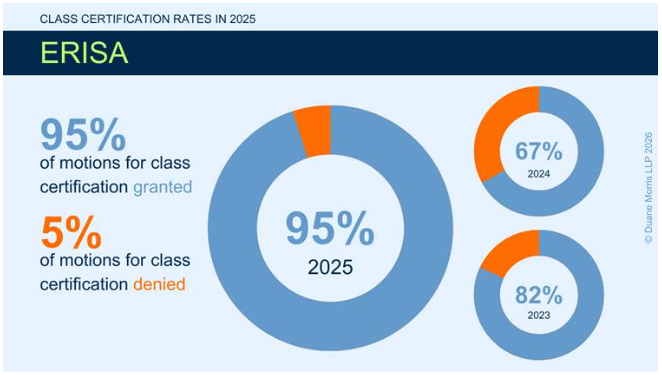
John: Right, and that’s why plaintiffs are so successful at this stage. In fact, just last year, in 2025, plaintiffs won class certification in 18 out of 19 cases. It’s about a 95% success rate.
Jerry: Kind of eye-popping success conversion ratio for plaintiffs, and kind of their mantra of find the claimant, file the lawsuit, certify the class, and then monetize it as the plaintiffs’ kind of approach. What do you see as the key attributes of a successful defense strategy, given that sort of statistical analytics underlying the class certification process?
John: Well, Jerry, the real battleground is early in the case. Defendants invest heavily in motions to dismiss, arguing that the plaintiffs haven’t stated a plausible claim. The idea is really to stop the case before it gets into expensive discovery and class proceedings.
Anshul: Exactly, so defendants often argue that plaintiffs are simply second-guessing fiduciary decisions with hindsight, you know, basically saying, oh, you could have picked cheaper or better investments, but without actually alleging a flawed decision-making process.
Jerry: How are the courts reacting to that sort of opposition and response by the plaintiffs’ bar?
Anshul: So I think that, you know, plaintiffs push back by saying that they don’t have access to the internal fiduciary process before discovery. So they argue that it’s unfair to require detailed allegations at the pleading stage, when that information is usually in the defendant’s hands.
John: And courts have been split on that issue. In 2025, like prior years, outcomes on motions to dismiss and standing challenges were mixed and very fact-specific.
Jerry: Well, taking a page from your book, John, about trying to stop these cases before they get started. The U.S. Supreme Court obviously has decided in the employment-related space quite a few arbitration issues, and one way to stop a class action before it starts is with an arbitration agreement with a class action waiver that forces the claim and an individual arbitration claim. How is that working, or what are the limits to that defense in the ERISA space?
John: Yeah, unfortunately, there has not been a big shift to arbitration and enforcement of that. In 2025, courts were actually more inclined to deny motions to compel arbitration in ERISA cases and were hesitant to enforce class action waivers. Despite these broader trends that you mentioned favoring arbitration, ERISA cases are being treated differently, and courts seem reluctant to limit participants’ ability to bring class-wide claims.
Jerry: A very interesting divergence in terms of the case law. Were there some major legal developments on the ERISA front this past year that would inform this sort of decision-making?
Anshul: Yes, so one of the biggest was the Supreme Court’s decision in Cunningham v. Cornell University, which clarified and, you know, arguably lowered, the pleading standards for prohibited transaction claims under ERISA. In siding with the plaintiffs, the Supreme Court in this case held that Section 1108 exceptions are affirmative defenses, not implied elements, and that a plaintiff need only provide a plausible argument that Section 1106 has been violated in order to survive a motion to dismiss.
John: And another major trend is the rise of 401(k) forfeiture claims. These cases focus on how plan sponsors use forfeited employer contributions. The Internal Revenue Code gives employers, plan sponsors latitude on this area, but plaintiffs argue that those funds should reduce administrative costs for participants and not benefit the employer. Litigation tied to ESG investing decisions and even planned surcharges on tobacco users show how ERISA litigation continues to evolve into new areas.
Jerry: Well, it’s certainly true that treatment of 401(k) forfeitures and the rise of ESG investing are reshaping the ERISA landscape. I see it every morning when we check the docket of the new class actions filed around the country. This is certainly a burgeoning area under ERISA. High certification numbers typically beget settlements. How did the plaintiffs’ bar do in terms of taking down major ERISA settlements in 2025?
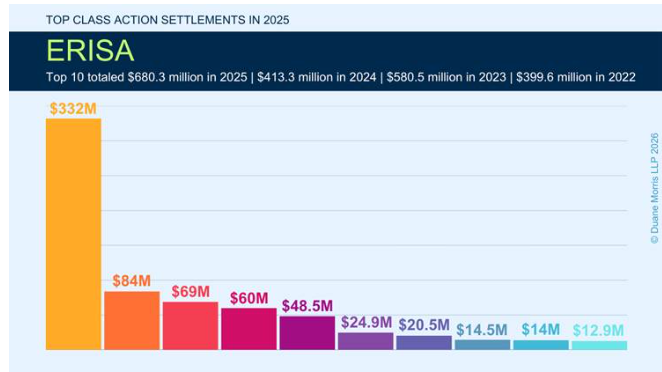
John: Very well. Plaintiffs did very well in securing high-dollar settlements in 2025. The top 10 ERSA class action settlements totaled over $680 million, which was a significant increase from 2024, when the top 10 yielded $413 million, and from even 2023, where the top 10 class action settlements totaled $580 million.
Jerry: Well, we’re tracking those numbers day by day in 2026 in terms of the record-breaking numbers underlying ERISA class action settlements. Well, thank you, gentlemen, for being here and joining us, and thank you, loyal listeners, for tuning in. Please stop by our blog and download a free copy of the ERISA Class Action Review e-book.
John: Thanks for having me, Jerry, and thanks to all your listeners.
Anshul: Yes, thank you, Jerry, and thank you all for tuning in to the Weekly Wire.
