


On 14 December 2023, the Commonwealth Government released the Exposure Draft of the new Aged Care Bill 2023 (New Act).
The New Act is the centrepiece of ongoing legislative reforms in response to the recommendations made by the Royal Commission into Aged Care Quality and Safety. The Exposure Draft amends existing provisions and introduces new provisions which are based on the rights-based approach recommended by the Royal Commission.
The Exposure Draft contains several placeholder provisions and as the Government has not yet released an Exposure Draft to the proposed new subordinate Rules (New Rules), many aspects of the operation of the new regulatory model remain unclear.
In this update, we provide an overview of the New Act and some of the impacts it may have on providers.
OLDER PEOPLE AT THE HEART OF THE NEW ACT
The New Act places older people at the focal point of the legislative framework, with the intention to foreground consumer choice, dignity, control and safety clearly filtered through the new provisions.
This is a significant shift from the Current Act which is grounded on fees and payments, and providers.
KEY FOUNDATIONAL CHANGES

STRUCTURE: The New Act will be accompanied by one set of New Rules, replacing the branched structure that currently regulates the sector.
RIGHTS-BASED APPROACH: Underpinning the focus on older people is the human rights-based approach of the New Act. This is foregrounded in the Statement of Rights and Objects in the New Act.
CONSTITUTIONAL POWER: While the Current Act draws on the Commonwealth’s corporations power, the New Act relies on the external affairs power, which allows the New Act to shift its focus from providers to the rights of care recipients (now referred to as ‘Individuals’ in the New Act).
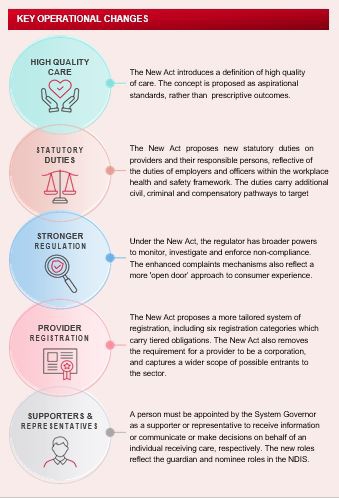

KEY IMPACTS ON PROVIDERS OF AGED CARE
- The New Act signals a 'step up' in expectations on providers and their responsible persons, with these heightened obligations subject to strengthened regulatory powers introduced under the New Act for the Aged Care Quality and Safety Commission. However, the New Act places a greater emphasis on 'relational regulation' and aims to drive cultural change and improve quality outcomes for older people.
- The overarching shift of the New Act towards a more person-centred approach grounded in a human-rights focus will possibly require providers to take a more proactive approach to strengthening their internal policies and procedures to promote resident care and experience
- Providers should consider their workforce training and supports to assess their appropriateness against the proposed expanded whistle-blower protections, heightened standards of care and upcoming worker screening requirements and ensure sustainability against the need to upskill workforces to meet enhanced expectations around consumer care.
- While the legislation appears to capture residents receiving aged care services in Retirement Village settings under its protections, in our view, at this stage the legislation does not make it clear that it intends to introduce the operators themselves into the legislative framework. Ultimately, the impact of the legislation on Retirement Village operators will depend on the breadth of services being delivered in villages by the operator.
- The impact of the new provider registration regime changes will stem largely from the graduated registration requirements imposed on various categories, and the consequential obligations that will align with certain groups of providers. For example, category-specific conditions will see some providers needing to comply with stricter requirements, such as maintaining adequate Incident Management Systems, ensuring compliance with the Aged Care Quality Standards, or demonstrating the capability for and commitment to continuous improvement. The regulator's enforcement powers which are linked to registration will also interplay with the registration categories.
