


Today’s announcement on the UK’s Electronic Travel Authorisation (ETA) scheme finally sheds light when it will be expanded to the remaining 83 other countries.
The rules confirm that the ETA scheme will be fully rolled out to all applicable countries by April 2025 – later than the original end of 2024 deadline.
The ETA scheme first launched in October 2023 for Qatari nationals before expanding to nationals of GCC countries (Bahrain, Jordan, Kuwait, Oman, Saudi Arabia and the United Arab Emirates) in February 2024.
Applying for an ETA means that all relevant travellers (including EU/EEA/Swiss, US, Australian and Canadian nationals) will need to declare criminal convictions and any adverse UK immigration history. According to the Government press release before the ETA scheme was first launched, the US ESTA-style scheme will “slam the door on criminals before they even get here”.
This blog looks at what the ETA system will look like, how it will impact travellers and whether the UK’s immigration authorities will be able to deal with the additional visa casework the new system will bring. It includes statistics on the number of visitors to the UK that could be affected.
More information (including other blogs and our ETA FAQs) can be found on our ETA webpage. Watch out for details of our upcoming webinars in which we will discuss the latest changes to the ETA scheme.
Timing of implementation
It has now been confirmed that the ETA will be rolled out to the remaining countries as follows where someone is travelling to the UK:
- On or after 2 April 2025 (and can start to apply for an ETA from 5 March 2025) – all applicable EU and EEA counties plus Switzerland including Andorra, Austria, Belgium, Bulgaria, Croatia, Cyprus, Czechia, Denmark, Estonia, Finland, France, Germany, Greece, Hungary, Iceland, Italy, Latvia, Liechtenstein, Lithuania, Luxembourg, Malta, Monaco, Netherlands, Norway, Poland, Portugal, Romania, San Marino, Slovakia, Slovenia, Spain, Sweden, Switzerland and Vatican City.
The US ESTA - a warning for travellers
Many readers will be familiar with Electronic Travel Authorisations and e-visas used in various countries. The US, for example, has operated the Electronic System for Travel Authorization (ESTA) since January 2010, requiring all travellers from Visa Waiver Program participant countries coming for visits to the United States to complete an online form and pay a fee prior to travel. The form asks applicants to reply to eligibility questions including about whether they have “been arrested or convicted for a crime that resulted in serious damage to property or serious harm to another person or government authority?” If the answer to that question (or any eligibility question) is “yes”, then the ESTA application will be denied. The applicant may then be able to apply for a B-1 visit visa at a US Consulate abroad and request a “waiver of inadmissibility”. This is a complex, expensive and time-consuming process, requiring advice from specialist US immigration lawyers. It can often take many months and in many cases these requests are denied.
These denials affect travellers across the whole spectrum, including celebrities, senior executives on business trips and ordinary leisure travellers who at some stage in their lives have come into contact with the criminal justice system. Even a caution for drug possession can result in denial.
The current position with visitors coming to the UK
Travelling to the UK as a visitor with a criminal conviction
Since 1 December 2020, new Immigration Rules regulate the way in which criminal convictions can lead to the refusal of entry to the UK or a UK visa.
The rules mean those who have received a custodial sentence of 12 months or more (even if they have served less time) or whose offending is persistent or has caused “serious harm”, face a permanent mandatory refusal of any visa or request for admission. It does not matter when the sentence was received and as there is no discretion, even those with very historic sentences find it hard to argue against this mandatory refusal unless there are exceptional circumstances.
For those with custodial sentences of less than 12 months, they face refusals for 12 months after the end of any custodial sentence and even those with non-custodial sentences or other out of court disposals face a refusal for 12 months from the date of conviction. This means there is effectively a 12-month exclusion period after the end of their sentence or date of conviction.
There are dozens of countries whose nationals can come to the UK without a visa. This includes the EEA, the US, Australia, Canada, New Zealand, Singapore, Japan, South Korea, the list also includes Brazil, Mexico, Argentina and Chile. Non-visa countries account for a total population of over 1.5 billion.
Non-visa nationals do not need to be pre-cleared before travelling. They can simply board a flight and arrive at the UK border. Certain privileged nationalities (EU/EEA/Switzerland, Australia, Canada, Iceland, Japan, Liechtenstein, New Zealand, Norway, Singapore, South Korea and the USA) are authorised to use e-Gates at UK ports of entry and can be admitted without even seeing a border official and being asked any questions.
Travellers who go through the “all other passports” queue are typically asked about the length and purpose of stay. They are not routinely asked whether they have criminal convictions. This essentially means that non-visa nationals are never asked to answer questions about criminal convictions. The only exception is where their name features on a database where details of serious convictions (sexual offences, drugs, serious violence and terrorism) have been shared with the UK through international criminal justice cooperation channels such as Europol, INTERPOL or through the “5 Eyes” group (the UK, USA, Canada, Australia and New Zealand).
The likelihood is, therefore, that most non-visa nationals will not currently have issues on arrival in the UK. As a result, business travellers who have minor or even historic convictions never need to disclose these unless they are specifically asked a question by an Immigration Officer which they are required to answer truthfully.
What is going to change?
The Immigration Rules on the ETA system make it clear that the key eligibility criteria for an ETA are the “suitability” requirements for those visiting the UK, which in essence looks at their criminal history, any other non-conducive grounds as to whether they can come to the UK and whether they have previously breached UK immigration law or made false representations. This means that many people who have been visiting the UK without issue will now find themselves being refused an ETA and directed to apply for a visa.
How do you apply for an ETA?
The application can be made on a mobile device using the UK ETA app. Applicants scan their passport, take a selfie and complete a questionnaire with personal details, previous immigration history and details of any criminal convictions.
The rules released today also include two new grounds for refusal of an ETA: (i) the applicant has previously had a visitor visa application refused (and it was not subsequently approved) and (ii) where someone has had an ETA cancelled (and they have not subsequently been granted a UK visa).
The cost of an ETA is £10 per person. This is “competitive” when compared to the €7 to be charged for the ETIAS and the USD$ 21 charged for an ESTA.
The Home Office will carry out checks and decisions should be made within 3 working days, but if further checks are required it may take longer.
If successful, ETAs will be granted for two years or to the expiry date of the applicant’s passport, whichever is sooner. Airline carriers and UK Border Force officials should be automatically notified that someone has an ETA.
The impact of the ETA on visitors
While the ETA will do much to level the playing field as between visa and non-visa nationals coming to the UK as visitors in that all visitors will have their criminal background checked, it will create a plethora of new cases in relation to visa refusals on the basis of criminality. The introduction of the ETA will increase these types of cases very significantly.
For most the ETA will be a simple additional administrative hurdle but the real challenge will be for those who do not qualify for an ETA and will instead have to face the significantly more complex, costly and time-consuming process of applying for a visit visa.
The Home Office has previously said it expects there to be around 30 million applications for ETAs a year once the system is fully operational. If only 1% of those have criminal convictions which would not have previously been needed to be disclosed, that will generate (assuming they all apply) an extra 300,000 visa applications which the Home Office will need to process.
The ETA is partly intended to flush out those who might not meet the rules or qualify for permission to enter as visitors by allowing the UK more time and information to run background checks and catalogue who’s travelling to the UK before they actually arrive. It seems likely that those with criminal convictions or previous immigration breaches who have not been caught by the lack of sophistication in the checks, may start to encounter difficulties.
How many non-visa nationals come into the UK as a visitor?
In May 2019 the Government removed the need for all non-EEA travellers to fill in landing cards upon arrival in the UK and expanded the use of eGates. That has meant the Home Office no longer has a breakdown of data by nationality showing the number of people who have entered the UK. But if we look at the last available data back pre-pandemic in 2018, we can see that the top 10 non-EEA nationalities for entry to the UK as a visitor were:
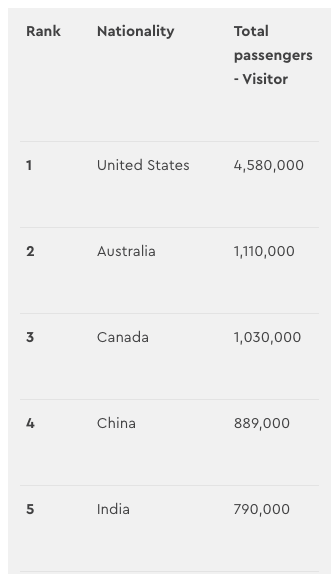
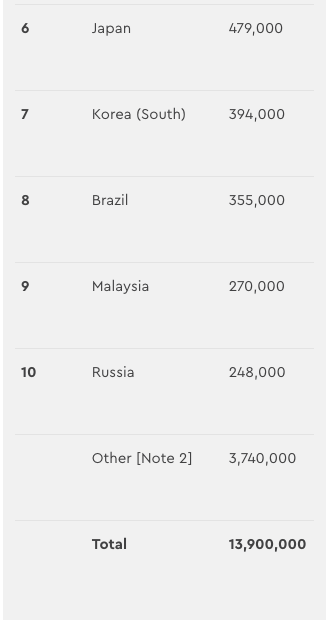
Of those nationalities, it is the US, Australia, Canada, Japan, South Korea, Brazil and Malaysia which as non-visa national countries will need to apply for an ETA as non-visa nationals.
The highest number of visitors by far were from the US. Looking at the US alone, according to some reports, as many as one in three adult US citizens could have a criminal record. Whilst it is difficult to know exact figures and what types of offences may have been committed (and indeed whether being arrested counts), out of the 4.58 million US national visitors to the UK in 2018 it is easy to see that on any view a huge number of people could have an issue if they applied for an ETA to the UK.
Will the Home Office be able to cope with the increase in visitor visa applications and are there any issues for employers?
Many visa applicants across all visa routes (including visits, work and family) have frequently seen very long delays – especially when changes are made for example the Ukraine schemes and the British National (Overseas) visa and the UK’s Home Office redeploys staff. There are real concerns around the capacity of Home Office staff to deal with this additional caseload, much of which will be complex due to the need to consider criminal issues with such cases already often severely delayed. The Home Office have stated that they are aware of the likely increased visa demand and that this is factored into their capacity planning.
The other issue is that employers will have to deal with employees having to disclose their historic or recent criminal convictions which might normally be treated as “spent” or expunged and not disclosable in relation to their employment. To date for example, a US executive who travels frequently to the UK and the EU will not have to disclose this information, but all that will change in January 2025 when US nationals need to apply for an ETA.
The well-publicised issues faced by travellers to the US are likely to be replicated not only in the UK but in the EU as more and more visa-free visitors are required to provide details of their past indiscretions. We expect that much litigation will flow from this and that the UK courts may be dealing with many more cases of judicial review of decisions to exclude people on criminality grounds, as there is currently no right of appeal against refusal of a visit visa.
It is entirely likely that many individuals will not complete these processes properly before travelling, or will encounter technical issues which will emerge and need to be resolved at the border or when boarding a flight, so expect border delays and problems once the scheme has been rolled out more extensively.
Not to get caught out or risk becoming flustered at an airport – travellers should do the digital paperwork well in advance of boarding their flights when their time to apply comes around.
