


This chapter provides an overview of the key legal landscape governing employment in Thailand.
1. Relevant laws and regulations
In Thailand, except for government and state enterprises officer/administration, all employment arrangements in Thailand are governed by the following Thai labor laws and regulations:
- Thai Civil and Commercial Code (the “CCC”), the main body of laws that institutes rights and obligations of private persons (natural and juristic persons) across broad area of laws including law of contracts which is the work of employment relationship under contractual basis;
- Labor Protection Act BE 2541 (1998) (as amended) (the “LPA”), the law that governs standard relationship between employer and employee including working conditions in private sector;
- Labor Relation Act BE 2518 (1975) (as amended), the law that sets out matters in relation to collective bargaining between employer and employee to encourage more stable work and better quality of employee’s life;
- Social Security Act BE 2533 (1990) (as amended), the law that sets out requirements for both employer and employee for a contribution to a social security fund and other related matters; and
- Emergency Decree on Administration of Aliens Working BE 2560 (2017) (as amended), the law that governs foreign workers employment in Thailand and impose penalties for both employer and foreign employee who fails to observe the law.
2. Legal Definition of Employment
Under the LPA, there is no legal requirement on a form of employment agreement, thus any written or oral agreement that clearly states that an employee who agrees to work for an employer to whom such employer agrees to pay a salary or wage in return for the work done by the employee constitutes an employment relationship. The relationship between the employer and the employee under the employment agreement shall be primarily governed by the LPA. An employment relationship is distinct from a “Hire of Work”, which is a relationship between the employer and a contractor and which is governed by the CCC.
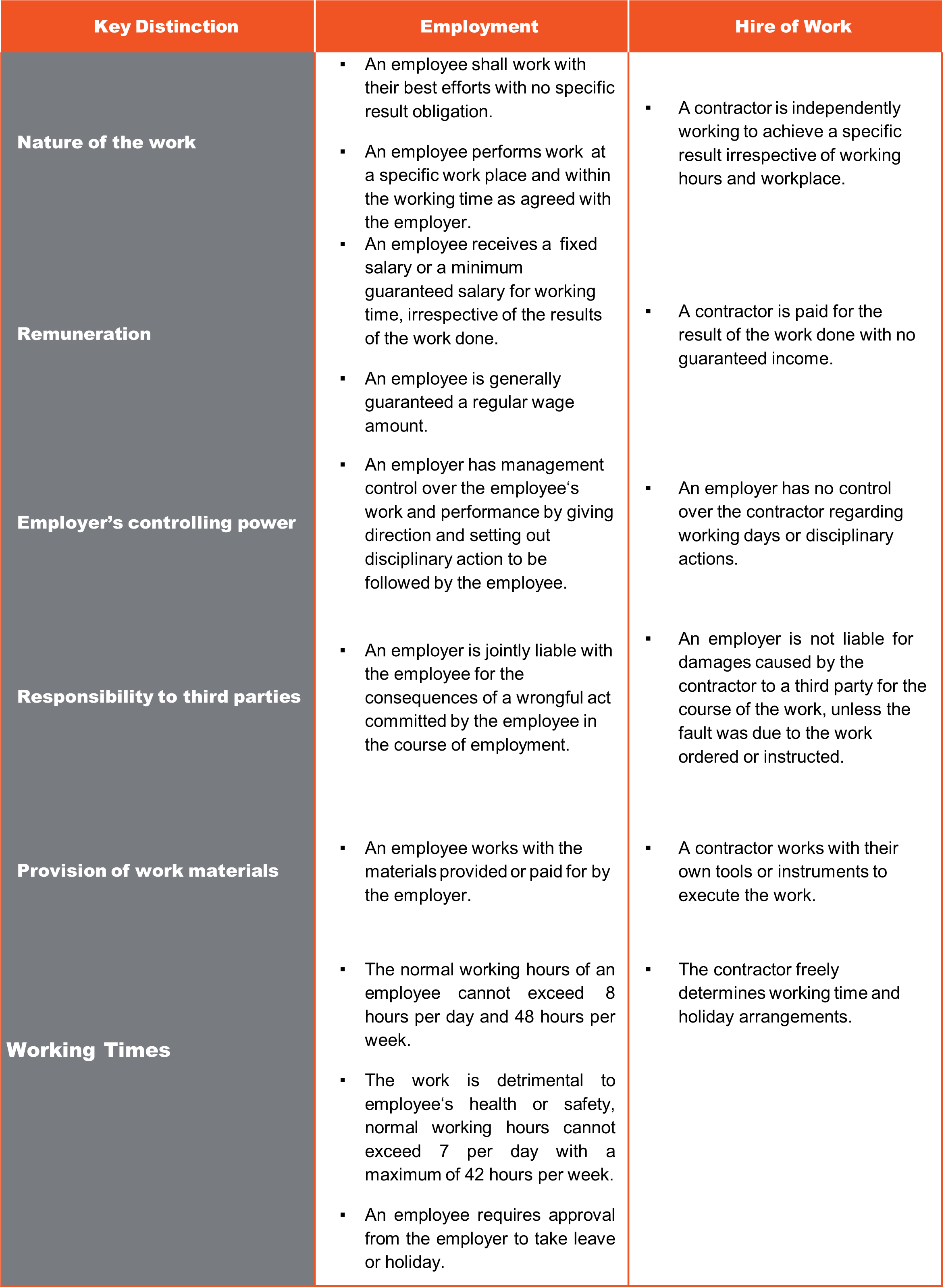
The following are key distinctions differentiating Employment and Hire of Work;
Under the employment agreement, the employees could be classified into;
I. Fixed-term employees
An employee who is employed for a specified period. The fixed-term employment will automatically terminate upon the expiry of the contract, without requiring any notice of termination, provided that it must be clearly stated in the employment agreement.
Under the LPA, the fixed-term employees must be employed for a period of not exceeding 2 years for a special project which is not in the normal course of business or trade of the employer. Once the employment period ends, the fixed-term employee is not entitled to severance pay benefits.
However, if a fixed-term employment contract contains the following details or clauses, it will not be considered as fixed-term employment but permanent employment:
- scheduled contract terms more than 2 years; or
- allows the employer to terminate the contract at any time on their sole discretion prior to the end of employment terms; or
- allows the employer to extend the probation period or terminate the contract any time at their own will prior to the end of employment terms;
II. Permanent employees
An employee who is employed for an unlimited term of employment. Permanent employees are entitled to overtime payment and holiday pay, including severance pay, where applicable.
3. Entitlement to Statutory Employment Rights
All employees are entitled to the minimum statutory entitlements provided by the LPA, as well as benefits from the Social Securities Fund and Workmen’s Compensation Fund. In contrast, contractors are not entitled to these employment rights and benefits, since the relationship with the employer is governed mainly by the CCC.
Any dispute relating to an employment relationship must be brought before the Thai Labor Court, while disputes relating to the independent contractor relationship are brought before the Thai Civil Court. The following are key statutory employment rights under LPA;
I. Wage
Employees are entitled to a minimum wage when necessary. Please note that in Thailand, the minimum wage varies in each province.
If an employer fails to comply with the payment of the minimum wage or skilled worker minimum wage, the employer may be subject to imprisonment for a term of six months or less or fine of no more than THB 100,000 or both.
II. Working hours and Holiday
In principle, working hours must not exceed 8 hours per day and 48 hours per week. If the working hours are less than 8 hours in one day, the employer and employee may agree to add the remaining time to the working hours of another work day. However, note that the working hours mentioned above may be different for some types of work, subject to delegated legislation prescribed by the Ministry of Labour.
Employers may not require employees to work on holidays. If an employer requires an employee to work on holidays, it must be a case where the nature or condition of the work requires continuous performance, a break from work would obstruct the performance of work due to the nature of the work or in case of an emergency, and to the extent necessary. In addition, employers may require an employee to work on a holiday where the place of business is prescribed by the Labour Ministerial Regulations.
Employers must grant employees at least one holiday per week and there must not be more than a six-day interval between holidays. Moreover, employers must determine 13 or more public holidays as announced annually by the Thai government.
III. Overtime and holiday pay
It is generally necessary for an employer to obtain consent from an employee in order to require the employee to work overtime, to work on a holiday, or to work overtime on a holiday. Further, the employer may require the employee to work overtime only when necessary or when prescribed by Labor Ministerial Regulations.
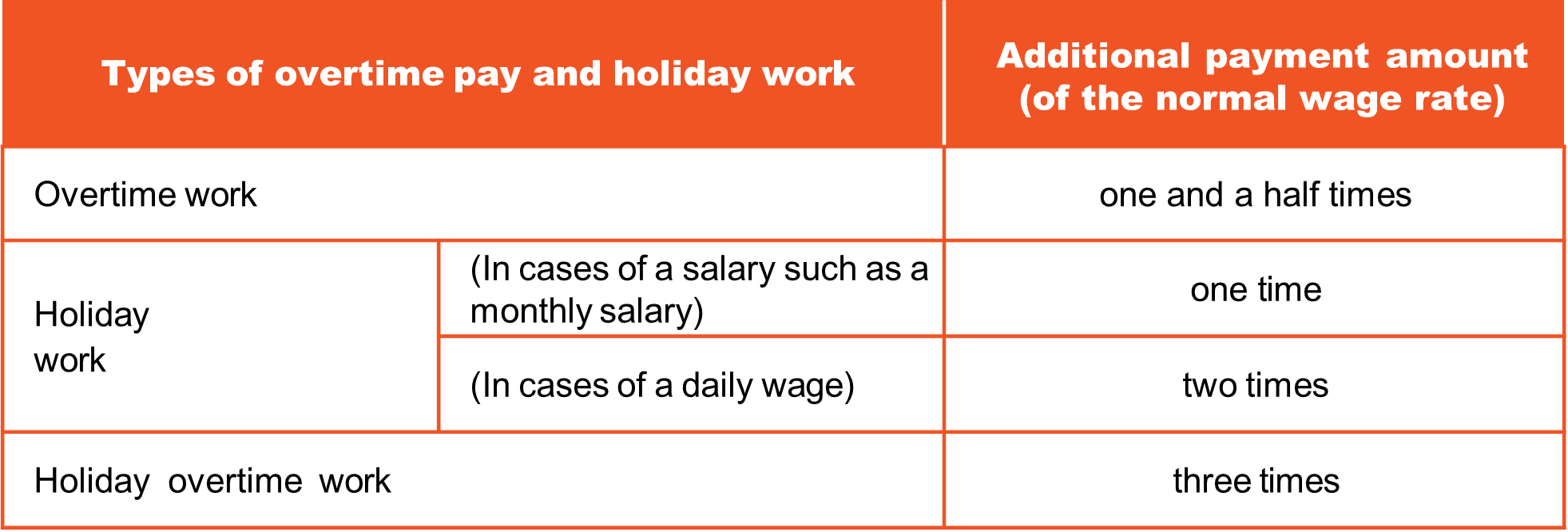
If working overtime and/or work on holiday is required, an employer must pay employees an overtime payment or a holiday pay (as the case maybe) at the rate stipulated by law as follows;
I. Leave
Employees are entitled to at least 13 public holidays each year, which include the National Labor Day. Employees are also entitled to the following leaves pursuant to Thai labor law:
- Annual Leave
Employees who have worked continuously for at least 1 year are entitled to annual paid leave of at least 6 working days per year.
- Sick Leave
An employee is entitled to sick leave as long such employee is actually sick but the employer is obliged to pay wages for no more than 30 working days of sick leave per year.
In an event that the employee is absent for at least 3 consecutive days, the employer may require the employee to submit a medical certificate from a first-class medical practitioner or a government hospital. If the employee is unable to do so, the employee must provide an explanation to the employer.
- Maternity Leave
Pregnant employees are entitled to maternity leave for the maximum of 98 days per childbirth, and such 98-day leave must include leave days for pregnancy check-ups prior to delivery and holidays. The employer is obliged to pay wages for not less than 45 days of the 98 days of maternity leave.
- Sterilization Leave
Employees are entitled to sterilization leave for the required period as prescribed in a medical certificate from a first- class medical practitioner submitted to the employer and the employer must provide wages for all sterilization day leave.
- Personal Affairs Leave
Employees are entitled to at least 3 working days of personal leave per year and the employer must provide wages for only 3 days personal leave per year.
- Military Service Leave
Employees are entitled to military service leave in order to receive inspections, military training, or service according to the law related to military service and the employer must provide wages for up to 60 days of military service leave per year.
- Professional Development and Training Leave
Employees are entitled to take professional development leave in order to receive training or develop skills in accordance with Labor Ministerial Regulations.
4. Employment of Female Labour
The employers are not allowed to require a female employee to perform certain works such as mining or construction work which is to be performed underground, under water, in a cave, in a tunnel or mountain shaft, or working on a scaffold of 10 meter or more above the ground, or producing or transporting of explosive materials.
The employers must not terminate the employment of a female employee because of her pregnancy, and employers are prohibited from requesting a pregnant employee to work between 10.00 p.m. and 06.00 a.m., to work overtime, or to work on holidays.
The employers are also prohibited from requesting the pregnant employee to perform any of the following work:
- work involving vibrating machinery or engine;
- work of driving or going on a vehicle;
- work of lifting, carrying on the back, carrying on shoulder, carrying with a pole across shoulder, carrying on a head, pulling or pushing of loads in excess of fifteen kilograms;
- work on a boat; or
- any other work as prescribed in the Ministerial Regulations.
5. Employment of Child Labor
An employer shall not employ a child under 15 years of age as an employee.
A child under 18 years of age may be employed, but he or she must not be required to work overtime or on a holiday, or to work between 10.00 p.m. and 06.00 a.m. (unless written permission is granted by the competent authority).
The employer of a child labourer must also provide a resting period of not less than 1 whole hour after he or she has worked for not more than 4 hours; and during the period of such 4 hours, the child employee shall have a resting period as specified by the employer.
In addition, a child labourer must not be required to work in places such as slaughterhouse, gambling place, and recreation place, and he or she must not be required by the employer to work in the following establishments:
- metal smelting, blowing, casting or rolling;
- metal pressing;
- work involving heat, cold, vibration, noise and light of an abnormal level which may be hazardous as prescribed in the Ministerial Regulations;
- work involving hazardous chemical substances as prescribed in the Ministerial Regulations;
- work involving poisonous microorganisms which may be a virus, bacterium, fungus, or any other germs as prescribed in the Ministerial Regulations;
- work involving poisonous substances, explosive or inflammable material, other than work in a fuel service station as prescribed in the Ministerial Regulations;
- driving or controlling a forklift or a crane as prescribed in the Ministerial Regulations;
- work using an electric or motor saw;
- work that must be done underground, underwater, in a cave, tunnel or mountain shaft;
- work involving radioactivity as prescribed in the Ministerial Regulations;
- cleaning of machinery or engines while in operation;
- work which must be done on scaffolding ten meters or more above the ground; or
- other work as prescribed by law.
6. Termination of Employment
An employer or employee can terminate an employment contract by giving advance notice to the other party before the wage payment due date (if wages are paid monthly, it should not be more than 3 months), in order for the termination to be effective on the following wage payment due date.
However, if the employer wishes to terminate the employment contract with immediate effect, without an advance notice period, the employer must pay the wage that the employee would have received during the advance notice period. This payment is so-called a payment in lieu of advance notice.
In addition, if the termination is due to the employee’s serious misconducts, the employer is not obliged to provide advance notice of termination, or payment in lieu of advance notice, or severance pay. Such serious misconduct consists of the following:
- the employee performed his or her duty dishonestly or intentionally committed a criminal offence against the employer;
- the employee wilfully caused damage to the employer;
- the employee committed negligent acts causing serious damage to the employer;
- the employee violated a work rule, regulation or lawful and fair order of the employer, and after the employer has already issued a written warning to the employee. Such written warning shall be valid for a period not exceeding 1 year from the date of the offence commitment;
- the employee is absent from duty without justifiable reason for 3 consecutive working days regardless of whether there is holiday in between; or
- the employee was being sentenced to imprisonment by a final court judgment.
For termination of employment due to serious misconduct, the employer must provide a written notice stating the reason for the termination. If the employer has not done so, the employer cannot afterwards claim for such cause.
7. Severance Payments
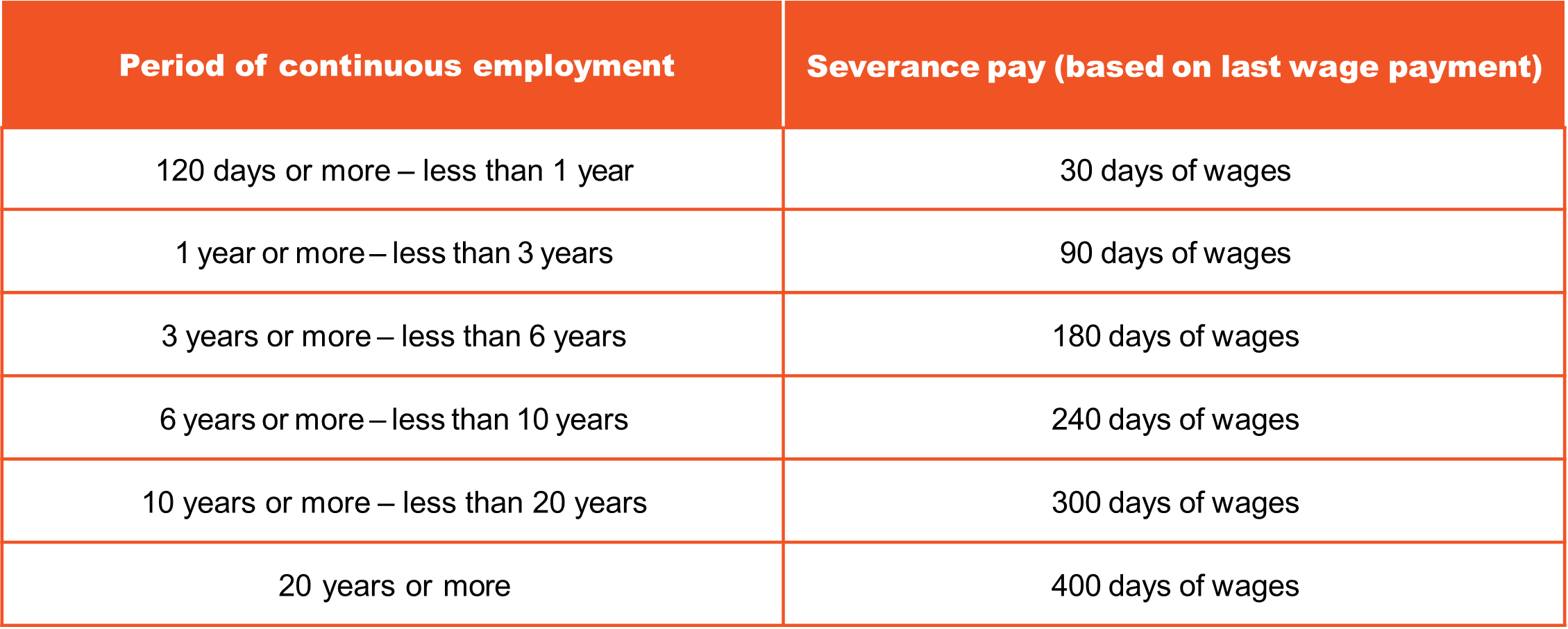
An employee who has been terminated without serious misconduct causes is entitled to statutory severance pay. The amount of statutory severance pay is based on the employee’s length of service with the employer, as follows:
A terminated employee is also entitled to:
- any outstanding salary or other expenses;
- payment of in lieu of advance notice (if advance notice is not given);
- payment for accumulated holidays in the previous year; and
- payment for unused leave of the current year on a pro-rata basis.
8. Social Security Fund
Social Security Fund (the “SSF”) is established to provide security and coverage to the insured employees so that the ensured employees shall receive compensation in case of injury, sickness, invalidity, and death which are not caused by employment, including, childbirth, child allowance, old age, and unemployment.
The employers are required to register their employees with the Workmen’s Compensation and Social Security Fund. Both the employee and the employer must contribute to the SSF on a monthly basis, at a rate of 5% (each) of the of the employee’s salary. The monthly salary base is capped at THB 15,000, so the maximum monthly contribution amount from the employee and the employer is THB 750 each.
9. Employee Committee
A workplace having 50 or more employees may establish an employee committee as the representative of all employees to discuss and negotiate with employer on employment welfare, work rules, employee’s complaints including compromising and settling dispute in a work place. The employee committee may petition the Labor Court for a decision regarding any act of the employer which may be unfair or causes excessive grievance to the employees.
The employee committee is protected by laws against being dismissed, punished or obstructed to perform their duty by the employer unless approved by the Labour Court.
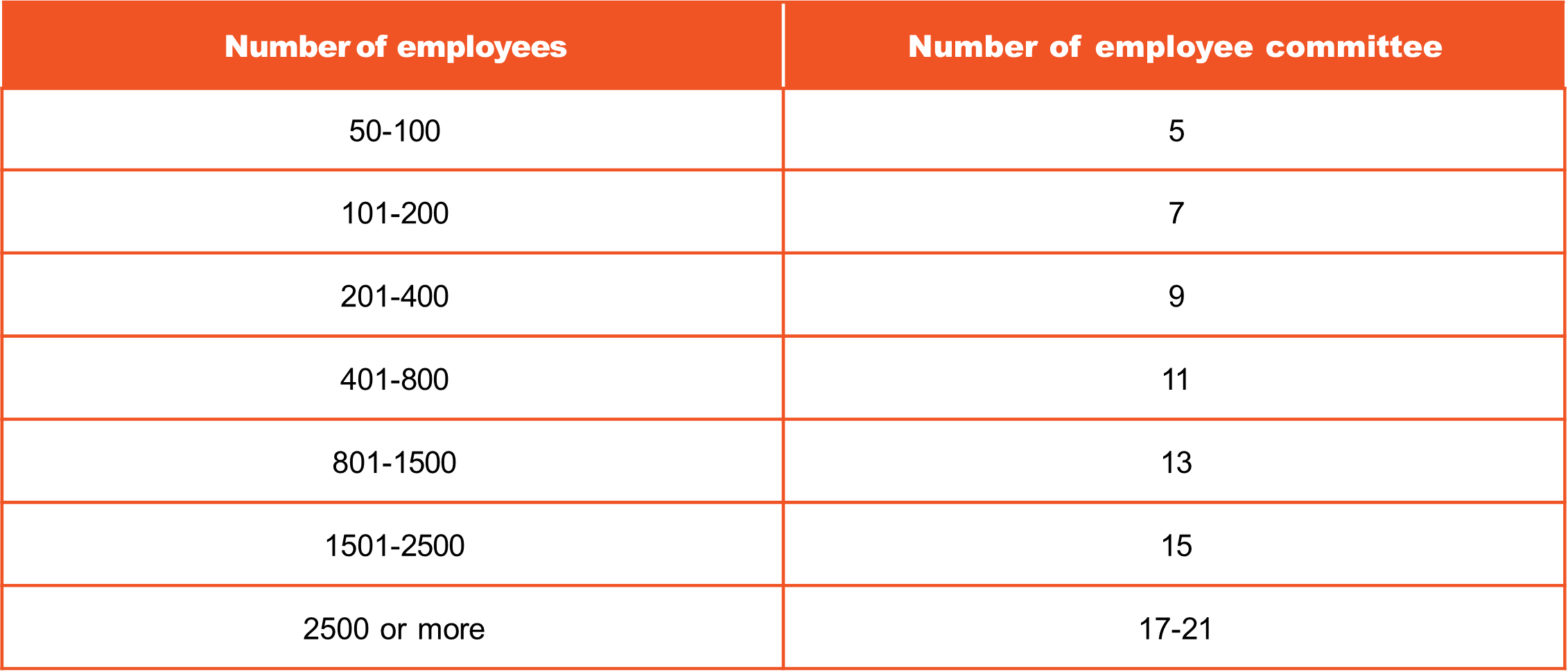
The number of the employee committee to be appointed or elected by the employees is based on the total number of employees of the work place as follows:
10. Foreign Worker
All foreign nationals are prohibited from working in Thailand unless a work permit is granted to allow such foreign employee to engage in any occupation except for reserved occupation and/or profession for Thai nationals where foreigners are prohibited to engage i.e. wood carving, cloth weaving by hand, brokerage or agency, tour guide, hairdressing including professional in relation to accounting, legal, architectural, engineering etc.
Any foreign employee who works without a work permit or engage in any reserved occupation for Thai, shall subject to imprisonment of not more than 5 years or a fine of between THB 2,000 to THB 100,000, or both.
In addition, an employer who employs a foreign employee who does not have a work permit or employs a foreign employee to work on the reserved works shall also subject to a fine from THB 400,000 to THB 800,000 per one foreign employee employed.
