

Divisional applications are a critical tool for enhancing patent portfolios in both Japan and the U.S., yet the strategic considerations for their use differ significantly between the two countries. In Japan, divisional applications provide unique opportunities for applicants to
continue prosecution while expanding patent protection, but the process comes with strict time constraints. Understanding these differences is essential for applicants seeking to maximize the value of their intellectual property in both jurisdictions.
Understanding Divisional Applications
In the U.S., divisional applications are typically filed to claim distinct inventions excluded due to a restriction requirement (35 USC 121), with the filing date of the parent application preserved. U.S. applicants benefit from multiple options for continuing prosecution, including Continuation-in-Part (CIP) and Request for Continued Examination (RCE), allowing flexibility in addressing rejections and introducing new material.
Japan, however, operates under a more restrictive framework. While a divisional application may be filed to enhance patent portfolios and extend claim scope, it must be done within specific time limits. Importantly, Japanese law does not allow for CIP filings, meaning that new matter cannot be introduced after the initial filing. As a result, applicants must carefully draft their claims to avoid double patenting, which arises when claims are identical or substantially identical to those of the parent application.
Key Differences in Timing and Process
The primary distinction between the U.S. and Japan is the timing of divisional filings. In Japan, applicants must file divisional applications within a limited period, often during the response period for an Office Action or immediately after a patent grant but before registration. This contrasts with the U.S., where divisional applications may be filed at any point during the pendency of the parent application, offering greater flexibility.
Another critical consideration is that Japan allows the suspension of examination of a divisional application while the parent application is pending, enabling applicants to refine claims based on the progress of the parent case. This suspension offers a significant strategic advantage for those looking to expand their patent portfolio, but it requires foresight, as the opportunity to file a divisional application closes after the appeal stage in most cases.
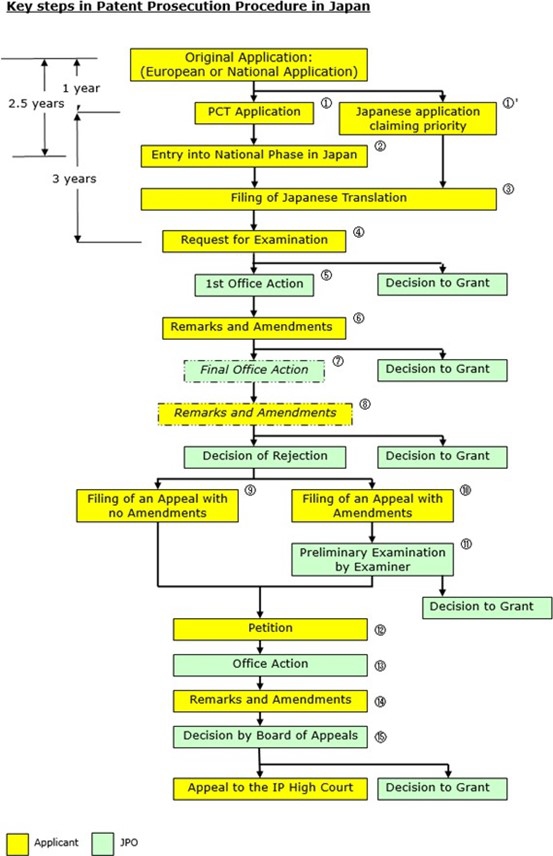
A divisional application can be filed:
- at any time before receiving the first Notice of Reasons for Rejection (any time between ①’ and ⑤ or between ② and ⑤);
- within the three-month period (extendable up to another three months) for filing a response to each Notice of Reasons for Rejection (either of ⑥, ⑧ or ⑭);
- at the time when an appeal is filed against the Decision of Rejection (either of ⑨ or ⑩);
- within the four-month period for filing an appeal against the Decision of Rejection (even if the appeal is not actually filed) (after the box of “Decision of Rejection” in the flowchart, even if the appeal is not actually filed); and
- within the thirty-day period after receiving the Decision of Grant in the regular examination (NOT after filing an appeal) (after the first three “Decision to Grant” boxes among the five “Decision to Grant” boxes in the flowchart).
Strategic Considerations
When filing divisional applications in Japan, applicants should carefully weigh several factors:
- Scope of protection: Divisional applications allow for additional aspects of an invention to be patented, which can help build a robust patent portfolio. However, because new matter cannot be added, careful attention must be paid to the claims at the time of filing.
- Timing: In Japan, divisional applications must be filed within a strict timeframe, typically before the parent application is registered. Late decisions to file a divisional can lead to missed opportunities, especially since registration can happen rapidly after fee payment.
- Double patenting: Applicants must ensure that divisional claims do not overlap with the parent application’s claims, in order to avoid rejections. Unlike in the U.S., where obviousness-type double patenting can be addressed with a terminal disclaimer, Japan’s system does not allow such remedies.
Case Study: Amgen vs. Sanofi
A well-known case illustrating the strategic use of divisional applications is the Amgen vs. Sanofi patent dispute in the pharmaceutical industry. Amgen effectively used divisional applications to enhance its original patent, filing multiple divisionals to claim different aspects of its invention. By filing six divisional applications, Amgen strengthened its patent portfolio and successfully enforced its rights (Japanese Patent Number: 5705288, and 5906333) against Sanofi, underscoring the power of divisional filings in complex patent litigation.
Amgen filed the infringement suit in 2017. In 2019, Sanofi appealed the judgment, but the
finding of infringement was upheld. Sanofi subsequently took the appeal to the Supreme Court, which declined to hear the case, in 2020, solidifying the conclusion of infringement.
Conclusion
While both the U.S. and Japan offer divisional applications as a way to strengthen patent portfolios, the strategic approach to their use differs greatly. In Japan, applicants must act swiftly and strategically to take full advantage of divisional filings, ensuring that claims are carefully drafted and filed within the allotted timeframe. For companies seeking to protect their innovations in Japan, early planning and proactive communication with patent agents are essential.
By understanding these differences and leveraging divisional applications effectively, applicants can enhance their patent protection and gain a competitive edge in the global market.
