


The European Commission has proposed a revision of the current SPC system, proposing significant changes to the current regime. Various stakeholders have already expressed support for a centralised SPC system and the enhanced harmonisation and simplification, which the new SPC system is expected to bring. However, concerns have been raised about the possible strategic misuse of the pre-grant opposition procedure and the EUIPO being the central examination authority. In this article, we will focus on the key aspects of the proposed SPC reform.
Centralised examination procedure
Today, to obtain SPC protection in more than one Member State for a given product, applicants must file separate national SPC applications in the national languages of the respective Member States. This has led to inconsistencies between Member States on SPC matters, in particular differing interpretations of the SPC regulation, which, in turn, has led to numerous preliminary references to the Court of Justice of the European Union (CJEU). The proposed new centralised examination procedure is intended to solve this particular issue, among others, by improving consistency and transparency.
Under the proposed SPC reform, applicants would be able to file a single, or combined, application. This application will be subject to a single examination by the EU Intellectual Property Office (EUIPO), which, if positive, will result in the grant of a unitary SPC (for the 17 Member States currently participating in the unitary patent system) and/or of national SPCs in the Member States currently not participating in the unitary patent system.
Not surprisingly, the centralised route will be mandatory for unitary SPC applications. However, it is important to highlight that the centralised examination procedure will also become mandatory for SPC applications that rely on a traditional non-unitary European patent as the basic patent if the product in question has been authorised via the centralised marketing authorisation procedure. For such centralised (non-unitary) SPC applications, the national patent offices will still formally grant the SPC. However, in contrast to the currently applicable procedure, the national patent offices' grant of the SPC will be based on a binding examination opinion produced and published by the EUIPO.
The centralised route will not be available for SPC applications that rely on national patents or for products with marketing authorisations obtained via the decentralised or national routes. Such SPC applications would still need to be filed with the relevant national patent offices.
* Supplementary protection certificates (SPCs) are sui generis intellectual property rights which in practice extend the 20-year term of patents for medicinal or plant protection products (PPPs) by up to five years. SPCs aim to offset the loss of effective patent protection due to the compulsory and lengthy trials required in the EU for the regulatory marketing authorisation of these products
Examination of centralised SPC applications
A panel of three examiners, a member from the EUIPO and two qualified examiners from relevant national offices, will carry out the substantive examination of a centralised SPC application. The substantive examination will result in the publication of an examination opinion.
During the examination period, third parties may provide written observations on the validity of a unitary SPC application within three months of publication of the SPC application. The examination panel is under no obligation to take these written observations into account.
If the EUIPO concludes that the conditions for obtaining an SPC have been met, a positive examination opinion will be issued, whereas a negative examination opinion will be issued if the EUIPO concludes that the conditions have not been met. The examination opinion will be translated into the official languages of all designated Member States.
Any third party (opponent) may initiate an opposition procedure during a period of two months following the publication of a positive examination opinion in respect of a centralised application. Oppositions may only be filed by third parties on the grounds that one or more of the conditions for obtaining an SPC have not been met. An opposition panel will examine the oppositions. Examiners from national patent offices may be involved in these opposition procedures. However, the opposition panel must not include any examiner previously involved in the examination panel that examined the centralised application. Decisions on opposition applications will be made within six months unless the case is deemed complex.
Any decision by the EUIPO in the opposition procedure may be appealed to the EUIPO Boards of Appeal. The decision made by the Boards of Appeal may, in turn, be appealed to the European General Court, and a final appeal may be filed with the European Court of Justice. These appeal procedures will also be available to the applicant if the EUIPO's examination opinion is negative, i.e., when it proposes to refuse the grant of a unitary SPC.
It is important to note that the opposition procedure takes place prior to the grant of an SPC. Neither a unitary SPC nor a centralised (non-unitary) SPC will be granted until the time limits or the procedures for opposition and appeal have expired/have been finalised. This is in contrast to the current "EPO model" for examining and granting European patents, which does not include pre-grant opposition proceedings.
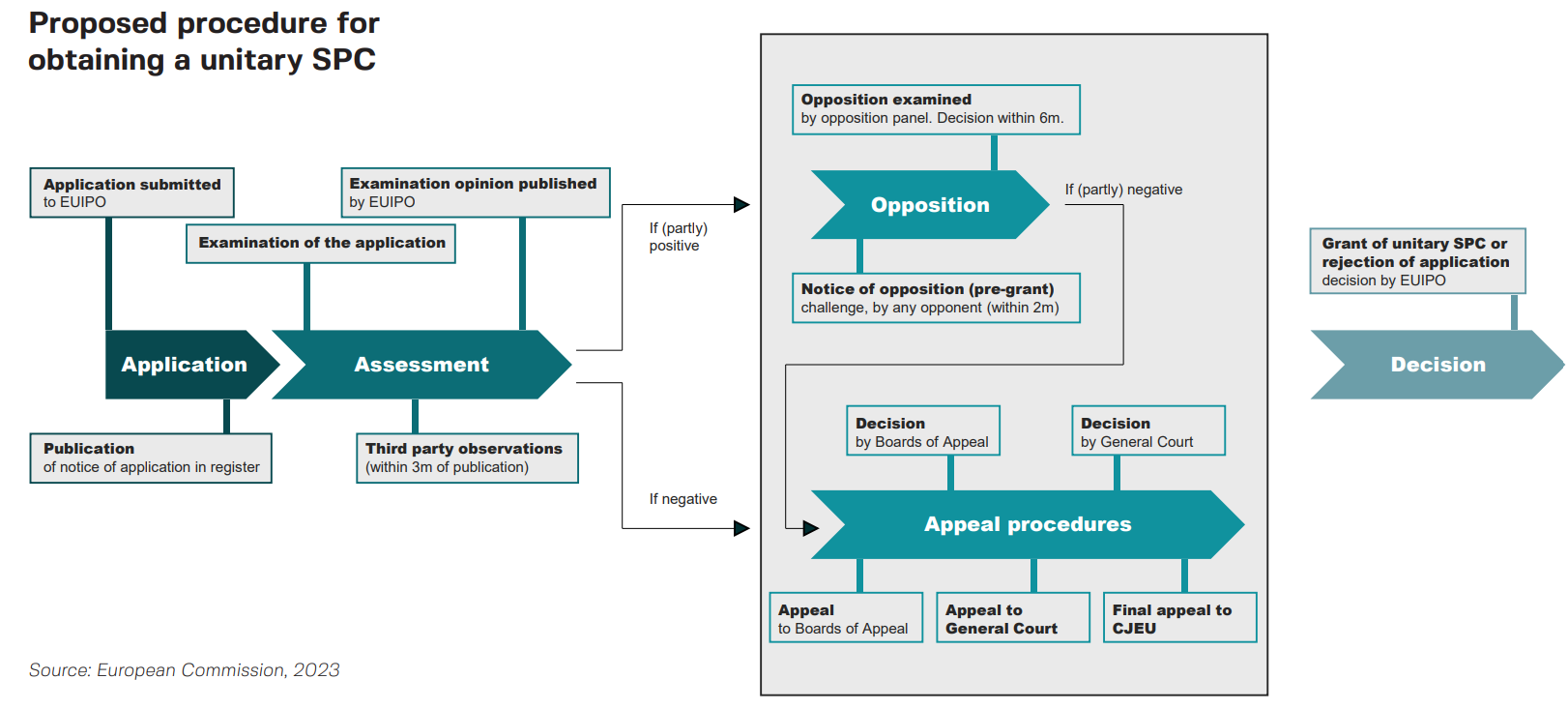
In light of the proposed pre-grant opposition procedure, the publication of a positive examination opinion will therefore be a relevant procedural step for third parties to monitor going forward, particularly as third parties may use pre-grant opposition procedures against positive examination opinions tactically to delay the grant of unitary SPCs and/or centralised (non-unitary) SPCs with the effect that they cannot be enforced against potential infringers until the end of the opposition and appeal proceedings.
Unitary SPCs
The introduction of the unitary SPC is motivated by the introduction of the unitary patent. To obtain a unitary SPC, the proposal requires that the basic patent is a unitary patent, and the marketing authorisation invoked for the SPC application must be one granted via the centralised marketing authorisation procedure.
In addition to these two specific requirements, the conditions that must be met for the grant of a unitary SPC are the same under this proposal as under the current regulation, meaning that the product cannot already have been the subject of a certificate, nor of a unitary certificate, and that the authorisation on which the certificate is granted is the first authorisation to place the product on the market as a medicinal product.
As with the unitary patent, a unitary SPC would be valid in all Member States that participate in the Agreement on a Unified Patent Court (UPCA) (currently 17 Member States).
Applicants must apply to the EUIPO for a unitary SPC within six months of receiving marketing authorisation for the product in question, or, if the authorisation is granted before unitary effect is attributed to the basic patent, within six months after unitary effect has been attributed to the basic patent.
Post-grant invalidity actions against a unitary SPC may either be brought before the EUIPO by filing for a declaration of invalidity or before a competent court of a Member State (including the Unified Patent Court) by filing a counterclaim for invalidity. However, the competent court of a Member State must reject a counterclaim for a declaration of invalidity if a decision made by the EUIPO relating to the same subject matter and cause of action and involving the same parties has already become final.
What is the status?
Most recently, the feedback period for stakeholders to comment on the proposed new SPC regulations has closed. Overall, the position on a centralised SPC system is positive, with stakeholders generally welcoming the increased harmonisation and simplification which the new SPC system is expected to bring. However, several stakeholders have raised concerns, particularly regarding the pre-grant opposition procedure, which will, according to the EPI (the professional body representing professional representatives before the EPO), "result in endless delays" and "the de facto non-useability of the centralised SPC system". Similarly, the Chartered Institute of Patent Attorneys (professional and examining body for patent agents in the UK) has expressed concerns that the "pre-grant oppositions would be vulnerable to misuse, for example as a tactic to enable (generic) product launch in the period between expiry of the basic patent and resolution of the (potentially meritless) pre-grant opposition".
Moreover, some stakeholders have expressed doubts about the EUIPO serving as the examination authority, citing a perceived lack of expertise in SPC matters. The received feedback will now be discussed, and possible amendments may be made to the proposed SPC reform.
As for the timeline, no specific date has been set for the entry into force of the SPC proposals, and we are still in the early stages of the process. A plenary sitting is anticipated to take place during the first half of 2024. It is not expected that the SPC proposals will enter into force until 2025, and, even then, transitional provisions will most likely apply for pending SPC applications.
