


On 8 April 2025, the European Parliament’s Committee on Environment, Food Safety and Public Health (ENVI Committee) voted in favour of entering into inter-institutional negotiations concerning the European Commission’s Proposal for Regulation on plants obtained by certain new genomic techniques and their food and feed, which had been published on 5 July 2023. The Commission’s proposal aims to establish EU rules for plants produced by new genomic techniques (hereinafter, “NGT plants”), which “provide new opportunities to alter the genetic material of an organism allowing the rapid development of plant varieties with specific characteristics”, as well as their food and feed.
This article examines how NGT plants are regulated under current legislation on genetically modified organisms (hereinafter, GMOs) and how this would change under the proposed rules. The article then examines the commercial implications of the proposal, focusing mainly on intellectual property rights.
New genomic techniques (NGTs) are different from established genomic techniques
New genomic techniques (NGTs) is an umbrella term used in the EU to describe a variety of techniques that can alter the genetic material of an organism and that have emerged or have been developed since 2001, when Directive 2001/18/EC on the deliberate release into the environment of GMOs was adopted. In many cases, NGTs can lead to more targeted and precise modifications to the genome than conventional breeding or established genetic modification techniques developed prior to 2001. Some of these modifications could also be produced in nature or obtained by conventional breeding techniques.
Among NGTs, there is targeted mutagenesis (i.e., newer techniques of mutagenesis that induce mutation(s) in selected target locations of the genome without insertion of foreign genetic material), and cisgenesis (i.e., the insertion of genetic material into a recipient organism from a donor). NGTs are different from established genomic techniques because they have novel features, for example, higher precision and speed in introducing the desired genetic modifications and the insertion of genetic material only from a crossable species.
Targeted mutagenesis and cisgenesis do not introduce genetic material from non-crossable species, whereas this is the case with established genomic techniques. In addition, in some cases, products containing or consisting of plants with genetic modifications introduced by NGTs cannot be differentiated from products containing or consisting of plants bred with conventional breeding methods by analytical methods, whereas this is always possible for established genomic techniques (see Trade Perspectives, Issue No. 1 of January 2022).
The status of NGTs under EU law
The Commission’s Proposal was issued following the judgment of the Court of Justice of the European Union (CJEU) of 25 July 2018 in Case C-528/16, which established that organisms obtained by mutagenesis are GMOs and are, in principle, subject to the obligations laid down by Directive 2001/18/EC, as the technique and methods of mutagenesis alters a plant’s genetic material in a way that does not occur naturally (see Trade Perspectives, Issue No. 4 of 28 February 2020). As a consequence of the judgement, on 8 November 2019, Council Decision (EU) 2019/1904 requested the Commission to submit a study on the status of NGTs under EU law.
According to the study conducted by the Commission, NGTs can provide multiple benefits, especially in the agri-food sector. NGTs “can make plants resistant to pests and diseases, needing less chemical pesticides (e.g. fungi-resistant maize or potato), or resistant to the effects of climate change (e.g. rain resistant wheat or drought-tolerant rice)” and “can also improve the nutrient content of vegetables for healthier diets (e.g. soybean oil with healthier fatty acid content), or reduce content of harmful substances such as toxins and allergens (e.g. potatoes with reduced acrylamide content)”.
Within the scope of the Commission’s proposal are plants produced by targeted mutagenesis and cisgenesis (including intragenesis, where the exogenous genetic material can be introduced with modifications), products containing or consisting of these plants, and food and feed containing, consisting or produced from these plants. At present, all NGT plants fall under the scope of the current EU legislation on GMOs, namely Directive 2001/18, Regulation No 1829/2003 on genetically modified food and feed, Regulation No 1830/2003 concerning the traceability and labelling of GMOs, and Directive 2009/41/EC on the contained use of GMOs.
The Commission’s proposal seeks to classify NGT plants into two categories:
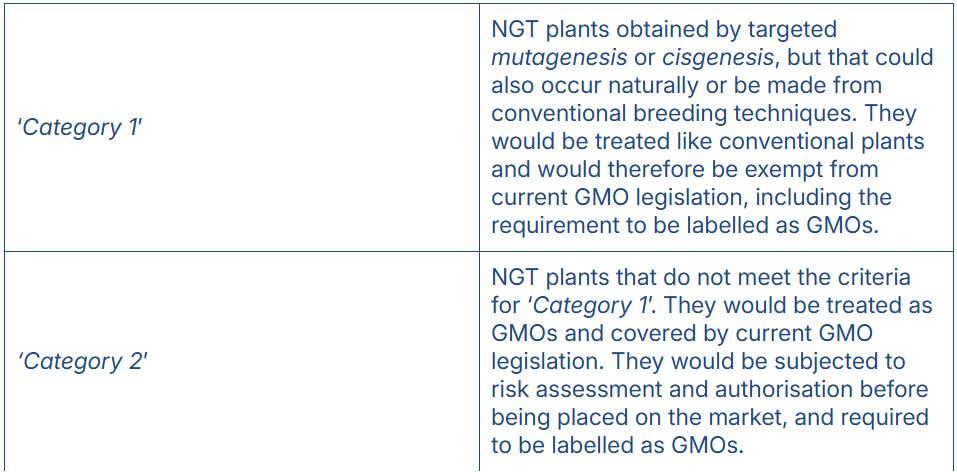
Compared to the current framework under Directive 2000/18/EC, there would be essentially a deregulation of ‘Category 1’ NGT plants, which would be treated like conventional plants and would therefore be exempt from current GMO legislation.
Commercial implications – the matter of patentability of NGT plants
The matter of patentability of NGT plants has important commercial implications. The Commission’s proposal notes that many stakeholders, such as breeders and farmers’ organisations, have expressed concern about patents on NGTs, particularly “breeders’ access to patented genetic material and access by farmers to plant reproductive material from NGT plants, bearing in mind that certain NGT plants are undistinguishable from plants obtained by conventional breeding techniques”. On the other hand, CropLife Europe, an association that represents the crop protection sector, reportedly said that the proposed regulation provides farmers with better seeds, strengthens food systems, and promotes sustainability.
On 7 February 2025, the European Parliament adopted its negotiating position on the Commission’s proposal. With respect to patents, Members of Parliament (MEPs) voted in favour of “a full ban on patents for all NGT plants, plant material, parts thereof, genetic information and process features they contain, to avoid legal uncertainties, increased costs and new dependencies for farmers and breeders”. On 14 March 2025, the EU Member States’ representatives (Coreper) endorsed the Council of the EU’s negotiating mandate on the Commission’s proposal. However, the Council suggests a number of changes, including on patenting.
Under the Council’s mandate, companies or breeders applying to register a Category 1 NGT plant would have to submit information on all existing or pending patents, which would then have to be included in a publicly available database. Furthermore, on a voluntary basis, companies or breeders can also inform of the patent holder’s intention to licence the use of a patented Category 1 NGT plant under equitable conditions. The Council’s mandate also provides for the creation of an expert group on the effect of patents on NGT plants, as well as the publication by the Commission of a study on the impact of patenting on innovation, on the availability of seeds to farmers, and on the competitiveness of the EU plant breeding sector, with a special focus on how breeders can have access to patented NGT plants.
Conclusion
Inter-institutional negotiations between the Commission, Parliament, and Council will start in the coming weeks and months. Regarding patents, the Council’s position goes against the European Parliament’s position, which advocates for the prohibition of patents on natural plants and genes to ensure farmers’ access to all genetic resources for varietal innovation, particularly for small traditional seed companies that cannot afford licensing fees.
However, it should be noted that the representatives of the institutions are not strictly bound by the positions adopted. As the Regulation has not yet been formally adopted, changes to the final version remain possible. Interested stakeholders should contribute to the legislative process by interacting with their Governments, trade associations and other affected stakeholders.
