


“Gig economy” is an emerging global trend alongside technological advancement. It generally describes the economy in which people take up part-time jobs and/or engage in project-based and/ or temporary freelance works via digital job-matching platforms. Gig economy has prospered in HK in recent years as the pandemic alters the job market landscape. Employers tend to downsize the portion of permanent staff and increase the number of temporary/ part-time worker to allow for flexibility. The growth of gig economy is also attributed by the blooming online platforms and e-commerce industry, such as those engaging in food delivery and ride-hailing. Conventional sectors such as banking, retail and information technology have hired more gig worker to bring flexibility to their employment structures. In this article, we would look at how the employment relationship under the gig economy is governed under our present legal framework.
Gig Workers' Status in HK
While gig employment is a relatively new concept in Hong Kong, the characterization of such relationship is still determined by the conventional “employee/self-employed” dichotomy. A gig worker can be an “employee” or a “self-employed” depending on how the contract is drafted. If one is classified as employee under the law, s/he is entitled to the statutory benefits and protections under, among others, the Employment Ordinance (Cap. 57) (“EO”), the Employees’ Compensation Ordinance (Cap. 282) (“ECO”) and the Mandatory Provident Fund Schemes Ordinance (Cap. 485) (“MPFSO”).
Therefore, the employee/self-employed distinction remains to be the starting point prior to understanding the gig worker’s legal rights in the HK employment context. The major differences between self-employed persons, fixed term employment and permanent employment under the labour protection regime in Hong Kong are summarized in the following table:-
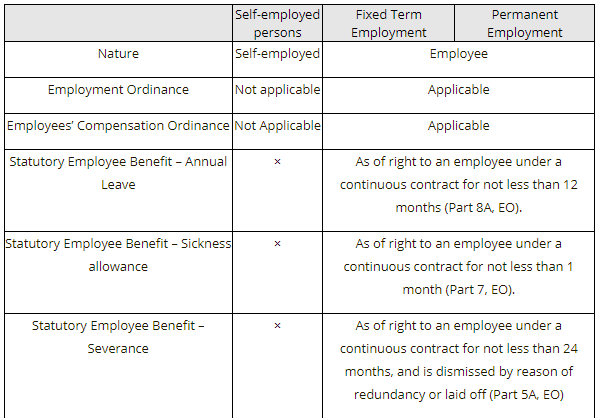
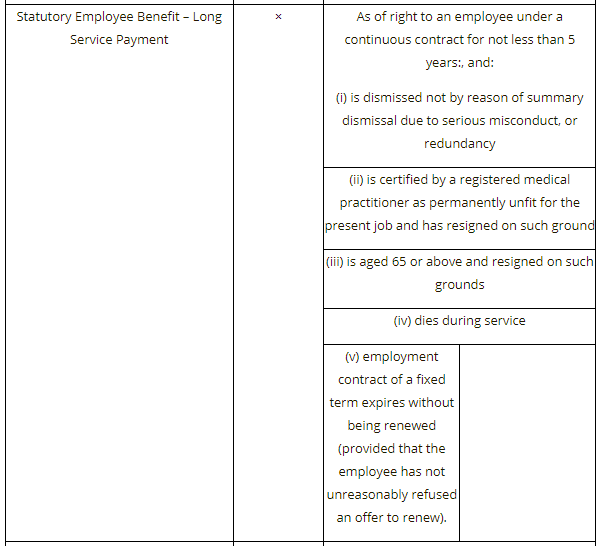
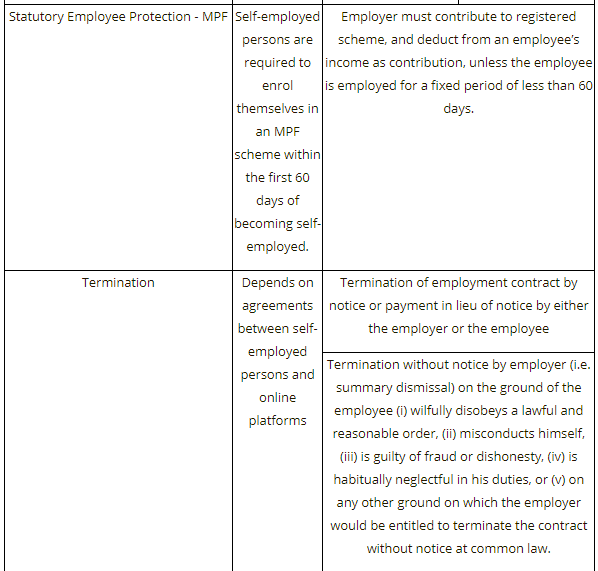
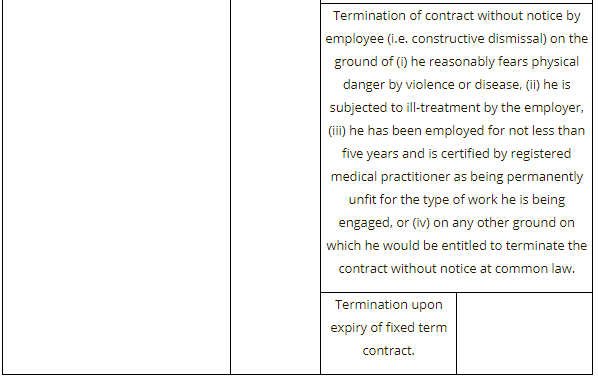
As shown in the table, under the current labour protection regime, many, if not all, labour rights stem from the “employee” status. Often time, businesses are attracted to contract out parts of their works to gig worker because they are generally expected to be self-employed and the businesses need not bother themselves with submission of return to the HKIRD or MPF arrangement which would otherwise be compulsory if they are in the capacity of employers. Whether the gig employment constitutes an employee/ self-employed relationship is, however, not always easy to determine.
Precedent cases, however, suggest that an “agent”, “consultant”, “freelancer” or “contractor” (however one names it) might still be deemed an “employee”. What further muddles the water is the few landmark cases by courts of other jurisdictions ruling that gig worker are indeed “employees” or “workers” who are entitled to certain labour rights. For example, The UK Supreme Court has unanimously held that Uber drivers were “workers” under UK employment legislation, thus entitled to labour rights such as national minimum wage and paid annual leave: Uber BV and others (Appellants) v Aslam and others (Respondents) [2021] UKSC 5. The Amsterdam’s Court of Appeals has ruled that riders of Deliveroo, an online food delivery platform, must be treated as employees, and a Barcelona Court in Spain has ordered a payment of 1.3 million euros in social contributions for the same reason. All these rulings were made in 2021, and they seemed to have contributed to a more gig worker's protection in Denmark, Austria and Sweden.
HK Courts’ Consideration
In Hong Kong, the determination of employer-employee relationship is highly fact-specific and is a matter for the courts to decide on a case-by-case basis. In the leading authority, Poon Chau Nam v Yim Siu Cheung [2007] HKCFA 19, it was decided that the existence of an employer-employee relationship is a matter of overall impression against the background of indicia of employment. The list of factors that would be considered by the courts in determining the question was explained in Tang Chau Yuet v Fu Kin Po [2011] 1 HKLRD 519. Factors include: -
- Alleged employer’s degree of control over the task of the alleged employee – if the alleged employee has liberty to decide how, when, where one works, he is more likely to be viewed as “self-employed” rather than “employee”;
- Alleged employee’s own provision of equipment;
- Alleged employee’s own hiring of helpers;
- Alleged employee’s own bearing of financial risk and the degree of it;
- Alleged employee’s opportunity to profit from sound management in the performance of his task;
- Alleged employee’s bearing of responsibility for investment and management;
- Alleged employee’s role in the alleged employer’s organization;
- Alleged employer’s bearing of responsibility in relation to insurance and tax for the alleged employee;
- Alleged employee’s carrying on business in the trade in question;
- The parties’ own view of their relationship; and,
- The traditional structure of the trade or profession concerned and the practices within it.
How the Hong Kong Court would perceive the gig worker's relationship with their principals is yet to be seen. In this regard, reference could be drawn to the UK Supreme Court decision in Uber BV where their Lordships unanimously came to the following conclusion and found that Uber drivers are “workers”, i.e. an intermediate class with basic labour protection under the UK law: -
- Fixed remuneration – Uber has control over the fares, as well as the sole discretion to make full or partial refunds upon complaints.
- Standard contractual terms – Uber drivers are required to accept Uber’s standard form of contract.
- Restricted driver’s choice to accept rides – Uber exercise controls over acceptance of the request by the driver by first controlling information provided to the driver, and second by monitoring the driver’s rate of acceptance and cancellation of trip requests, with penalty for high cancellation rate.
- Control over types of car and platform – types of car and technology integral to the service is wholly owned and controlled by Uber
- Restricted communication between passenger and driver – Communication is limited to the minimum necessary to prevent drivers from establishing any relationship with a passenger.
The Uber case was highly fact-sensitive. The above factors, or some of them, may or may not be present in other online platforms and gig employment, which could lead to very different result. Nonetheless, it would be advisable for online platforms or businesses in e-commerce, or anyone intending to hire gig worker, to go over the checklist above and assess their proper relationship with the gig worker.
