


On March 2nd, 2021 it entered into force Law no. 21/2021 ratifying Law Decree no. 183/2020 (“2021 Milleproroghe Decree”) with amendments. On March 13th, 2021 the Italian Government issued Law decree no. 30/2021 containing “… measures to support employees with children studying from home or in quarantine”. Eventually, on March 22nd, 2021, the Italian Government issued Law Decree no. 41/2021 (“Sostegni Decree”). The measures in matter of employment aimed at facing the Covid-19 emergency may be summarised as follows.
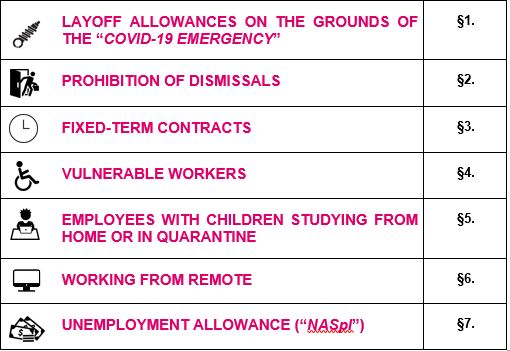
1. LAYOFF ALLOWANCES ON THE GROUNDS OF THE “COVID-19 EMERGENCY”
According to the Sostegni Decree employers may benefit from:
1.1 13 weeks of the “Cassa Integrazione Guadagni Ordinaria (CIGO)” national layoff allowance fund on the grounds of the “Covid-19 emergency” to be used as from April 1st, 2021 through June 30th, 2021;
1.2 28 weeks of the “Assegno Ordinario” and of the “Cassa Integrazione in Deroga” national layoff allowances funds to be used as from April 1st, 2021 through December 31st, 2021.
All employees in employment as at March 23rd, 2021 and temporarily laid off because of the Covid-19 emergency are eligible to be paid the layoff allowances under §§1.1 and 1.2 above.
The application to benefit from the layoff allowances under this §1. are to be submitted to the Italian National Institute for Social Security (“INPS”) by the end of the month following that of the beginning of the layoff.
The access to the layoff allowances under this §1.
2. PROHIBITION OF DISMISSALS
The Sostegni Decree extended the prohibition of collective and individual dismissals for redundancy until June 30th, 2021.
For those employers who will file an application to access to the “Assegno Ordinario” or to the “Cassa Integrazione in Deroga” national layoff allowances funds (see §1.2 above), the above prohibition will apply until October 31st, 2021.
Dismissals are still allowed:
2.1 in the event of closing down of the operations of the employer without continuation, even on a partial basis, of its activity, provided that such closing down does not amount to a transfer of a going concern;
2.2 with regard to those employees who decide to accept an incentive to leave as defined by a collective agreement to be entered into at a company level;
2.3 in case of bankruptcy of the employer, without continuation, even on a partial basis, of its activity;
2.4 in case of employees being hired by the new contractor in the framework of a change of the contractor under a procurement or a service contract.
3. FIXED-TERM CONTRACT
Until June 30th, 2021 employers may: (i) renew fixed-term employment contracts; or (ii) extend their term; once and for a maximum of 12 months without having to indicate any of the specific grounds usually required by Italian law to this end. In any case, the overall duration of renewed or extended fixed term employment contracts must not exceed 24 months in the aggregate.
This provision also applies when a fixed-term employment contract has already been renewed or extended before the entering into force of the Sostegni Decree.
4. VULNERABLE WORKERS
Until June 30th, 2021 “vulnerable workers”[1] will work from remote. To this end, such workers may: (i) be assigned different duties, though within the same category as contemplated by the applicable Collective Bargaining Agreement; or (ii) take part to training activities even from remote.
If their job does not fit a remote working pattern, their absences from work as prescribed by the health authorities will be regarded as periods of hospitalisation. Such absences from work will not count against the grace-period during which a sick worker may not be dismissed (in Italian “periodo di comporto”).
5. EMPLOYEES WITH CHILDREN STUDYING FROM HOME OR IN QUARANTINE
According to Law Decree no. 30/2021:
5.1 until June 30th, 2021, employees with at least one cohabiting child under 16 years old, are entitled to work from remote for a period of time corresponding as a whole or in part to: (i) school closures; (ii) the length of the sickness of the child infected by the Covi-19 virus; and (iii) the period of quarantine of the child;
5.2 if the job of the above employees does not fit with a remote working pattern:
5.2.1 employees with at least one cohabiting child under 14 years old as well as employees with at least one child with serious disabilities[2] will be permitted to abstain from work. During their absence from work such employees will be eligible to be paid an indemnity equal to 50% of their remuneration under Sect. 23 of Legislative Decree no. 151/2001. Moreover, they will accrue their pension entitlement even in the absence of contributions payable by the employer;
5.2.2 employees with at least one cohabiting child in between 14 and 16 years old will be permitted to abstain from work even if they will not be eligible to the payment of any indemnity, nor to the accrual of any pension entitlement. However, such employees may not be dismissed for their absence from work.
6. WORKING FROM REMOTE
Without prejudice to what stated under §§4. and 5. above, according to Law Decree 183/2020 as amended by Law no. 21/2021, until April 30th, 2021 employers may impose on their employees to work from remote even without a previous agreement. If so, employers must provide the employees concerned with an information in matter of health and safety at work by using a form made available by INAIL.
7. UNEMPLOYMENT ALLOWANCE
Until December 31st, 2021 employees unintentionally losing their job will be eligible to the payment of the unemployment allowance paid by INPS even if they did not work for at least 30 days in the year preceding the date of termination of their employment.
