


Summary
At present, there is no specific Australian legislation regulating artificial intelligence (AI) technologies. That is in contrast to some other jurisdictions, which have legislation in place, or significantly advanced draft laws, specifically regulating the technology. The Australian Commonwealth government's interim "safe and responsible AI consultation" response (released January 2024) summarises the government's response to public consultation undertaken1 on supporting responsible AI technology through an appropriate and targeted regulatory framework (Interim Response)2. The Interim Response builds on stakeholder submissions and relays at a high level how the government intends to ensure AI technologies are designed, developed, and deployed safely and responsibly. In this update, we provide an overview of the government's Interim Response and speculate on how the regulation of AI technologies in Australia may take shape moving forward.
A Look Back
Our publication titled "AI and the Law in Australia and Abroad A Risk and Regulatory Approach" (December 2023)3 provided commentary on the then current state of governmental policy on AI regulation,4 and relayed three key themes gleaned from the government's policy statements.5 Those three key themes were:
• The question of whether existing technology-neutral legislation is suitable can only be answered after a comprehensive review of the relevant applicable commonwealth and state laws to appropriately and critically assess if AI-specific legislation is necessary. The suitability of existing technology-neutral legislation can only be determined after a comprehensive review of the relevant applicable commonwealth and state laws to appropriately and critically assess whether AI-specific legislation is necessary. 6
• Irrespective of the need for AI-specific legislation, it is necessary to consider whether the existing regulatory regimes of broad application are appropriate and adaptable to AI risks.7
• The introduction of AI-specific legislation should consider the way in which regulations come into force, including whether a new regulator is required to administer new laws.8
• The Interim Response further advanced and refined policy on AI regulation, taking into account the public consultation
The Government’s Interim Response
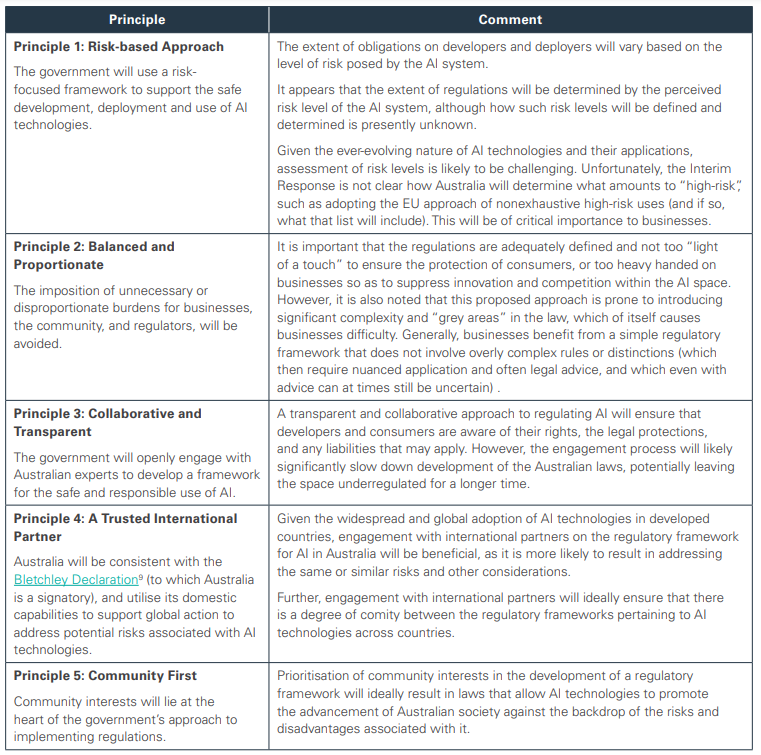
The Interim Response contains the guiding principles that the government considers ought be followed in the process of developing and formalising a regulatory framework for AI in Australia. Those principles and our comments on each principle are displayed below:
The Interim Response contemplates both short-term and long-term action that the government will take with respect to regulation of AI. These anticipated responses are summarised below:
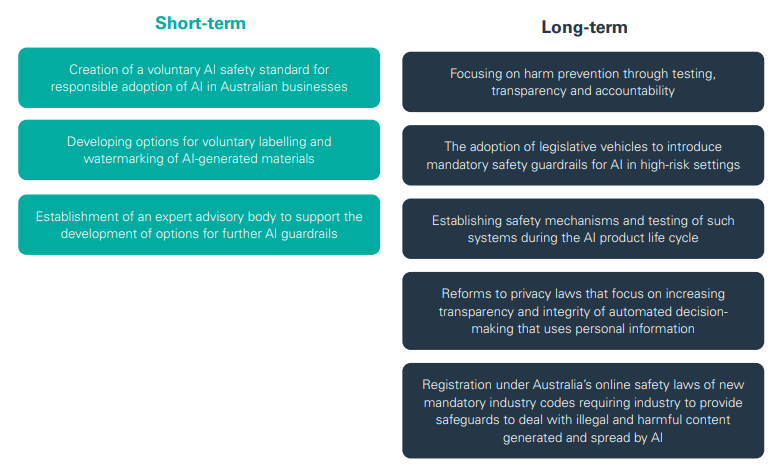
The shape and nature of the long-term actions will be informed by further community consultation and the effect of the shortterm responses.
As evidenced in the short-term and long-term actions proposed in the Interim Response, prevention of harm from the adoption and use of AI technology is the government’s main priority as it works toward finalising a regulatory regime for AI. This approach is consistent with the EU’s proposed AI regulations and the EU’s adoption of metrics to determine varying levels of “risk” in the development and deployment of AI systems.
As such, the implementation of a regulatory framework will likely be multifaceted and with a focus on risk minimisation, meaning businesses will be subject to layers of compliance dependent on the AI systems they may or may not deploy. If the laws developed in the Australian context emulate the EU’s framework, businesses operating in Australia and abroad would benefit from a more universal application of regulations, where any checks and balances applicable to the development, deployment and use of AI is consistent on a global scale.
Moving Forward
As mentioned earlier, it is important to remember that the Interim Response is just that: interim. Businesses have the opportunity to have a say through the proposed consultations.
It remains to be seen exactly how the regulations governing AI technologies in Australia will be shaped. That said, the Interim Response suggests the government will roll out any regulatory regime in a way that includes, at a minimum, amendment of existing legislation. Given the lack of substantive detail in the Interim Response, this is likely to occur over an extended period of time. While we know this will draw on the guiding principles referred to above in addition to the short-term responses to be actioned, take into account further consultation, and be informed by the experience internationally as the laws in those jurisdictions are tested, it seems Australia still has a long journey ahead in formulating the details of its regulatory approach. With the pace of development of AI, if the approach is too consultation heavy, the review risks being outdated before it is even completed.
We continue to watch this space.
In the meantime, there are a number of steps businesses can take to remain agile pending further clarity and to also ideally position themselves to adapt and respond to increased future regulation. These include:
• Training employees on responsible use of AI and the risks associated with using such technologies.
• Establishing internal policies and protocols that addresses the risks of AI and provide strategies to mitigate harm to business. These include ensuring those policies and protocols consider whether disclosure regarding the use of AI should be given and when human oversight is required, and provide clear guidance on responsibility.
• Building robust cybersecurity infrastructure around the deployment of any AI technologies in the business cycle, including rigorous testing of systems before and after implementation.
• Undertaking audits.
• Considering adopting the government’s voluntary AI safety standard, once released.
• Reviewing existing insurance policies and considering risks that may perpetuate as AI usage grows.
• Balancing the use of AI technologies with existing non-AI technologies and other manual processes.
