

This is the February 2026 edition of Anchovy News. Here you will find articles concerning ICANN, the domain name industry and the recuperation of domain names across the globe. In this issue we cover:
1. .AI reaches the 1 million mark
2. Global domain name numbers show healthy growth
3. No switch from Switch for .CH
6. From lost in space to lost in the UDRP
DOMAIN NAME INDUSTRY NEWS
Headline 1
.AI reaches the 1 million mark
The current mania for all things AI (Artificial Intelligence) and the accompanying boom in AI-related domain name registrations continues apace, as tech and AI companies scramble to grab their piece of .AI real estate. This has provided a bonanza in recent years for the .AI country-code Top-Level Domain (ccTLD) and its Caribbean island home of Anguilla, which just announced that its registrations had surpassed the one million mark.
In 2020, the number of registered .AI domain names stood at 107,000. By 2022, this had risen to 148,000, followed in 2023 by 359,000, which represented a whopping 142% increase on the previous year's figures as AI fever took hold. By 2025, the figure had risen to 800,000 as growth of the TLD tracked the explosion of interest in Artificial Intelligence and its entry into just about every area of everyday life and everyone's conversations.
In a recent social media post, the Anguillan government has confirmed that the .AI Registry had surpassed one million .AI domain name registrations at the end of 2025, “marking a historic milestone for Anguilla and underscoring the island's unique role in the global artificial intelligence economy.” The post also noted how the growth represented “a powerful example of how digital assets can deliver real, tangible benefits to local communities” as the revenue from domain name sales had “directly supported major national development projects in Anguilla, including airport and road development, tax relief for locals and increased health services for the young and elderly.”
The unexpected growth of the .AI ccTLD in recent years has been a boon for the island nation, which has fewer than 20,000 residents. Like the islands of Tuvalu (.TV) and the British Indian Ocean Territory (.IO) before it, which also transcended their geographical origins to ride the waves of trend-driven domain name growth, Anguilla is enjoying its moment in the sun. It has directed revenues from its ccTLD to critical national infrastructure projects and towards reducing its national debt in order to improve the lives of its citizens.
The aftermarket for .AI domain names is also booming, with recent sales such as law.ai ($350,000), cloud.ai ($600,000) and you.ai ($700,000) continuing to break records. Meanwhile, outside the .AI ccTLD, AI domain name sales went turbo with the recent sale of ai.com for $70 million, which is more than double the previous record ($30 million for voice.com).
While Anguilla may currently be rejoicing at its good fortune, in 2024 its former Premier, Ellis Webster, warned against relying solely on revenue from .AI domain names: “You can't predict how long this is going to last… And so I don't want to have our economy and our country and all our programs just based on this. And then all of a sudden there's a new fad comes up in the next year or two, and then we are left now having to make significant expenditure cuts, removing programs”.
In spite of this warning, there is no sign that .AI's popularity is likely to wane any time soon.
For more information on the registration or the recuperation of .AI domain names, please contact David Taylor or Jane Seager.
Headline 2
Global domain name numbers show healthy growth
Domain Name Industry Brief's Quarterly Report for Q4 2025 has shown an upward trend across the board for domain name growth over the relevant period when compared with the Q3 2025 figures, with the strongest growth year-on-year coming from new generic Top-Level Domains (gTLDs).
The fourth quarter of 2025 ended with 386.9 million domain names across all Top-Level Domains (TLDs). This represents an increase of 8.4 million domain names (or 2.2%) compared with the third quarter of 2025, and a year-over-year increase of 22.7 million domain names (or 6.2%), which provides evidence of healthy growth in global domain name numbers.
The combined number of domain names under the two main legacy gTLDs .COM and .NET reached 173.5 million by the end of Q4 2025, reflecting a quarterly increase of 1.6 million domain names (or 0.9%) and a year-over-year increase of 4.5 million domain names (or 2.6%). As of 31 December 2025, the .COM base totalled 161 million domain names, while .NET accounted for 12.5 million. New .COM and .NET domain name registrations totalled 10.7 million during Q4 2025, up from 9.5 million in Q4 2024. The preliminary combined renewal rate for these gTLDs was 75%.
The number of domain names under the other legacy gTLDs (such as .ORG or .INFO) totalled 20 million at the end of Q4 2025. This represents a quarterly increase of 1.1 million domain names (or 5.6%) and a year-over-year increase of 2.4 million domain names (or 13.7%). The latest combined renewal rate estimate for these gTLDs was 70.8%.
The strongest growth among all gTLDs is for new gTLDs as their number totalled 47.8 million at the end of 2025, which represents a quarterly increase of 5 million domain names (or 11.6%) and a year-over-year increase of 11 million domain names (or 29.9%). However, the most recent combined renewal rate estimate for new gTLDs was 31.3%. This is notably lower than the .COM and .NET figures and shows the more transient and promotion-based nature of these registrations at this point in time.
All gTLDs combined, 1,265 extensions (including Internationalised Domain Name (IDN) extensions) were delegated in the root zone as of 31 December 2025. The number of domain names under the top 10 gTLDs represented 88.9% of all gTLD domain names and 55.4% of total TLD domain names, with renewal rates among the top 10 gTLDs ranging from 76.9% (.ORG) to 14.5% (.SHOP). The top 10 gTLDs were:
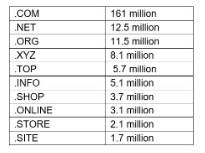
As for country-code Top Level Domains (ccTLDs), the total number of domain names reached 145.6 million at the end of Q4 2025, marking a quarterly increase of 0.8 million domain names (or 0.6%) and a year-over-year increase of 4.8 million domain names (or 3.4%).
At the end of 2025, a total of 316 ccTLD extensions were delegated in the root zone, including IDN extensions. The number of domain names under the top 10 ccTLDs accounted for 57.4% of all ccTLD domain names, with renewal rates ranging from 80.0% (.EU) to 71.4% (.RU). The top 10 ccTLDs were:
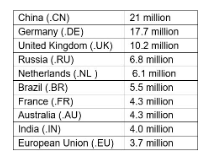
The above figures provide evidence of a solid growth trajectory for the global domain name system and, while legacy extensions such as .COM, .NET, and leading ccTLDs continue to provide stability, with moderate growth and strong renewal rates, it seems that the primary engine of expansion is now the new gTLD segment.
For more information or to register domain names in any jurisdiction, please contact David Taylor or Jane Seager.
Headline 3
No switch from Switch for .CH
The Federal Office of Communications (OFCOM) has recently announced that it will continue its collaboration with the Switch Foundation for the management of Switzerland's .CH domain name space. According to OFCOM, the decision to redelegate the Registry function to Switch (whose mandate was due to expire at the end of 2026) was driven by the need to ensure operational continuity, meet security requirements, and maintain high levels of satisfaction among market participants.
Switch has served as the Registry for the .CH country-code Top-Level Domain (ccTLD) since 2003. As such it is responsible for the technical and administrative management of .CH. However, its duties do not include selling .CH domain names directly to end users, as this function is handled by accredited registrars.
In explaining its decision to renew Switch's mandate, OFCOM highlighted several key considerations. The regulator stressed the importance of continuous, secure, and resilient management of the .CH domain name space, noting that its stability directly affects the availability, security, and reliability of digital services operating under .CH. According to OFCOM, this reliability is essential to sustaining public, business, and government confidence in Switzerland's digital infrastructure.
OFCOM also stated that this approach ensured continuity in domain management while avoiding the additional costs, instability, and potential delays that could result from transferring .CH operations to another provider. The new contract, which is scheduled to come into force on 1 January 2027, will run for an initial five-year term and may be renewed once. While the mandate will continue largely as before, OFCOM did point out that targeted adjustments to the service catalogue “to strengthen .ch domain security and the fight against cybercrime” had been made.
For more information on .CH domain names, please contact David Taylor or Jane Seager.
DOMAIN NAME RECUPERATION NEWS
Headline 4
Not x-tremely distinctive
In a recent decision under the Uniform Domain Name Dispute Resolution Policy (the UDRP or the Policy) before the World Intellectual Property Organization (WIPO), a Panel denied the transfer of the domain name xholidays.com (the "disputed Domain Name"). The Panel found that the Complainant had not provided any evidence that it had used its trade mark prior to the registration or first use of the disputed Domain Name, and therefore it was not clear whether such trade mark had any reputation or goodwill that the Respondent may have sought to take advantage of by acquiring and using the disputed Domain Name.
The Complainant, a UK company operating under the name X Holidays Limited since 2023, operated an online travel agency and booking platform. It was the owner of the trade marks X-HOLIDAYS, XHOLIDAYS, and XHOLIDAY, all registered on 7 March 2025, as well as the domain name x-holidays.com, registered in 2022.
The Respondent was an individual based in the United Arab Emirates (UAE) who operated several businesses incorporated and licensed to trade in Dubai, including a travel agency trading under the name "X Holidays".
The Respondent acquired the disputed Domain Name in February 2025. The evidence submitted indicated that the disputed Domain Name initially resolved to a website offering travel agency services under the name "X Holidays". On 18 November 2025, the disputed Domain Name pointed to a generic e-commerce website lacking any substantive content, and at the time the Complaint was filed it did not resolve to any active website.
To be successful in a complaint under the UDRP, a complainant must satisfy the following three requirements:
(i) The domain name registered by the respondent is identical or confusingly similar to a trade mark or service mark in which the complainant has rights; and
(ii) The respondent has no rights or legitimate interests in respect of the domain name; and
(iii) The domain name has been registered and is being used in bad faith.
The Complainant asserted that it had met all the requirements set out in the Policy and that the disputed Domain Name had been registered and used in bad faith in order to take advantage of confusion with the Complainant's trade mark to commercially benefit the Respondent's competing travel agency.
The Respondent claimed that the choice of the disputed Domain Name was driven by the fact that his travel agency was part of a family of X-incorporated business names. In addition, the Respondent argued that he specialised in tailored relationships with wealthy UAE-based clients, unlike the Respondent's offering, which focused on high-volume travel bookings.
In relation to the first element, the Panel found that the Complainant satisfied the first element of the UDRP because it had established rights in the trade mark XHOLIDAYS, which was entirely reproduced in the disputed Domain Name.
The Panel declined to address the second limb, i.e., the Respondent's rights or legitimate interests, in light of its analysis on the third limb.
Regarding the third limb, the Panel found that the Complainant had provided insufficient evidence that the disputed Domain Name was registered and used in bad faith. Not only was the Complainant's trade mark registered after the disputed Domain Name had been acquired by the Respondent, it also remained unclear as to when the Complainant had first used its trade mark in commerce. Under its general powers set out in paragraphs 10 and 12 of the UDRP Rules, the Panel conducted an independent review of the Internet Archive records of the Complainant's website and found that the only available archived results showed a "403 Forbidden" error and did not establish when the website was first launched. Furthermore, neither the Complainant's registration of the domain name x-holidays.com in 2022, nor its change of name in 2023 established when the Complainant had actually used its trade mark for the first time. Subsequently, the Panel found that it could not be determined that the Complainant had used its trade mark before the Respondent had acquired and first used the disputed Domain Name, nor that the Complainant's trade mark had developed any reputation or goodwill that might have been commercially exploited by the Respondent.
Additionally, the Respondent was located in the UAE, and the record contained no evidence that the Complainant's business was present or promoted there in a manner that could have brought the Complainant's trade mark to the Respondent's attention. The Panel also highlighted the absence of any targeting, observing that the Respondent's previous websites differed substantially from the Complainant's in appearance and content. Moreover, there was no evidence of prior cybersquatting by the Respondent. The Panel also pointed out that the Complainant's trade mark lacked distinctiveness, as it combined the commonplace Latin letter "X" with the descriptive term "holidays". Thus it was therefore not inconceivable that a third party may have independently conceived of the disputed Domain Name without any intention of targeting the Complainant. This was also evidenced by the Panel's preliminary online searches revealing the existence of at least one other similar named travel agency, "xholidayindia".
In light of the above, the Panel concluded that the Complainant had failed to demonstrate that the Respondent had registered and used the disputed Domain Name in bad faith, and the Complaint was therefore denied.
The Respondent requested a finding of Reverse Domain Name (RDNH) but the Panel decided not to make such a finding. Given that the Complainant was self-represented, the Panel noted that it was subject to a lower standard when assessing a claim of RDNH. The Complainant filed its trade mark application, registered its domain name and changed its company name before the acquisition and use of the disputed Domain Name by the Respondent, suggesting prior use of the Complainant's trade mark. Both parties operated in the same industry. While the Complainant may have had a genuine belief in cybersquatting, it ultimately failed to provide sufficient supporting evidence. Considering all these circumstances, the Panel declined to find RDNH.
This case underlines that evidence that a respondent's registration of a domain name targeted a complainant's rights and sought to take advantage of them is generally paramount under the UDRP. Evidence of a complainant's trade mark rights alone will usually not suffice, especially when the trade mark at issue is not inherently distinctive.
The decision is available here.
Headline 5
Log me in or log me out?
In a recent decision under the Uniform Domain Name Dispute Resolution Policy (the UDRP or the Policy) before the World Intellectual Property Organization (WIPO), a Panel denied the transfer of the Domain Name at issue, finding that the Complainant had failed to establish that the Respondent lacked rights or legitimate interests in the Domain Name.
The Complainant, Goto Technologies USA, LLC, was a company based in the United States providing software and software-as-a-service solutions for remote collaboration and IT management. It owned various trade marks around the world for LOGMEIN, including a United States word trade mark registered in 2006, and used the domain name logmein.com to point to its main commercial website. The Complainant further asserted that the LOGMEIN mark was well known, relying on continuous use since 2004, millions of daily users, and extensive media coverage, including industry awards and reviews in prominent technology publications.
The Respondent, Domain Admin, Reg.AI, based in the United States, argued that it had acquired the disputed Domain Name for its descriptive meaning and not to target the Complainant's trade mark, relying on the expression “log me in” as a descriptive reference to authentication functionality.
The disputed Domain Name, logmein.ai, was initially registered in 2019, and the Respondent claimed that it was subsequently acquired in 2023. At the time of the proceedings, it resolved to a parking page offering the Domain Name for sale at a price of USD 26,999.
To be successful in a complaint under the UDRP, a complainant must satisfy the following three requirements:
(a) The domain name registered by the respondent is identical or confusingly similar to a trade mark or service mark in which the complainant has rights; and
(b) The respondent has no rights or legitimate interests in respect of the domain name; and
(c) The domain name has been registered and is being used in bad faith.
With respect to the first limb, the Panel concluded that the Complainant had rights in the LOGMEIN trade mark through registration and use, as demonstrated in the record, and that the disputed Domain Name was identical to that trade mark. Accordingly, the Panel found that the first requirement of the Policy was satisfied.
With respect to the second limb, the Complainant argued that the Respondent lacked any rights or legitimate interests in the disputed Domain Name. It asserted that the Domain Name had been registered primarily for resale and that the expression “log me in” did not constitute a legitimate descriptive use capable of supporting a bona fide offering of goods or services.
The Respondent contested this view, arguing that it had acquired the disputed Domain Name for its descriptive meaning in connection with the development of an AI-powered browser automation and authentication tool. It maintained that “log me in” was a descriptive expression referring to authentication functionality and relied on its alleged demonstrable preparations to develop such a product prior to notice of the dispute. In support of its position, the Respondent produced evidence showing the creation of a code repository shortly after acquisition of the Domain Name, the development of browser automation and authentication prototypes, and preparatory work on a website, an administrative dashboard, a browser extension and documentation.
The Panel recalled that the overall burden of proof rested with the Complainant. It further noted that, while the registration and offering of a domain name for sale did not in itself confer rights or legitimate interests, prior panels had recognised that registration based on a domain name's descriptive meaning could be legitimate under the Policy, provided the respondent demonstrated credible evidence of good-faith preparations for a bona fide offering of goods or services.
On the record before it, the Panel found that the Respondent had provided a plausible explanation, supported by evidence, showing demonstrable preparations to use the disputed Domain Name in connection with a bona fide offering of services. Accordingly, the Panel concluded that the Complainant had failed to establish that the Respondent lacked rights or legitimate interests in the disputed Domain Name and that the second requirement of the Policy was not satisfied. Notably, the Panel rejected the Complainant's contention that the expression “log me in” could only be understood as a reference to its trade mark. While observing that the Respondent may have overstated the extent to which “log me in” is an established expression, the Panel considered that the Complainant's position, denying any descriptive value altogether, was equally unpersuasive.
Given its findings under the second limb, the Panel did not consider it necessary to address the issue of bad faith registration and use under the third limb of the Policy.
The Respondent requested a finding of Reverse Domain Name Hijacking, arguing that the Complaint had been brought in bad faith. The Panel declined to make such a finding, noting that the mere lack of success of the Complaint was insufficient and that, at the time it was filed, the Complainant owned an established trade mark enjoying a degree of renown. The Panel further observed that the Respondent held a number of domain names corresponding to well-known trade marks and was offering them for sale at prices high enough to support the suspicion of cybersquatting, and that the Respondent had not previously provided the Complainant with corroborating evidence of his demonstrable preparations to develop his business.
This case highlights the burden on complainants under the second limb of the Policy, particularly where a respondent puts forward a plausible reason for acquiring a domain name. The decision also shows that panels will not readily find Reverse Domain Name Hijacking where a complaint, although unsuccessful, is not unreasonable in light of the circumstances.
The decision is available here.
Headline 6
From lost in space to lost in the UDRP
In a recent decision under the Uniform Domain Name Dispute Resolution Policy (UDRP) before the World Intellectual Property Organization (WIPO), a Panel denied the transfer of the Domain Name at issue, finding that the Complainant's limited unregistered trade mark rights were insufficient to establish that the Respondent had targeted those rights at the time of registration of the Domain Name.
The Complainant was a Swiss musician and DJ, who had used the name "Space Planet" or "Spaceplanet" since at least 1998. He was the previous registrant of the Domain Name and displayed the corresponding URL and email address on his CDs and other promotional materials. His music releases under the SPACEPLANET name were distributed in Germany, Austria, and Switzerland (often known as the DACH countries), and he used the website associated with the Domain Name to promote his musical activities until 2012. The Respondent was XYZ Invest LLC based in the US.
The Domain Name spaceplanet.com, which was initially registered by the Complainant, lapsed in 2024 due to non-renewal and subsequently became available for registration. It was registered by the Respondent in January 2025 and resolved to a webpage offering the Domain Name for sale for USD 21,499 or for lease at a monthly rate of USD 466.
To be successful in a complaint under the UDRP, a complainant must satisfy the following three requirements:
(a) The domain name registered by the respondent is identical or confusingly similar to a trade mark or service mark in which the complainant has rights; and
(b) The respondent has no rights or legitimate interests in respect of the domain name; and
(c) The domain name has been registered and is being used in bad faith.
With respect to the first limb, the Complainant claimed unregistered trade mark rights in SPACE PLANET based on long‑term, public use of this name since the late 1990s for music production, DJ performances, events and digital releases. He pointed to public association of this name on CDs, vinyls, flyers, promotional materials and the long‑term reference to “SpacePlanet.com” on artwork, as well as current use of another domain name spaceplanet.ch and a music event held in December 2025 under the same name.
The Respondent argued that the name "space planet" combined two common English words and was inherently generic or descriptive, so a heightened evidentiary burden applied to prove acquired distinctiveness. It asserted that the Complainant provided no sales, revenue, advertising or media evidence, and that the limited evidence submitted (e.g., limited Spotify listeners, a small number of YouTube subscribers and historical artwork) showed only a small niche following, not trademark‑level recognition. The Respondent also emphasised a roughly 16‑year gap in evidenced use of the Domain Name between 2009 and 2025, and criticised the Complainant's Google search, which combined “spaceplanet+dj+s.i.one”, as being a classic example of search result manipulation.
The Panel rejected the idea that the name "space planet" was purely descriptive, finding that while both words were dictionary terms, their juxtaposition was not a common phrase like “spaceman” but amounted to a distinctive phrase. On secondary meaning, the Panel accepted that the Complainant's evidence was thin but gave weight to professional distribution of releases in the DACH region, ongoing (if modest) streaming under the name, cumulative YouTube views and long‑term use dating back to the mid‑1990s. Taking everything together, the Panel held that the Complainant had established unregistered rights in SPACE PLANET "albeit only marginally", and that the Domain Name was identical to that mark for UDRP purposes. The first requirement was therefore satisfied.
Regarding the second limb, the Complainant argued that the Respondent had never been commonly known by this name, and highlighted that the Respondent had made no demonstrable preparations to use the Domain Name for a bona fide offering, instead pointing it to a page offering it for sale / lease.
The Respondent maintained that investing in and holding domains consisting of dictionary words or common phrases for resale could be bona fide and was not inherently illegitimate. It argued that a standard sales landing page, without any reference to the Complainant or music‑related services, reflected legitimate market activity in a “premium generic domain”, not an attempt to trade on someone else's mark.
Since the three UDRP requirements are conjunctive and the Panel ultimately found no bad faith, it held that "no good purpose would be served" by deciding the rights or legitimate interests issue. It therefore made no determination under the second limb.
As far as the third limb was concerned, the Complainant argued that his long‑standing public use of the name "space planet" and the previous operation of the website at the Domain Name made it implausible that the Respondent was unaware of his rights when registering the Domain Name. According to the Complainant, the Respondent's conduct - anonymously acquiring his lapsed domain name and listing it for a substantial price on a parking page - showed a speculative intent to exploit his established mark.
The Respondent insisted that it had no knowledge of the Complainant's niche, geographically limited mark when registering the Domain Name, and that weak, obscure marks would make independent selection of generic terms more likely. The Respondent stressed that passive holding and sale of descriptive or dictionary‑word domain names was not per se illegitimate, and that the asking price reflected general market value, supported by an appraisal suggesting an even higher average value. The Respondent noted that it had never contacted the Complainant, never tailored content referencing him, used a neutral marketplace page and had no music‑related content or branding that might suggest targeting.
The Panel reiterated that the Complainant had to show that the Domain Name was registered with him or his rights in mind and with an intent to target them. It found no evidence that the Complainant's limited unregistered rights - as a Swiss DJ with modest online recognition - would have come to the attention of a Nevada‑based domain investor, and the Respondent expressly denied such knowledge. The Panel noted that the Domain Name was registered after it dropped and returned to the general pool, with historic Wayback entries suggesting abandonment since around 2012, and that nothing in the record pointed to an intent to sell specifically to the Complainant or exploit his mark.
In particular, the Panel was unimpressed by the Complainant's tailored Google search, explaining that the more probative evidence would have been neutral searches for “space planet” or “spaceplanet” (ideally from the Respondent's location and time-limited to the period before the Respondent's registration of the Domain Name) showing meaningful reach of the mark.
In view of the above, the Panel concluded that the Complainant had not established that the Respondent registered or used the Domain Name with the Complainant's mark in mind, and that the aim was not to profit from or exploit that mark. The third requirement was therefore not satisfied, and the Complaint was denied.
Finally, contrary to the Respondent's position, the Panel found that the Complaint was “not wholly without merit” and that the Complainant was entitled to test whether he was being targeted, even though he ultimately failed to prove bad faith. The request for a finding of reverse domain name hijacking was therefore denied.
This decision provides at least two practical takeaways for brand owners, particularly individuals or niche creative projects relying on unregistered rights. First, recovering a lapsed domain name through the UDRP is inherently challenging. Panels draw a clear distinction between clear cybersquatting and the potentially legitimate registration of expired domain names that are not obviously trade mark abusive. A mere failure to renew is not a circumstance the UDRP is designed to remedy. Secondly, although unregistered rights may be established on the basis of relatively modest commercial use, they remain inherently fragile. Less distinctive marks carry significantly less evidentiary weight when panels assess whether a respondent was likely aware of a complainant's alleged rights at the time of registration of a disputed domain name, and thus whether such registration was in bad faith.
The decision is available here.
