


Abstract:
Contemporary patent litigation is no longer limited to determining whether technology has been copied. Increasingly, it involves strategic disputes over how globally deployed technologies should be licensed under Fair, Reasonable, and Non-Discriminatory (FRAND) terms.
This shift reflects a structural mismatch: technology markets and standards operate globally, while patent rights and enforcement remain territorial.
The Amazon v. InterDigital dispute illustrates this transformation. What began as a licensing disagreement over standard-essential patents (SEPs) has evolved into a multi-jurisdictional contest spanning the United States, Europe, China, Germany, and the United Kingdom. At its core, the conflict centers on procedural control, the determination of global royalty rates, and the strategic leverage parties seek in shaping the forum and outcome of SEP licensing terms.
This article argues that procedural strategy, rather than technical infringement, is becoming the decisive factor in modern SEP conflicts.
The Landscape of Modern Patent Litigation
a) Growth and Scale of Enforcement
Patent enforcement remains a vital mechanism for protecting innovation. In 2024 alone, the USPTO reported more than 430,000 patent applications and approximately 324,000 grants. This activity is mirrored in the courts, where U.S. patent infringement filings increased from 3,115 cases in 2023 to 3,806 in 2024.
Much of this activity is concentrated in sectors dependent on standardized technologies, where patent enforcement intersects with global licensing negotiations. Approximately 40% of patent disputes involve smartphone-related standards (such as 4G/5G, Wi-Fi, and codecs), which serve as the primary drivers of global SEP litigation.
b) The Dominance of Standard-Essential Patents (SEPs)
SEP enforcement differs fundamentally from traditional patent litigation by shifting the focus from technical infringement to FRAND licensing terms. Although SEPs represent roughly 15% of patent lawsuits, their economic impact is disproportionate because they cover technologies that are technically indispensable to standardized products.
Structural Drivers of Strategic SEP Litigation:
Three structural characteristics explain why SEP disputes have become uniquely strategic:
- Global Impact: Disputes affect entire product lines and worldwide licensing negotiations rather than single markets.
- Leverage over Adjudication: As most cases end in settlement, litigation is primarily used as tactical leverage to influence final FRAND rates.
- Jurisdictional War: High-stakes conflicts increasingly revolve around “forum selection” and which court has the authority to set global royalty rates.
Amazon v. InterDigital
InterDigital: A technology developer specializing in wireless communications, video compression, and streaming technologies. The company primarily monetizes its innovations through patent licensing rather than product manufacturing and is the owner of the SEPs at issue.
Amazon: A global technology implementer that utilizes video compression and streaming standards across services such as Prime Video, Fire TV, and its cloud infrastructure ecosystem.
Issue: The dispute centers on Amazon’s use of video compression and streaming technologies that InterDigital claims are protected by its patents. While Amazon acknowledges the importance of these technologies, it contests InterDigital’s proposed licensing terms, scope, and procedural framework. Amazon has further sought judicial determination of a worldwide FRAND license.
Multi-Jurisdictional Litigation: The Amazon-InterDigital conflict epitomizes modern SEP enforcement. Spanning the United States, Europe, China, Germany, the United Kingdom, and the Unified Patent Court (UPC), the litigation concerns video-coding standards such as HDR, AV1, and VP9 used in Amazon’s global streaming ecosystem.
What began as a licensing disagreement has evolved into a multi-jurisdictional procedural campaign involving:
- Anti-suit and anti-anti-suit injunctions
- Interim licensing mechanisms
- Competing claims over which court should determine global FRAND royalty rates
The litigation illustrates a fundamental tension: implementers seek certainty through global rate-setting, while patent holders emphasize their territorial enforcement rights.
Figure 1 illustrates the key procedural milestones in the dispute, highlighting the rapid escalation of cross-border litigation between August 2025 and September 2026.
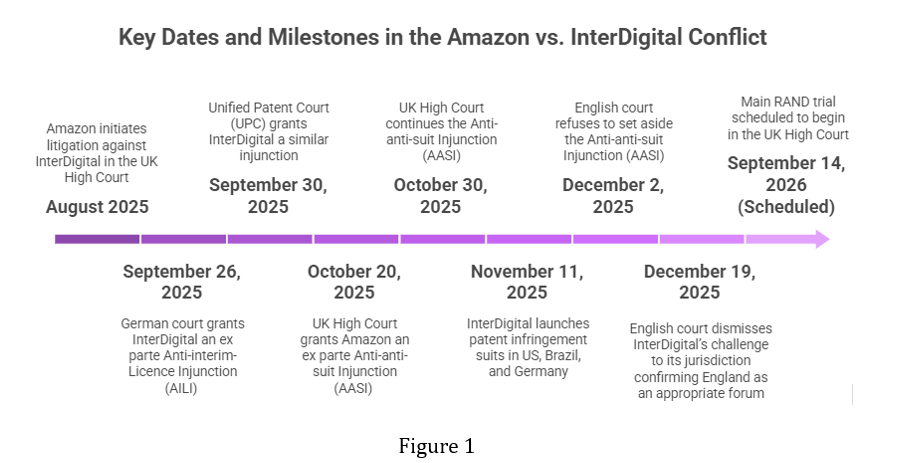
Impact of this case:
1. 1.The Jurisdictional "Escalation Ladder": The dispute illustrates what may be described as a jurisdictional escalation ladder, where parties deploy increasingly complex procedural tools across multiple jurisdictions.
a. The Interim License (Amazon's Shield): The UK High Court utilizes "interim licenses" to preserve commercial continuity. These arrangements ensure ongoing royalty payments during litigation while preventing the immediate use of injunctions as negotiating pressure. The approach reflects a policy preference for maintaining market stability while FRAND terms are settled.
b. The Anti-Interim-License Injunction (InterDigital's Sword): The UPC and German courts have rejected this "hold the ring" philosophy. They issued the first-ever Anti-Interim-Licence Injunctions (AILIs), ruling that forcing a patent holder into an interim license "fatally undermines" their constitutional right to enforce their property. This divergence underscores a growing constitutional tension between property enforcement and global licensing efficiency.
c. Financial Enforcement Pressure: The UPC Mannheim Local Division has used aggressive enforcement measures, warning Amazon of an initial €50 million ($59M) fine and daily penalties if it attempts to use a UK-style license to block UPC proceedings.
2. Commercial & Industry: The dispute is no longer confined to the courtroom; it is now affecting consumer services and broader cloud competition.
a. Amazon Web Services (AWS) Policy Shift: As of February 6, 2026, Amazon has reportedly stopped defending its AWS cloud customers against video patent infringement claims. Amazon argues that escalating royalty demands from patent holders could force broader pricing adjustments for cloud users.
b. The "Disney Effect": In a parallel but related strategy, InterDigital successfully secured a German injunction against Disney+, causing the streaming service to disable Dolby Vision and HDR10+ for users across several European countries in early 2026. This highlights the increasingly aggressive enforcement strategies emerging in video streaming patent disputes.
Fragmented Forums, Unified Stakes:
These challenges give rise to a critical question: Which court should take the lead in determining global licensing terms?
Rather than converging on a single forum, the dispute has fragmented into overlapping legal fronts. A defining feature of the case is the use of injunctions as strategic tools, not merely remedies for infringement. InterDigital’s efforts to prevent Amazon from obtaining interim or court-imposed licenses reflect a broader concern among patent holders: that implementers may use procedural tactics to delay payment while continuing to exploit patented technology.
Amazon, on the other hand, has pursued judicial protections to ensure continued access to critical technology while licensing terms are being resolved, framing injunction threats as inconsistent with FRAND principles.
These developments illustrate broader patterns emerging in SEP litigation and provide several practical insights for industry participants.
Key Takeaways:
ü Parallel Global Litigation Is Now Structural
Contemporary SEP disputes routinely unfold across multiple jurisdictions simultaneously, reflecting the inherent tension between global technology deployment and territorial patent rights.
ü The “Global Rate” Debate Remains Central
A defining issue is whether a single forum can determine worldwide FRAND terms. Courts, particularly in the UK, have demonstrated readiness to assume this role where domestic patent rights and market effects are substantial.
ü Jurisdiction Hinges on the Substance of Rights
Courts increasingly look beyond contractual framing to assess whether disputes fundamentally concern national patent enforcement, which often anchors jurisdiction.
ü Procedural Tools Have Become Negotiation Instruments
Injunctions, anti-suit orders, and interim licensing regimes increasingly function as strategic bargaining tools rather than purely remedial mechanisms.
ü Comity Sustains the Multi-Forum System
Judicial emphasis on international considerations allows parallel proceedings to coexist, ensuring that no single ruling formally binds foreign courts while still influencing global negotiations.
ü Forum Challenges Face a High Bar
Efforts to relocate disputes succeed only when another jurisdiction is demonstrably more appropriate, reinforcing the importance of territorial nexus in SEP litigation.
ü Strategic Insight for Industry
Ultimately, while parties may deploy complex procedural strategies, outcomes tend to align with where the strongest connection to patent rights and market impact exists.
Conclusion
More broadly, the dynamics illustrated in this dispute reflect a transformation in patent litigation involving standardized technologies. As innovation ecosystems become increasingly global, the traditional territorial structure of patent rights is creating new layers of procedural complexity. Courts are increasingly shaping the framework through which global licensing negotiations unfold.
In this environment, litigation strategy is becoming inseparable from licensing strategy. Forum selection, interim licensing mechanisms, and cross-border procedural tools are emerging as central components of SEP disputes, influencing bargaining power and the timing of commercial outcomes. For both innovators and implementers, managing these jurisdictional dynamics is now as critical as the underlying technological merits of a patent portfolio.
Looking ahead, the evolution of SEP litigation will likely be driven by how courts balance territorial enforcement with the realities of globally integrated technology markets. The jurisdictions that develop predictable approaches to FRAND disputes and cross-border procedural conflicts may increasingly position themselves as key venues for resolving the licensing tensions that define the modern digital economy.
