

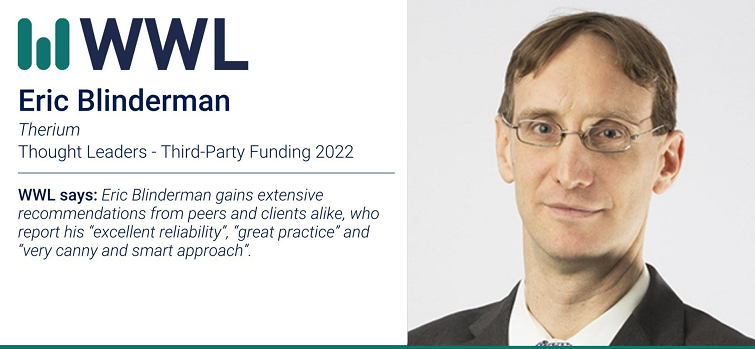
Eric Blinderman gains extensive recommendations from peers and clients alike, who report his “excellent reliability”, “great practice” and “very canny and smart approach”.
Questions & Answers
Mr. Blinderman is the CEO of Therium Capital Management (USA), Inc. Mr. Blinderman launched Therium’s US operations in 2016 and has overseen its growth. Globally, Therium has invested in disputes valued in excess of $74 billion. Prior to Therium, Mr. Blinderman was international litigation counsel at Proskauer and served in Iraq as an associate general counsel of the Coalition Provisional Authority and as chief legal counsel and associate deputy to the Regime Crimes Liaison’s Office.
What key trends are currently developing in international third-party funding?
There are many trends developing in international third-party funding. First, the international legal community is increasingly familiar with litigation finance and the tools the industry can provide to assist practitioners in developing their practices. Second, courts and tribunals are becoming more familiar with litigation finance and seem to have accepted its role in ensuring the parity of resources for litigants. Third, claimants of all types (large and small) have become more aware of how the litigation finance industry operates. Collectively, this has led to a robust increase in diversity of claim types and product types, and a general increase in deal flow for litigation finance firms.
How does your experience in high-level international dispute resolution enhance your role and approach as Chief Executive Officer at Therium?
Having practiced law for many years as a complex commercial litigator, I am very familiar with the nuances of litigation tactics and strategy. I also understand the demands that are placed upon busy lawyers as they manage their practices. I take these lessons to heart when managing Therium’s business and try to ensure that our processes are user friendly, do not waste the time of attorneys and claimants, and provide additional value for all stakeholders in the litigation finance process.
As the market has matured, funders are increasingly no longer relying solely on law firms to bring in work. How have you seen this materialise in your own work?
Therium’s pipeline is driven by a variety of sources, which include but are not limited to law firms, brokers, other funders, individual
claimants, and corporations. Given this diversity, Therium tries to devote significant resources to each of these tranches of opportunities and remain responsive to every inquiry that crosses our desks.
How is the market moved away from single case funding to portfolio funding?
As law firms and corporate clients have become more sophisticated about the benefits of litigation finance, they have sought to bundle multiple claims into a variety of portfolio products. In so doing, such clients can obtain significant price breaks compared to traditional single case financing, while the funder is able to reduce its risk. This evolution is beneficial to all, and I expect such products to consume an increasing amount of Therium’s investment capital in the years ahead.
How do you seek to educate law firms and clients about third-party funding when entering new markets?
When entering new markets, Therium pursues all the traditional educational steps that one would take in more mature markets. By conducting in-person meetings or telephone briefings with potential clients, we can answer any questions, explain the process, and resolve outstanding issues at an early stage. Further, Therium will always seek to partner with trusted intermediaries in any new market to ensure that any products it offers are tailored to the individual needs of that market, which may differ from other markets in which Therium operates.
How does Therium seek to differentiate itself from other competitors when competing for the same pool of cases?
Therium seeks to differentiate itself from competitors by focusing on the basics: hard work, diligence, and efficiency. While those may not sound like differentiators, what we are really doing is preparing for our diligence calls so we can focus on the issues that matter and manage expectations throughout the underwriting and case management process so there are no surprises. We also remain available throughout the lifecycle of any case we finance (at all hours of the day) to trouble shoot and assist as the litigation process progresses.
Why did you decide to take a position as Adjunct Professor of Law at Vanderbilt Law School?
I taught international commercial arbitration at the Vanderbilt Law School for several years and took the position to give back to the legal community. In short, I take a tremendous amount of personal satisfaction from teaching the next generation of attorneys about the litigation and arbitration process, and I enjoyed my time teaching immensely.
What advice would you give to up-and-coming generations considering a career in third-party funding?
All young attorneys should work hard, focus on practice areas that interest them, and learn how the judicial process works. Judicial clerkships (particularly at the trial court level) can help, although that is not a requirement. They should also try to become conversant in basic investing and financing concepts. By combining sound legal skills and judgment with a strong financial background, any smart, motivated individual can succeed in this industry.
