


A.Introduction
On January 19, 2026, the National Highways Authority of India (NHAI) issued a circular that fundamentally alters the landscape of dispute resolution for all Build-Operate-Transfer (BOT) (Toll), Hybrid Annuity Model (HAM), and Engineering, Procurement, and Construction (EPC) projects[1]. Citing a directive from the Ministry of Road Transport & Highways (MoRTH) dated January 12, 2026[2], the circular replaces the existing dispute resolution clauses in Model Concession Agreements (MCAs) with a new, value-based mechanism. What makes this move particularly significant is its retrospective application, impacting all existing and future concession agreements, with the sole exception of arbitrations that are already underway.
This article delves into the specifics of this new framework, comparing it with the erstwhile mechanisms prevalent in EPC, BOT (Toll) and HAM contracts. It further analyses the profound implications of this policy shift for concessionaires, the government, and the broader roads and infrastructure sector in India.
B.The Old Regime: A Multi-Tiered Path to Resolution
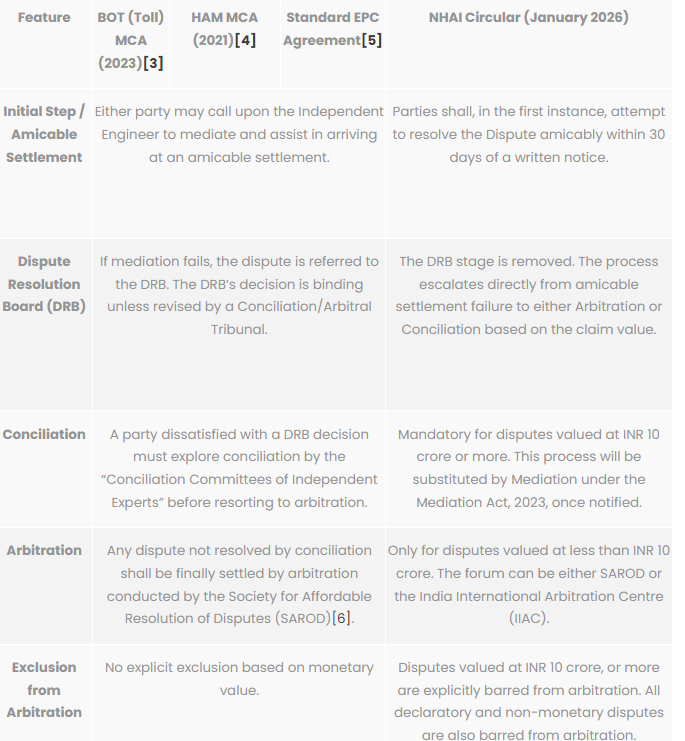
Before this amendment, the dispute resolution clauses in the BOT (Toll), HAM MCAs and standard EPC agreements provided for a multi-step process designed to encourage amicable settlement before escalating to formal arbitration.
Comparative Analysis of Dispute Resolution Mechanisms
C.The New Order: A Bifurcated Approach Based on Claim Value
The new dispute resolution chapter, introduced by the January 2026 circular, dismantles the previous multi-tier structure and introduces a mechanism bifurcated by the monetary value of the dispute.
The circular states that the new chapter overrides existing provisions for all BOT (Toll), HAM, and EPC projects with immediate effect, except for ongoing arbitrations.
The key features of the new clause are:
(i) Amicable Settlement: The process still begins with a mandatory 30-day period for the parties to attempt an amicable resolution after a dispute is notified in writing.
(ii) Disputes Below INR 10 crore:
(a)Any dispute with a value of less than INR 10 crore that remains unresolved will be referred to arbitration.
(b)The arbitration will be conducted by either SAROD or the India International Arbitration Centre (IIAC).
(c)The arbitral award is final and binding on the parties.
(iii) Disputes of INR 10 crore and above:
(a) Crucially, the circular states that any dispute valued at or above INR 10 crore “shall not be referred to Arbitration.”
(b) These high-value disputes are to be resolved through Conciliation under the Arbitration and Conciliation Act, 1996.
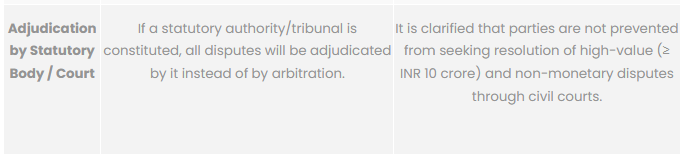
(c) The clause explicitly states that parties are not prevented from seeking resolution of such disputes through civil courts.
(iv) Declaratory and Non-Monetary Disputes: The new clause also stipulates that all “declaratory disputes or non-monetary disputes shall not be referred to Arbitration,” directing these matters towards the civil courts.
D.Implications for the Roads and Infrastructure Sector
The retrospective introduction of this new mechanism carries significant implications for all stakeholders in the highway sector.
(i) The End of Universal Arbitration for High-Value Claims: The most drastic change is the removal of arbitration as a recourse for high-value claims. Previously, concessionaires had the assurance that any dispute, regardless of size, could ultimately be resolved through a binding arbitral process, which is generally faster and more efficient than litigation. By funneling all claims of INR 10 crore and above towards conciliation or the court system, the government has fundamentally altered this expectation.
Conciliation, unlike arbitration, is a non-binding process. While a settlement agreement reached through conciliation is enforceable as an arbitral award, the process itself cannot compel a resolution if one party is unwilling to agree. The new clause’s explicit mention of civil courts as a recourse for these disputes suggests an acknowledgment that conciliation may often fail. This pushes parties towards the traditional court system, which can be slow and is burdened, potentially delaying the resolution of major disputes by several years.
(ii) Increased Risk and Uncertainty for Concessionaires and Lenders: For concessionaires and their lenders, this change introduces a new layer of risk and uncertainty. Large claims, often related to changes in scope, land acquisition delays, or termination payments, are the ones that can critically impact a project’s financial viability. The prospect of having to litigate these claims in civil courts, with the associated time and cost overruns, will be a major concern. This could affect the bankability of future projects and may lead to higher risk premiums being priced into bids.
(iii) Retrospective Application and Contractual Sanctity: The decision to apply this circular retrospectively raises questions about the sanctity of contracts. Concessionaires who entered into agreements based on the promise of a specific, multi-tiered dispute resolution mechanism culminating in arbitration now find the rules changed mid-stream. While the circular carves out an exception for “ongoing arbitration matters,” it does not protect disputes that have arisen but have not yet been formally referred to an arbitral tribunal. This retroactive and unilateral modification of a fundamental contractual term could be a point of legal challenge and may erode investor confidence.
(iv) A Potential Shift in Power Dynamics: By removing binding arbitration for large claims, the new mechanism may inadvertently shift the power dynamic in favor of NHAI. Considering that most concession agreements require the concessionaire to provide performance security in the form of bank guarantees, any claim by NHAI is typically adjusted by appropriating such performance security. As a result, it is the concessionaire that ends up becoming the claimant in most arbitrations. Consequently, faced with the prospect of protracted court battles, concessionaires might feel pressured to accept settlements during the conciliation stage that they might otherwise have contested in arbitration.
(E) Past Amendments to ongoing NHAI Concession Agreements
There have been several instances where NHAI has, in the past, amended existing concession agreements and their dispute resolution processes through policy circulars. The reaction to these amendments has varied, ranging from acceptance to significant legal challenges that have reached the Supreme Court of India.
The most notable instance of a backlash against a unilateral amendment by circular is the dispute in Ssangyong Engineering & Construction Co. Ltd. v. NHAI, where NHAI’s attempt to change the price escalation formula via circular was ultimately struck down by the Supreme Court[1].
(F) Specific Amendments to Dispute Resolution Processes in Ongoing Contracts
NHAI has repeatedly used policy circulars to introduce or modify dispute resolution mechanisms applicable to existing contracts, setting a clear precedent for the approach taken in the recent January 2026 circular.
(i) Introduction and Extension of Conciliation Mechanisms (2012-2017): NHAI first established an alternative dispute resolution mechanism for one-time settlement of claims in item-rate contracts on December 3, 2012. More significantly, this mechanism was later extended on April 5, 2016, to apply to other existing contract forms, including BOT (Toll), BOT (Annuity), and Hybrid-Annuity models[2].
Subsequently, through Policy Circular No. 2.1.23/2017 dated June 2, 2017, NHAI formally established a comprehensive system for amicable settlement through “Conciliation Committees of Independent Experts” (CCIEs). These guidelines were framed following a decision by the Cabinet Committee on Economic Affairs (CCEA) to create a more robust conciliation framework for the construction sector. The 2017 policy explicitly noted that conciliation could be pursued even when arbitral proceedings were ongoing. This history demonstrates a long-standing policy of superimposing conciliation processes onto existing dispute resolution frameworks via circulars.
(ii)Deletion of DRB Stage for Lower Value Contracts (2025): In a direct parallel to the value-based bifurcation in the 2026 circular, NHAI issued a policy circular on May 2, 2025, amending the dispute resolution clause for EPC, Performance-Based Maintenance, and item rate contracts. Citing the lack of feasibility in constituting a Dispute Resolution Board (DRB) for smaller projects[3], NHAI decided that for all such projects with a cost of INR 300 crore or less, the sub-clause mandating referral to a DRB would be deleted. This is a clear instance of altering a specific tier of the agreed dispute waterfall for a class of ongoing contracts based on a monetary threshold.
(iii) Clarification on the Primacy of DRB (2025): Through a circular dated June 12, 2025[4], NHAI issued a clarification to the standard operating procedures for dispute resolution. It noted that concessionaires were submitting requests for conciliation while disputes were still pending before the DRB. NHAI clarified that it would not accept any conciliation request unless the dispute had first been decided by the DRB or the DRB was unable to resolve it.This shows NHAI actively managing and modifying the procedural sequence of dispute resolution in existing contracts through circulars.
G.Amendments to Other Substantive Contractual Terms
Besides dispute resolution, NHAI has also issued circulars altering key commercial terms of ongoing contracts, which have elicited different reactions.
(i) Favourable Amendments (Change-in-Law Claims): In a circular dated September 3, 2025[1], NHAI removed the requirement for deducting a threshold amount from “Change-in-Law” claims. This amendment ensured that concessionaires would be fully reimbursed for additional costs, restoring them to their original financial position. Such an amendment, being beneficial to concessionaires, is unlikely to face backlash and illustrates a scenario where unilateral amendments are accepted.
(ii) Contested Amendments (Price Escalation Formula): The landmark case of Ssangyong Engineering & Construction Co. Ltd. v. NHAI arose from a circular issued by NHAI that revised the base year for the Wholesale Price Index (WPI) from 1993-94 to 2004-05 for calculating price escalation. Ssangyong contested this, arguing it was a unilateral and impermissible amendment of the contract. The dispute went to arbitration, where the majority award upheld NHAI’s circular. However, the Supreme Court of India ultimately set aside the majority award, finding it to be patently illegal as it effectively rewrote the contract. This case serves as the principal example of a severe backlash to an amendment-by-circular, demonstrating that courts will intervene to protect the sanctity of a contract when such amendments are detrimental to one party.
H. Judicial and Sectoral Reaction to Unilateral Amendments
The reaction from concessionaires and the judiciary will provide crucial insight into the potential reception of the new 2026 dispute resolution mechanism. The Ssangyong case is a powerful precedent. The Supreme Court’s decision to set aside an arbitral award that validated NHAI’s circular sends a strong signal. A court is likely to view any unilateral amendment that fundamentally alters the commercial bargain or risk allocation with suspicion. The new 2026 circular, which removes the right to binding arbitration for high-value claims (over INR 10 crore) and substitutes it with non-binding conciliation or litigation, can be argued to be a fundamental alteration of the contractual bargain that concessionaires and their lenders relied upon.
In this regard, the National Highways Builders Federation (NHBF) has expressed its opposition against the new circular[2] and have written to the Finance Minister on January 17, 2026 stating inter alia that the revised dispute resolution framework, discourages investment and transfers risks to the banking system. The NHBF contended that this unilateral change was against the “settled principle of fair contracting” and would severely impair project cash flows, trigger lenders’ concerns on project bankability, and ultimately transfer significant financial stress to the banking system.
While the Union Budget 2026-27[1], presented on February 1, 2026, did not directly reverse this policy, it introduced a significant de-risking measure with the proposed “Infrastructure Risk Guarantee Fund”. This fund is designed to provide partial credit guarantees to lenders, thereby strengthening developer confidence during the high-risk construction phase. This budgetary initiative can be seen as a strategic policy response to mitigate the heightened risk perception and bankability concerns that were amplified by the industry in the wake of the new dispute resolution framework.
I. Conclusion: A Bumpy Road Ahead?
NHAI has a well-established practice of issuing policy circulars to amend the terms of ongoing concession agreements, including substantive changes to the multi-tier dispute resolution process. Past amendments have introduced conciliation frameworks and even altered the sequence of dispute resolution based on claim value, setting a precedent for the new 2026 circular.
The potential for appeal by concessionaires is significant and real (as evidenced by the NHBF’s contention). While financially beneficial amendments or procedural tweaks may be accepted, the Ssangyong case demonstrates that any unilateral change perceived as detrimental to the concessionaire’s contractual rights—such as altering a key commercial term or removing a critical remedy like arbitration—is vulnerable to successful legal challenge. The retrospective removal of arbitration for high-value disputes is a fundamental change to the risk profile of a project and directly implicates the principle of contractual sanctity that was upheld by the Supreme Court. Therefore, a strong reaction from existing concessionaires, potentially leading to litigation, can be reasonably foreseen.
The government’s intent behind this policy shift appears to be rooted in the guidelines issued by the Ministry of Finance for domestic public procurement contracts. The aim may be to reduce the government’s exposure to high-value arbitral awards. However, the chosen solution—removing arbitration for large claims and redirecting them to the courts—may create more problems than it solves.
This intent to aggressively minimize exposure to high-value awards is further evidenced by the government’s parallel strategy to clear the existing backlog of disputes. Shortly after overhauling the prospective dispute resolution framework, MoRTH and NHAI notified the Vivad se Vishwas-III (VsV-III) scheme in February[1] and March 2026[2]. While the January 2026 circular shuts the door on future arbitrations for large claims, the VsV-III scheme attempts to liquidate existing arbitral and court awards (passed up to late 2025) by offering one-time settlements. However, these settlements come at a steep commercial cost to the concessionaires, offering only 45% of the net arbitral award amount (or 65%-70% for court orders), and artificially capping the maximum eligible award value at INR 500 crore.
More critically, a subsequent clarification issued by NHAI on March 19, 2026, imposes a draconian “all-or-nothing” condition: to be eligible for the VsV-III scheme, a concessionaire must settle all pending arbitration and court cases, along with all underlying claims, in respect of a specific project collectively. This prevents concessionaires from strategically settling certain claims while pursuing others. Viewed holistically, the government’s dual-pronged approach is clear—force steep haircuts on past victories through restrictive settlement schemes like VsV-III, while simultaneously dismantling the binding arbitration mechanism for future high-value claims. For concessionaires and lenders, this leaves them navigating a precarious landscape, caught between accepting heavily discounted settlements today or facing the uncertainty of protracted civil litigation tomorrow.
While the continued use of arbitration for smaller claims and the introduction of the IIAC as an arbitral institution are positive steps, the bifurcation of the dispute resolution path based on monetary value is a contentious move. It risks replacing a system of expert-led, timely, and binding resolution with one characterized by delays and uncertainty. For a sector as critical as infrastructure, which relies heavily on private investment and contractual stability, this new road for dispute resolution may prove to be a bumpy one. The long-term impact on investor sentiment and the overall health of public-private partnerships in the roads sector remains to be seen.
Moreover, from the Union Budget 2026-27, a critical policy tension arises from the disconnect between the government’s fiscal push for infrastructure and its simultaneous overhaul of the dispute resolution framework. The Union Budget 2026-27 signals a clear intent to accelerate the expansion of India’s road network, earmarking an increased allocation of INR 3.09 lakh crore for MoRTH and INR 1.87 lakh crore for NHAI.[1]
However, this ambition to build more roads is potentially undermined by these circulars, which abolishes arbitration for all disputes valued over INR 10 crore and diverts them to the civil court system. Industry bodies and legal experts have cautioned that this step introduces significant uncertainty and risk, which could dampen investor confidence, impair project bankability, and lead to protracted litigation. Thus, while substantial capital is being injected to fast-track construction, the new dispute mechanism may create the very delays and commercial impediments that could stall project execution and deter the private sector participation necessary to achieve the government’s infrastructure objectives.
